News
Recent News
Guide to Traffic Control Courses in QLD: Your 2026 Career Roadmap
May 17, 2026

In 2026, a traffic controller is far more than someone holding a stop-slow bat; they are the frontline guardians of public safety on Queensland’s multi-billion dollar infrastructure projects. With the Gateway Motorway upgrade and Olympic preparations in full swing, the demand for qualified personnel has reached record levels. You might feel overwhelmed by the technical requirements or the distinction between different traffic control courses, but entering this field is a structured and rewarding process. It’s a role that requires discipline and a commitment to protecting both road workers and the community.
It’s common to feel uncertain about the 20-hour vocational placement or how to handle the TMR licensing paperwork. We understand that you want a clear path to employment without the confusion of conflicting information. This roadmap provides everything you need to master the requirements, choose the right training, and advance your career in traffic management. We’ll examine the differences between TC and TMI roles, clarify the mandatory practical components, and provide a step-by-step guide to securing your official QLD traffic controller ticket with total confidence.
Key Takeaways
- Distinguish between fundamental “Stop/Slow” duties and advanced Implementation roles to select the qualification that matches your career objectives.
- Navigate the mandatory practical placement and theory components required to move from a student to a compliant professional.
- Gain clarity on the TMR licensing lifecycle, including application fees and the three-year renewal process, to keep your accreditation valid.
- Discover why choosing industry-led traffic control courses offers a distinct advantage through exposure to real-world infrastructure standards and active field mentors.
- Confirm your eligibility by reviewing mandatory prerequisites such as the White Card and driver’s licence history before you begin your training.
Understanding Traffic Control Courses: Your Entry into a Safety-First Career
A career on the roads begins with a steadfast commitment to public welfare. Accredited traffic control courses are the essential gateway to this professional responsibility. These programs provide the technical foundation required to manage the flow of vehicles and pedestrians around active worksites. Understanding what is road traffic control involves far more than just holding a bat; it is a complex discipline rooted in risk mitigation and legislative compliance. In Queensland, the infrastructure sector is the backbone of the regional economy. Traffic controllers are the primary guardians of this environment. Their objective is clear and absolute: maintain a zero-harm site where every worker and commuter returns home safely.
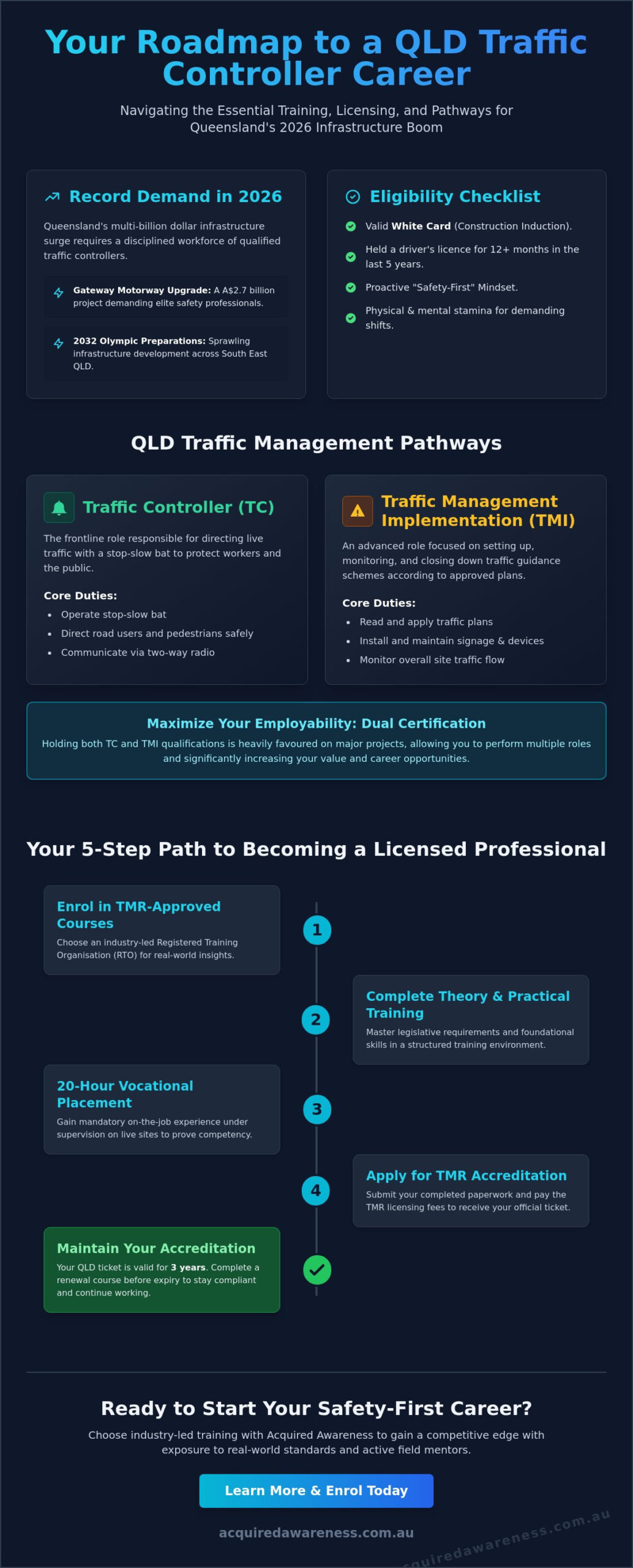
The demand for these skills has never been higher. As we move through 2026, South East Queensland is experiencing an unprecedented surge in infrastructure activity. Major projects, including the A$2.7 billion Gateway Motorway upgrade and the sprawling preparations for the 2032 Olympic Games, require a disciplined workforce. This isn’t just about filling roles; it’s about deploying competent professionals who can take full ownership of the environments they manage. When you enrol in these courses, you aren’t just getting a ticket. You’re joining an elite group of safety leaders dedicated to protecting the public.
The Professional Responsibility of a Traffic Controller
This is a disciplined safety profession, not a manual labour job. Effective controllers project a sense of calm authority that reassures stakeholders and the public alike. They remain unflappable when managing high-volume traffic or complex emergency scenarios. This level of competence is built through rigorous training and a deep sense of professional responsibility. Our approach to education is informed by our extensive traffic management services. We treat every trainee as a future colleague who must uphold the highest ethical and operational standards. Clear communication and meticulousness are the hallmarks of a successful controller. It’s about being a reliable partner on the road, ensuring that even the most chaotic operational scenarios remain under total control.
Who Should Enrol in These Courses?
If you’re a school leaver, a career changer, or a construction worker looking to upskill, traffic control courses offer a direct path to a stable and impactful career. The industry values individuals who are proactive and dependable. However, the role requires specific physical and mental attributes. You must have the stamina to remain alert during long shifts and the mental fortitude to monitor changing road hazards constantly. A “safety-first” mindset is the most critical prerequisite. You must be prepared to follow strict regulatory protocols without deviation. For those who take pride in their work and care for the well-being of their community, this career path offers a sense of purpose and long-term stability.
QLD Traffic Management Pathways: TC, TMI, and Design Explained
Queensland’s road safety infrastructure relies on a clear, regulated hierarchy of qualifications. To work on the state’s road network in 2026, you must complete TMR-approved training through a Registered Training Organisation (RTO). This ensures all personnel adhere to the QLD traffic management training standards. Unlike other jurisdictions, Queensland maintains a strict distinction between those who direct the flow of vehicles and those who design or implement the site layout. Understanding these traffic control courses and how they interconnect is the first step in your professional development. This structured approach ensures that every person on a worksite knows their specific safety mandate.
While some entry-level roles only require a single ticket, the industry trend in 2026 heavily favours dual certification. Many major infrastructure projects require workers to hold both Traffic Controller and Traffic Management Implementation qualifications. This versatility allows a single professional to set up the signage and then transition to active traffic direction. It’s a proactive way to increase your employability and ensure you can support your team in any operational scenario. This dual-role capability is particularly vital for rapid response teams and smaller maintenance crews where efficiency and safety must be perfectly balanced.
Traffic Controller (TC) Course: The Foundation
The Traffic Controller (TC) course is the foundational entry point for the industry. This “New Entrant” ticket focuses on the disciplined use of the stop-slow bat to manage vehicle flow. Trainees learn essential site set-up and radio communication protocols to ensure seamless coordination with team members. It’s a role that demands constant vigilance and a calm authority. This qualification is the primary requirement for those seeking traffic control jobs in Brisbane. Mastery of these fundamentals is essential before progressing to more complex site management responsibilities.
Traffic Management Implementation (TMI) Course
The Traffic Management Implementation (TMI) course shifts the focus to the physical environment of the worksite. Implementation officers don’t just direct traffic; they build the safety zone. This involves reading technical Traffic Guidance Schemes (TGS) and correctly placing signs, bollards, and arrow boards according to the Queensland Manual of Uniform Traffic Control Devices (MUTCD). It’s a role suited for those who enjoy the technical aspects of site management and want to take ownership of the physical layout. If you’re looking to advance, enrolling in accredited implementation training is a logical next step.
Advanced Pathways: Traffic Management Design
For those looking toward a career in planning and logistics, Traffic Management Design is the peak pathway. These professionals create the comprehensive Traffic Management Plans (TMPs) that govern every movement on a project site. This role represents a transition from operational execution on the road to strategic planning in an office environment. Designers must have a deep understanding of legislative requirements and site-specific hazards. It’s a career progression that rewards experience, meticulousness, and a high-level commitment to public safety standards.
What to Expect During Your Traffic Control Training in Brisbane
Completing traffic control courses is a methodical process that balances technical theory with hands-on operational practice. This structured approach ensures that every trainee develops the competence and stability required for high-stakes road environments. Training typically begins in a classroom setting where the focus is on the Queensland Manual of Uniform Traffic Control Devices (MUTCD) and the Queensland Guide to Traffic Management (QGTM). Understanding these regulatory frameworks is essential for maintaining a compliant and safe worksite. By aligning with industry best practices, our training programs ensure that students understand the legal and ethical weight of their professional responsibilities.
The classroom component generally spans one to two days, covering safety legislation, site hazard identification, and risk assessment strategies. Once the theory is mastered, trainees move to a controlled practical environment. Here, you will handle essential equipment such as stop-slow bats and two-way radios. This phase of training is designed to build your confidence and ensure your communication is clear and authoritative. It’s about developing the unflappable presence required to manage real-world traffic scenarios with total composure. Training with an RTO that adheres to the latest TMR standards is the only way to ensure your skills are relevant to the 2026 infrastructure landscape.
The 20-Hour Vocational Placement Requirement
The 20-hour vocational placement is a non-negotiable TMR mandate for all new traffic controllers. This requirement ensures that you have supervised, on-the-job experience before you are fully accredited. You must document these hours in an official logbook, which a qualified supervisor must sign to verify your competency. Many students find this stage difficult to navigate on their own. Acquired Awareness provides a distinct advantage here. As an active service provider, we can offer placement opportunities on our own diverse projects across South East Queensland. This direct link between education and operation allows you to learn from seasoned mentors in a real-world setting, ensuring you are well-prepared for the mission at hand.
Assessment and Competency
Final accreditation is based on a total demonstration of competency through written tests and practical assessments. You must prove that you can apply safety protocols under pressure and manage worksite hazards effectively. Before you can step onto any live construction or road site for your practical hours, you must hold a valid General Construction Induction Card. It’s essential to secure your white card QLD before your training begins. This card serves as your foundational safety credential, confirming you understand the basic hazards of the construction environment. Only after passing both the theoretical and practical assessments will you be eligible to apply for your official TMR traffic controller ticket.
Step-by-Step: How to Obtain and Maintain Your QLD Traffic Controller Ticket
The path to becoming a professional traffic controller is strictly governed by the Queensland Department of Transport and Main Roads (TMR). This regulatory body ensures that every individual on the road meets high standards of competence and medical fitness. A Queensland traffic controller ticket is valid for three years from the date of issue. Maintaining this accreditation requires a proactive approach to record-keeping and a steadfast commitment to ongoing professional development. It isn’t merely about holding a card; it’s about staying current with evolving safety standards and legislative mandates. You must take full ownership of your licensing status to ensure you remain a compliant guardian of public welfare.
TMR requires all applicants to meet specific suitability criteria. This includes a mandatory criminal history check and an assessment of medical fitness. These safeguards are essential because the role demands total composure and physical readiness in high-stakes environments. If you fail to keep your records up to date or miss a renewal deadline, you cannot legally perform traffic control duties on any Queensland road. This disciplined approach to licensing mirrors the structured nature of the industry itself, where meticulousness is the foundation of every safe worksite.
The Initial Application Process
Securing your first ticket involves three distinct and sequential phases. First, you must successfully complete accredited traffic control courses to receive your Statement of Attainment. This document serves as formal proof that you’ve mastered the theoretical and safety foundations of the role. Second, you must complete the mandatory 20 hours of vocational placement. This practical experience must be documented in an official logbook and verified by a qualified supervisor. Finally, you lodge your application with TMR. This step includes paying the required fees and submitting your training evidence. You must meet these suitability criteria to ensure you can safely manage the complex infrastructure projects across South East Queensland.
Renewal and Refresher Courses
Accreditation is a lifecycle, not a one-time event. To continue working, you must complete a refresher course every three years before your current card expires. A “Renewal” course is specifically designed for experienced professionals. It focuses on technical updates to the Queensland Manual of Uniform Traffic Control Devices (MUTCD) rather than basic bat techniques. If you allow your ticket to lapse, you may be required to retake the “New Entrant” program from the beginning. This ensures that no professional becomes complacent or out of touch with modern safety standards. For detailed timelines and specific requirements, check our guide on how to get your traffic controller licence in QLD.
If you are ready to begin your career or need to renew your professional credentials, you can book your training with Acquired Awareness today to ensure you meet all current TMR standards.
Why Industry-Led Training with Acquired Awareness Sets You Apart
Choosing where to enrol in traffic control courses is a decision that defines your professional trajectory. At Acquired Awareness, we bridge the gap between theoretical certification and operational excellence. We operate as both a premier service provider and a dedicated educational authority. This dual identity ensures that our curriculum isn’t just compliant; it’s grounded in the daily realities of the Queensland road network. Our instructors are active professionals in the South East Queensland field. They bring a wealth of experience from high-stakes environments directly into the training room. This immersion provides a level of preparation that generic training providers simply cannot replicate.
Our commitment to safety is a central guiding principle. We don’t view training as a “tick-box” exercise. Instead, we see it as the foundation of a disciplined safety profession. By learning from seasoned mentors, you develop the calm authority and unflappable presence required to manage complex traffic scenarios. We take pride in our regional heritage and our role as guardians of public welfare. This sense of professional responsibility is woven into every aspect of our instruction, preparing you to take full ownership of the sites you will eventually manage. Our goal is to produce graduates who are proactive, dependable, and ready to contribute to the state’s most critical infrastructure projects.
Training with an Active Traffic Management Company
Training with a company that actively manages major SEQ projects provides a distinct operational advantage. You gain hands-on experience with the exact traffic control equipment used on live sites today. Our state-of-the-art facilities in Brendale and Yatala are equipped with modern VMS boards, arrow boards, and the latest safety gear. This ensures that when you transition to the road, the tools of the trade are already familiar. We also provide deep insights into Brisbane-specific council permits and TMR site requirements. This local expertise is essential for navigating the complex regulatory landscape of our region. You aren’t just learning the rules; you’re learning how they are applied in real-world scenarios.
Launch Your Career with AATM
We believe in the quality of our instruction, which is why we actively seek to hire top-performing students from our training centres. This creates a direct pathway to job stability and career progression within our own operational teams. New recruits benefit from the ongoing mentorship of seasoned traffic management professionals who prioritize meticulousness and ethical standards. We don’t just issue tickets. We build careers. By choosing our traffic control courses, you are aligning yourself with an industry leader dedicated to your long-term success. Book your course today and take the first step toward a stable, safety-focused career with a partner that remains culturally grounded and steadfast in its mission.
Secure Your Place on Queensland’s Infrastructure Frontline
A career in traffic management is a path defined by professional responsibility and a commitment to public welfare. You’ve seen how the right traffic control courses provide more than just a ticket; they offer the technical foundation and calm authority needed to manage high-stakes environments. By mastering the distinction between TC and TMI roles and understanding the TMR licensing lifecycle, you’re prepared to join a workforce that keeps our community moving safely. Success in this field rewards those who are proactive and meticulous. We don’t just issue tickets. We build the next generation of safety professionals dedicated to the mission of zero harm.
Acquired Awareness stands as a reliable, regional partner in your professional development. As a TMR Approved Training Provider and an active South East QLD service provider (RTO #40905), we ensure your education is grounded in real-world operational standards. Our instructors take full ownership of your learning experience, preparing you for the technical depth of modern road projects. Enrol in a Traffic Control Course at AATC Today and take the first step toward a stable and impactful career. We look forward to welcoming you to our disciplined community of safety leaders.
Frequently Asked Questions
How long does a traffic control course take in QLD?
A standard traffic control course typically consists of one to two days of classroom theory followed by a mandatory 20-hour vocational placement. The theory component covers essential safety legislation and site hazard identification. Once the classroom phase is complete, you must document 20 hours of supervised on-the-job experience in an official logbook to meet TMR requirements.
Can I work interstate with a QLD traffic controller ticket?
Queensland does not automatically recognize traffic control licenses from other states, and other jurisdictions have their own specific requirements for QLD ticket holders. While mutual recognition processes exist, you should check with the relevant state transport authority before attempting to work interstate. Each state operates under different legislative frameworks and safety standards that require specific localized knowledge.
What is the difference between TC and TMI courses?
The Traffic Controller (TC) course focuses on the disciplined use of the stop-slow bat to manage vehicle flow. In contrast, the Traffic Management Implementation (TMI) course teaches you how to read technical Traffic Guidance Schemes and physically set up signs and devices. Many professionals choose to complete both traffic control courses to increase their versatility and employability on complex worksites.
How much does a traffic control course cost in Brisbane?
Costs for training vary depending on whether you are enrolling as a new entrant, seeking a renewal, or opting for a combined qualification. You should check with your chosen Registered Training Organisation for their current fee structure. Keep in mind that additional costs, such as the TMR accreditation fee and personal protective equipment, are separate from the course tuition.
Do I need a White Card to do a traffic control course?
Yes, a General Construction Induction Card, commonly known as a White Card, is a mandatory prerequisite for enrolling in any traffic management training. This card confirms that you understand basic construction site safety and hazards. You must hold this qualification before you can step onto an active road or construction site to complete your practical vocational placement.
What happens if my traffic control ticket expires?
If your ticket expires, you are no longer legally permitted to perform traffic control duties on Queensland roads. You must complete a refresher course and submit a renewal application to TMR before the expiry date. If your accreditation lapses, you may be required to retake the full “New Entrant” program rather than a shorter renewal course to ensure your skills meet current safety standards.
How do I find a vocational placement for my 20 hours of training?
Finding a placement requires connecting with an active traffic management company that can provide supervised hours on live worksites. Some training providers expect students to find their own placements, which can be challenging for new entrants. Choosing an RTO that is also an active service provider allows you to complete your 20 hours of training under the mentorship of seasoned professionals on real-world projects.
Is there a minimum age for traffic control training in Queensland?
You must be at least 18 years of age to undergo traffic control courses and obtain accreditation in Queensland. This requirement ensures that all personnel have the maturity and discipline necessary for high-stakes safety environments. Additionally, applicants must have held an open or provisional driver’s license within the last five years to meet TMR suitability criteria.