News
Recent News
Emergency Traffic Control Brisbane: Your 24/7 Rapid Response Guide (2026)
February 25, 2026
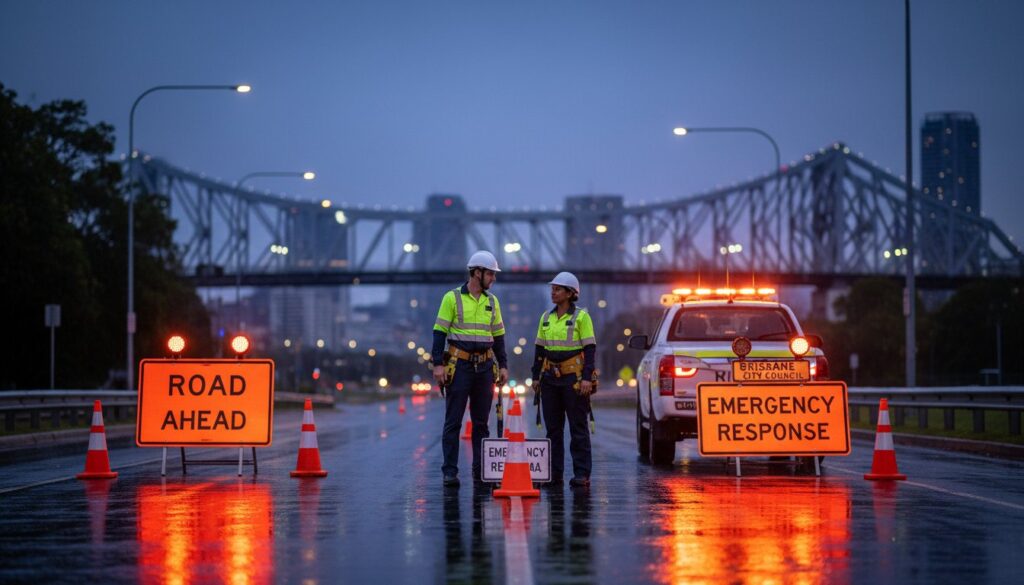
A sudden infrastructure failure, a vehicle accident, or an unexpected site hazard-when an emergency strikes on a Brisbane road, the clock starts ticking immediately. The initial chaos can be overwhelming, and the pressure to secure the area, protect the public, and maintain compliance is immense. In these high-stakes situations, deploying a fast and effective emergency traffic control Brisbane team is not just a logistical step; it’s a critical measure for risk mitigation and public safety.
A slow response or the wrong decision can lead to further danger, significant delays, and potential WHS breaches. This guide is your definitive resource for 2026, designed to provide the clarity you need under pressure. We will walk you through what happens during a traffic emergency, how to get a fully accredited team on-site rapidly, and the essential criteria for choosing a partner you can depend on-ensuring safety and restoring order with professional calm.
Key Takeaways
- Understand the specific Brisbane scenarios that require immediate traffic control, allowing you to act decisively when an unplanned event occurs.
- Learn how to maintain full compliance with Queensland’s safety regulations under pressure, protecting your project and the public from liability.
- Equip yourself with a practical checklist to vet providers, ensuring your chosen partner for emergency traffic control Brisbane can guarantee rapid, on-site deployment.
- Discover the critical path of an emergency response, from the initial phone assessment to on-site mobilisation, to minimise delays and mitigate site risk.
Table of Contents
- What Qualifies as a Traffic Control Emergency in Brisbane?
- The Emergency Response Process: From Your Call to On-Site Control
- Compliance Under Pressure: Navigating Brisbane's Regulations
- Choosing Your Brisbane Emergency Response Partner: A Checklist
- Acquired Awareness: Brisbane's Trusted 24/7 Emergency Team
What Qualifies as a Traffic Control Emergency in Brisbane?
A traffic control emergency is any unplanned event that disrupts the normal flow of traffic and creates an immediate risk to public or worker safety. Unlike scheduled roadworks, which involve extensive planning and pre-approved permits, an emergency demands a rapid, decisive response to secure a hazardous area. The key difference is urgency. Our immediate goals are always the same: mitigate the hazard, protect the community, and ensure the safety of all personnel on site. When the unexpected occurs, our commitment is to deliver a swift and compliant solution.
Common Triggers for Emergency Call-Outs
In our experience providing emergency traffic control in Brisbane, call-outs are most frequently triggered by sudden infrastructure failures or accidents. These events require immediate, professional intervention to prevent further incidents. Common scenarios include:
- Utility Failures: Burst water mains from Urban Utilities, power line damage involving Energex, or urgent NBN cable repairs that expose pits and trenches.
- Construction Site Incidents: Unexpected events such as a trench collapse, a major material spill onto a public road, or equipment failure that creates a traffic hazard.
- Public Infrastructure Damage: Severe weather events causing fallen trees, localised flooding, or traffic signal blackouts that leave major intersections dangerously uncontrolled.
- Vehicle Accidents: Road accidents are a frequent cause of emergency call-outs. While the reasons are diverse, proper vehicle maintenance, including reliable systems from brake specialists like Brakes4uSG, is a key factor in overall road safety.
Your Immediate Responsibilities On-Site
While you wait for our accredited team to arrive, your priority is to ensure no one enters the hazardous area. Do not attempt to direct traffic yourself. Instead, focus on clear communication and maintaining a safe distance. The information you provide during your call is critical for our fast and effective deployment.
Before calling, try to gather:
- The precise location, including street address, nearest cross-street, or a clear landmark.
- A concise description of the hazard (e.g., “deep excavation,” “fallen power line,” “water flooding the road”).
- Your name and an on-site contact number.
Using untrained staff to manage traffic is a significant breach of Work Health and Safety (WHS) regulations. This action not only endangers your personnel and the public but also violates fundamental road traffic control principles, exposing your organisation to severe liability. Safety is not negotiable; always leave it to certified professionals.
The Emergency Response Process: From Your Call to On-Site Control
When an unexpected incident disrupts traffic flow, a swift and structured response is critical for public safety and site security. At Acquired Awareness, we have refined our process to ensure a calm, methodical, and rapid deployment from the moment you contact us. Our commitment is to transform a chaotic situation into a controlled, safe environment with absolute precision.
The critical path from your initial call to having a fully compliant, safe work zone established follows four key stages:
- Step 1: Initial Contact and Assessment: Your call activates our 24/7 operations centre. Our dispatcher will calmly gather essential details: the precise location, known hazards like power lines or fluid spills, and specific access points. This initial intelligence is vital for a safe and effective deployment.
- Step 2: Rapid Crew Dispatch: With the assessment complete, our operations team immediately dispatches the nearest available crew. Our strategically located teams ensure we can provide fast emergency traffic control Brisbane wide, minimising delays and mitigating risks sooner.
- Step 3: Arrival with Full Capabilities: Our crews arrive in fully equipped, high-visibility vehicles. Each unit is a mobile command centre, stocked with compliant signage, traffic cones, arrow boards, and Variable Message Signs (VMS) for immediate deployment.
- Step 4: Securing the Work Zone: Our first priority is establishing a safe, controlled environment. Our accredited team secures the site in strict accordance with the Manual of Uniform Traffic Control Devices (MUTCD) and all relevant Queensland traffic management standards, ensuring the protection of your team, our controllers, and the public.
What to Expect in the First 15 Minutes
Within minutes of your call, our dispatcher provides a clear estimated time of arrival (ETA) and confirms your on-site contact person. We will ask targeted questions to understand potential hazards and create a unique job number for tracking and compliance. This initial conversation is designed for maximum clarity and efficiency, ensuring we have all the information needed before our team even leaves the depot.
On-Site Arrival and Setup Protocol
Upon arrival, our Team Leader conducts a dynamic on-site risk assessment to verify initial reports and identify any new hazards. A site-specific Traffic Guidance Scheme (TGS) is then implemented to manage vehicle and pedestrian flow safely. We immediately establish clear communication with your site foreman or project manager, ensuring our operations are fully integrated with yours from the moment we arrive.
Compliance Under Pressure: Navigating Brisbane’s Regulations
An after-hours incident doesn’t suspend the law. In fact, the legal and safety obligations for managing traffic become even more critical under pressure. The responsibility to protect workers, road users, and the public remains absolute. Engaging a non-compliant provider for emergency traffic control in Brisbane exposes your project to severe risks, including substantial fines, work-stoppages, and significant legal liability.
All traffic management activities in Queensland are governed by strict standards. The foundational document is the Traffic Management for Construction or Maintenance Work Code of Practice. Compliance requires adherence to the requirements set by both the state-level Department of Transport and Main Roads (TMR) and local authorities like Brisbane City Council, ensuring every setup is safe, legal, and effective.
Key Acronyms You Need to Know: TMR, MUTCD, TGS
Navigating compliance means understanding the language of the industry. These three acronyms are fundamental to any traffic management operation in Brisbane:
- TMR: The Department of Transport and Main Roads is the Queensland state government body that sets the regulations, training standards, and legal framework for all traffic control.
- MUTCD: The Manual of Uniform Traffic Control Devices is the official rulebook. It specifies the design, placement, and use of every sign, signal, and line marking used on our roads.
- TGS: A Traffic Guidance Scheme is the detailed, site-specific plan or diagram that shows exactly how traffic will be managed, including sign placement, controller positions, and lane closures.
Why Professional Accreditation Matters Most in a Crisis
In an emergency, you need proven experts. Professional accreditation is the non-negotiable benchmark of a competent and legally compliant traffic control provider. It guarantees a team has the verified skills and systems to manage high-risk environments safely.
Every controller deployed to your site must hold a current accreditation issued under Queensland’s Traffic Controller Accreditation Scheme. Furthermore, a professional provider will hold comprehensive insurance policies and operate under a certified Safety Management System. This structure not only ensures compliance but also protects you from liability. Crucially, an accredited team understands the protocols for liaising directly with police and emergency services, ensuring a coordinated, safe, and efficient response when it matters most.
Choosing Your Brisbane Emergency Response Partner: A Checklist
In a critical situation, you don’t have time to vet providers. The key to effective incident management is having a reliable partner already chosen. When evaluating a company for emergency traffic control Brisbane services, your questions should be direct and their answers unequivocal. A prepared, professional organisation will have clear, immediate responses that demonstrate their readiness.
Use this checklist to ensure your potential partner has the infrastructure, personnel, and processes to deliver under pressure:
- Do you have depots located near my Brisbane worksite for fast deployment? Proximity is non-negotiable. A provider must be able to guarantee rapid mobilisation from a local base to your site, minimising downtime and securing the area swiftly.
- Are all your traffic controllers TMR accredited and directly employed? This confirms a commitment to Queensland’s legal standards and professional integrity. Directly employed staff ensure consistent training and accountability, removing the risks associated with unknown subcontractors.
- Can you provide a compliant Traffic Guidance Scheme (TGS) for any situation? An emergency does not excuse the need for a fully compliant TGS. Your partner must possess the in-house expertise to assess the situation, design a plan, and implement it immediately to ensure public and worker safety.
- What is your 24/7 contact number and who answers the phone? The person answering your emergency call must be a decision-maker, such as an operations manager, who can dispatch a team without delay. There is no time for messages or call-backs.
The Importance of Local Depots
Strategically placed depots, such as in Brendale for the northside and Yatala for the south, are a core component of rapid response. This local footprint dramatically reduces travel time, ensuring crews arrive faster to secure your site. It also lowers mobilisation costs and guarantees your response team is comprised of local experts with an intimate, working knowledge of Brisbane’s complex road network and traffic patterns.
Red Flags to Watch Out For
Your diligence is the first line of defence against inadequate service. A lack of preparedness from a provider can expose you to significant risk. Be wary of any company that exhibits the following:
- Voicemail or an external answering service on their designated ’emergency’ hotline.
- An inability to immediately confirm TMR accreditation for every team member.
- Vague or evasive responses about depot locations or guaranteed response times.
- Hesitation when asked to provide details on their safety record or insurance policies.
True readiness comes from having a trusted, proven partner on standby. At Acquired Awareness, we build our reputation on transparent answers and unwavering reliability. Contact us to establish a partnership that protects your people, your project, and the public.
Acquired Awareness: Brisbane’s Trusted 24/7 Emergency Team
In a crisis, you need a partner who is prepared, professional, and always available. Acquired Awareness Traffic Management is that partner. We provide unwavering 24/7/365 emergency traffic control services across Brisbane and the entirety of South East Queensland. Our commitment is absolute. Through strategically located depots, we ensure our teams are positioned for rapid deployment, minimising risk and restoring order with calm authority.
Our strength lies in our people. We don’t use subcontractors for critical response. Our team consists of directly employed, fully accredited, and seasoned traffic controllers who understand the immense responsibility of their roles. Their expertise is your assurance of safety, compliance, and professionalism when it matters most.
Our Rapid Response Capabilities
When an emergency unfolds, our systems are designed for immediate and effective action. We have built our operational model around the certainty of the unexpected, ensuring we are always one step ahead. Our capabilities include:
- A dedicated 24/7 operations line answered directly by our own experienced staff, not a call centre. You get immediate access to decision-makers.
- Fully equipped vehicles stocked with compliant signage and safety equipment, ready for immediate dispatch from our local depots.
- In-house TGS design, allowing us to develop and implement compliant Traffic Guidance Schemes on the fly to suit any unexpected site conditions.
Save our 24/7 number for your next emergency.
Ready to Respond When You Need Us Most
Brisbane’s leading civil, construction, and utility companies trust Acquired Awareness Traffic Management to manage their most urgent situations. We provide expert emergency traffic control in Brisbane that allows your crews to focus on the critical task at hand-whether it’s a burst water main, a fallen power line, or an unexpected road failure. Our primary function is to secure the site and protect your team and the public, mitigating risk from the moment we arrive.
Don’t wait for a crisis to find a reliable traffic management partner. Proactive planning is the cornerstone of effective site safety. Partner with a team that is always prepared. Partner with Acquired Awareness Traffic Management.
Securing Brisbane’s Roads: Your Next Step in Emergency Preparedness
When a traffic incident occurs, a swift and professional response is non-negotiable. This guide has highlighted that effective emergency management hinges on two core principles: understanding Brisbane’s strict compliance standards and selecting a partner with the proven capability to act decisively. The right team doesn’t just manage chaos; they restore order with precision and an unwavering commitment to safety.
For dependable emergency traffic control brisbane, you need a protector. Acquired Awareness stands ready 24/7/365, backed by our TMR Accredited Traffic Controllers, strategically located Brisbane depots, and an industry-leading in-house RTO that ensures our team is the best in the field. Our commitment to excellence is your assurance of safety and compliance under pressure.
When seconds count, our team is here to deliver the protection you need. Call our 24/7 Operations Team for immediate assistance in Brisbane. Trust in our commitment to keeping our community safe. We are always prepared, so you can be too.
Frequently Asked Questions About Emergency Traffic Control
What is the average response time for emergency traffic control in Brisbane?
Our commitment is to rapid, effective deployment. For incidents within the Brisbane metropolitan area, our teams are typically on-site within 60 to 90 minutes of your call. Response times can vary based on the exact location, traffic conditions, and the scale of the incident. We prioritise immediate action to mitigate risks and secure the site, ensuring public and worker safety is established without delay. Our 24/7 operations centre coordinates the closest available crew for maximum efficiency.
Do I need a permit from Brisbane City Council for emergency roadworks?
For genuine emergencies that pose an immediate risk to public safety-such as a burst water main or fallen power lines-work can commence without a pre-approved permit. However, compliance is still mandatory. The relevant authority, like Brisbane City Council, must be notified as soon as practicably possible. Our team understands these protocols and can assist in managing the necessary communications and retrospective documentation to ensure your emergency works remain fully compliant with local regulations.
How much does emergency traffic control cost?
The cost of emergency traffic control is determined by several factors, including the number of accredited controllers required, the duration of the job, and the specific equipment needed, such as arrow boards or lighting towers. Rates are based on industry standards and reflect after-hours or public holiday penalty rates where applicable. We provide a clear cost structure upon dispatch, ensuring transparency. The primary investment is in guaranteeing the safety of the work zone and the general public.
What’s the difference between emergency traffic control and planned traffic management?
The key difference is proactivity versus reactivity. Planned traffic management is organised well in advance for scheduled projects like road construction or events, involving detailed Traffic Management Plans (TMPs) and permits. Emergency traffic control is an immediate, reactive service deployed in response to unforeseen incidents like accidents or infrastructure failures. It requires rapid assessment and implementation of safe work zones under high-pressure conditions to protect everyone involved.
Can you provide emergency traffic control for a police or fire incident?
Yes, absolutely. We work in direct support of Queensland Police Service (QPS), Queensland Fire and Emergency Services (QFES), and other first responders. Our role is to establish and maintain a safe perimeter around an incident, managing the flow of public traffic and preventing unauthorised access. This allows emergency services to focus entirely on their critical tasks without concern for vehicle or pedestrian interference, ensuring a secure and controlled operational environment.
Are your traffic controllers equipped for night work and bad weather?
Our commitment to safety is unwavering, regardless of the conditions. All traffic controllers are issued with high-visibility, wet-weather personal protective equipment (PPE) that meets Australian Standards. Our response vehicles are equipped with safety beacons, and we deploy portable lighting towers, illuminated signage, and reflective devices for night operations. When you call for emergency traffic control in Brisbane, you can be confident our team is prepared to manage the site safely through darkness, rain, or storm.
What information do I need to provide when I call for an emergency?
To ensure the fastest and most effective response, please be ready to provide our operator with clear and precise details. The most critical information includes the exact location of the incident, including the street address and nearest cross-street. You should also describe the nature of the emergency (e.g., fallen tree, vehicle accident, flooding) and provide your name and a reliable contact number. This allows us to dispatch the right team and equipment immediately.