
Blog
Recent Articles
Navigating the Brisbane City Council Traffic Permit Process: A 2026 Guide
April 20, 2026
A single technical error in your Traffic Guidance Scheme can trigger an automatic rejection, effectively stalling your civil project before the first safety cone is even placed. Securing a brisbane city council traffic permit has become increasingly complex since the full implementation of the Road Corridor Permit System (RCPS) online portal. We understand that managing the mandatory 20-day lead time is a constant pressure point for site supervisors and project managers. Missing this window by even 24 hours can derail an entire construction schedule and compromise site safety.
You can master these logistical hurdles and protect your project timelines by following our 2026 compliance framework. This guide provides the technical roadmap to ensure your submissions meet every QLD safety standard on the first attempt, eliminating the risk of permit rejection and compliance failures. We’ll break down the RCPS application workflow, explain how to design high-standard TGS documents, and share the exact criteria used by council assessors to approve your worksite access with total confidence. Our goal is to ensure your project stays on track while maintaining the highest levels of protection for your crew and the Brisbane community.
Key Takeaways
- Navigate the updated Road Corridor Permit System (RCPS) to maintain full compliance with Brisbane City Council’s latest regulatory framework.
- Master the distinction between strategic Traffic Management Plans and tactical Traffic Guidance Schemes to ensure your site documentation is audit-ready.
- Learn the precise steps required to obtain a brisbane city council traffic permit for road closures, construction zones, and bikeway impacts.
- Evaluate the true cost of DIY permit management against the “Expert Protector” model to eliminate compliance risks and project delays.
- Implement a “Safety First” methodology that secures your site and protects the public while meeting rigorous Queensland infrastructure standards.
Understanding the Brisbane City Council Traffic Permit Landscape
In July 2025, the Brisbane City Council (BCC) fundamentally changed how it manages the city’s movement by introducing the Road Corridor Permit System (RCPS). This framework ensures that every activity impacting the flow of people and vehicles aligns with established road traffic control principles. Safety is the primary driver behind these regulations. Any project that disrupts the normal operation of the road network requires a formal assessment to mitigate risks to the public and workers. Whether you are managing a bikeway closure or setting up a long-term construction work zone, obtaining a brisbane city council traffic permit is a mandatory step in your project planning phase.
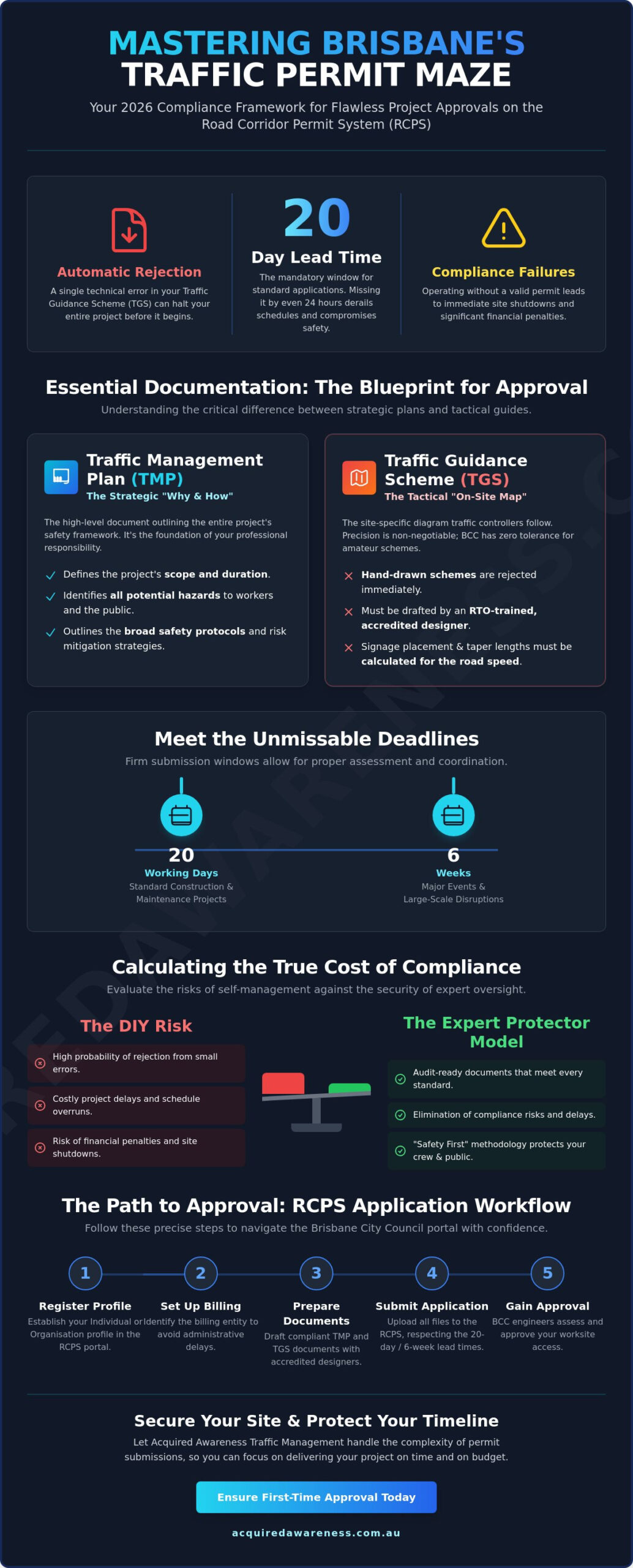
The council enforces strict timelines to ensure adequate review of every application. For standard construction or maintenance activities—including professional site enhancements by teams like INEX Landscaping—you must submit your application at least 20 working days before the intended start date. If your project involves a major event, this lead time increases to 6 weeks. These windows are firm. They allow BCC engineers to evaluate the impact on local traffic and coordinate with emergency services. Failure to respect these deadlines typically results in delayed approvals or project shutdowns.
The Role of the RCPS in 2026
By 2026, the RCPS has evolved into a highly efficient digital map-based tool. This system allows for precise coordination across the Brisbane road network, preventing conflicting works from occurring on the same corridor simultaneously. To access the portal, you must register either an Individual or Organisation profile. It is essential to establish financial responsibility for application fees during this registration. Identifying the billing entity early prevents administrative bottlenecks that can stall your brisbane city council traffic permit approval. This digital approach ensures transparency and accountability for all stakeholders involved in Queensland’s infrastructure development.
When is a Permit Legally Required?
Legal requirements for permits extend to any activity that occupies space on a footpath, parking lane, or traffic lane. A common misconception exists that “minor works” or short-term maintenance don’t require council approval. This is incorrect. Any obstruction that forces a pedestrian to deviate from their path or requires a vehicle to merge is a regulated activity. BCC officers regularly monitor sites for compliance. Operating without a valid permit leads to immediate site shutdowns and significant financial penalties. We prioritize compliance to ensure that every work site remains a controlled, safe environment for the Brisbane community. Integrity in these processes protects lives and keeps our city moving—a professional standard also essential when coordinating high-impact out-of-home media with companies like Great African Media.
The Essential Documentation: TMP vs. TGS
Obtaining a brisbane city council traffic permit depends on the quality of your technical documentation. Two primary documents form the backbone of any application. The Traffic Management Plan (TMP) serves as the high-level strategic document. It details the project’s scope, identifies potential hazards, and outlines the broad safety framework. It’s the “why” and “how” of your safety approach. We view the TMP as the foundation of our professional responsibility on any site.
The Traffic Guidance Scheme (TGS) acts as the tactical execution plan. While the TMP is strategic, the TGS is the literal map your controllers follow on-site. BCC assessment officers have zero tolerance for “hand-drawn” or amateur schemes. These are rejected immediately to prevent site incidents and public liability risks. You must use RTO-trained, accredited designers to draft these documents. This level of professional rigor aligns with the broader Queensland traffic control permit requirements, ensuring your site remains compliant and safe. We take pride in delivering documents that reflect our commitment to total site protection.
What Makes a TGS BCC-Compliant?
A TGS is a site-specific diagram that dictates exactly where traffic control devices are placed. To meet Council standards, every element must be precise. Signage placement and taper lengths are calculated based on the posted road speed. For instance, a 60km/h zone requires different spacing than a quiet suburban street. Your scheme must also protect pedestrians and cyclists. Designers must include clear, safe passage for these groups to ensure the community isn’t sidelined during your works. This methodical approach ensures nothing is left to chance.
Special Requirements for Events and Construction Zones
Complex projects involve more than just a single lane closure. For major events or “Construction Works Zones,” your documentation must address detour routes and impacts on Translink services. Brisbane City Council allows applicants to manage up to 5 street closures within a single brisbane city council traffic permit application. This requires a sophisticated understanding of local traffic flow and urban density. For long-term project permits, the “Construction Works Zone” designation is vital for maintaining consistent site access over several months. If you’re managing long-term infrastructure projects, our team can help you design compliant schemes that stand up to Council scrutiny.
DIY vs. Professional Permit Management: Calculating the Risk
Managing a brisbane city council traffic permit involves more than just filling out a form. It’s a calculation of risk versus reward. While the initial cost of a DIY application appears lower, the hidden expenses of rejection and project downtime are substantial. A single error in a Traffic Guidance Scheme (TGS) can halt a multi-million dollar construction project for weeks. We view permit management as a core component of site safety, not just an administrative hurdle.
Professional firms act as an “Expert Protector.” We identify potential council objections before the application reaches their desk. This foresight ensures compliance with the Manual of Uniform Traffic Control Devices (MUTCD) and specific local BCC guidelines. When you handle the process internally, you assume full liability. If a DIY traffic plan leads to a workplace incident, the legal and financial responsibility rests solely on your business. Professional providers carry comprehensive Public Liability and Professional Indemnity insurance, shifting that burden away from your project. We don’t just submit papers; we mitigate risk.
This philosophy of risk mitigation should also extend to your business’s digital infrastructure. To ensure your office remains resilient against technical disruptions, Aspire Computing offers specialized IT support and business continuity planning tailored for small businesses and home offices.
The most common objection we hear is that professional fees are an unnecessary expense. This perspective changes when you calculate the cost of a delayed crew. If a team of ten is sidelined because a permit wasn’t approved on time, the lost wages and plant hire costs can exceed A$5,000 in a single day. Professional management is an investment in project certainty. It’s about ensuring your start date remains fixed and your site remains compliant.
Common Reasons for BCC Permit Rejection
BCC requires a minimum of 20 working days for most applications. DIY applicants often fail to account for this lead time, leading to immediate rejection. Another frequent issue is the “After Approval” step. Many applicants forget to notify affected residents or businesses within the mandatory timeframes. Data inconsistency is also a major hurdle. If the work area described on the form doesn’t match the dimensions on the uploaded TGS, the council will return the application. We manage these schedules and details to ensure a first-time approval.
The Value of an Integrated Solution
An integrated approach connects the brisbane city council traffic permit directly to on-site execution. Professional firms manage the mandatory Queensland Police Service (QPS) liaison, which is required for many works involving police oversight or specific road closures. We ensure the TGS is implemented correctly by accredited controllers and high-quality equipment. This level of oversight protects you during random council audits. We deliver a seamless transition from the planning phase to the physical work zone, ensuring safety remains the primary focus throughout the project lifecycle.
Step-by-Step Guide to Applying for a Brisbane Traffic Permit
Securing a brisbane city council traffic permit requires a disciplined, methodical approach. It’s not a mere administrative task; it’s a safety-critical process that ensures every road user remains protected. Following these five steps will help you maintain compliance and avoid costly project delays.
- Step 1: Determine your permit type. You must identify if your work impacts a standard roadway, a dedicated bikeway, or requires a long-term Construction Zone. Each category has distinct assessment criteria.
- Step 2: Prepare technical documents. You’ll need a professional Traffic Guidance Scheme (TGS) and a Traffic Management Plan (TMP). Ensure your Public Liability Insurance is current and meets the minimum Council requirements.
- Step 3: Submit via the RCPS portal. All applications go through the Road Corridor Permit System. You must submit your application at least 20 full working days before your intended start date.
- Step 4: Pay fees and monitor RFIs. Pay the assessment fees immediately to begin the review. Watch your portal for Requests for Information (RFIs), as Council officers often require clarification on site-specific risks.
- Step 5: Secure QPS approval. Once the Council issues a Certificate of Assessment, you must finalize your permit with the Queensland Police Service if your work involves a road closure.
Navigating the RCPS Portal
The RCPS portal is a precise tool. When defining your work corridor, use the map functionality to click and drag exactly where your footprint sits. Don’t guess the boundaries. Accuracy here prevents your application from being returned for corrections. It’s also vital to link individual staff profiles to your main organisation account. This ensures your entire project team has visibility on the permit status. If your project timeline stretches beyond the standard one-month permit limit, you must initiate a renewal within the portal before the current permit expires to maintain legal site control.
Post-Approval: The QPS Permit
It’s a common mistake to assume a Council Certificate of Assessment is a permit to start work. It’s not. This document simply confirms that Council has reviewed your traffic plan. For any activity involving a road closure, you must take that certificate to the Queensland Police Service (QPS) to apply for the actual Road Closure Permit. High-impact works in the Brisbane CBD often require a coordinated police presence to manage heavy pedestrian and vehicle volumes. We recommend engaging with the QPS early to ensure officers are available for your scheduled dates, as their sign-off is the final link in the safety chain.
Securing Your Site with Acquired Awareness Traffic Management
Securing a brisbane city council traffic permit involves more than just administrative paperwork. It requires a deep understanding of the Queensland Guide to Temporary Traffic Management and a commitment to public welfare. Acquired Awareness Traffic Management (AATM) manages the end-to-end permit process for clients across South East Queensland. We take full ownership of the regulatory requirements. This allows your project team to focus on the construction or maintenance work at hand without the stress of compliance delays.
Our “Safety First” culture is the foundation of every project we undertake. We operate as a Registered Training Organisation (RTO), which distinguishes us from standard service providers. This means we don’t just follow safety protocols; we teach them. Our dual role as an educator and a service leader ensures that every traffic solution we deliver is backed by technical excellence and professional integrity. We provide a streamlined experience that moves your project from the initial permit design to on-site traffic control and equipment deployment with total precision.
- Full management of Council and Department of Transport and Main Roads (TMR) applications.
- Expert risk mitigation and site-specific safety assessments.
- Access to a highly trained workforce and modern traffic control equipment.
- Scalable solutions for small local works or major infrastructure projects.
Our Professional Design & Permitting Service
AATM utilizes industry-leading software to develop high-quality, BCC-compliant Traffic Guidance Schemes (TGS). We ensure every plan meets the rigorous legislative requirements for 2026 and beyond. Our team leverages established relationships with Brisbane City Council and the Queensland Police Service to facilitate smoother approval processes. We understand the technical expectations of local authorities. This expertise reduces the likelihood of plan rejections and ensures your brisbane city council traffic permit is secured as efficiently as possible.
Get Started with Your Brisbane Project
Early consultation is the most effective strategy to avoid the standard 20-day permit processing delay. By engaging our Brisbane team during your project’s planning phase, we can identify potential hurdles before they impact your timeline. We provide comprehensive, transparent quotes that cover every aspect of your traffic management needs. Our experts are ready to protect your site, your staff, and the Brisbane community. Reach out to us to discuss your specific requirements.
Secure Your Project’s Compliance and Safety
Navigating the 2026 requirements for a brisbane city council traffic permit demands precision and an uncompromising focus on safety. You’ve seen how the distinction between a Traffic Management Plan and a Traffic Guidance Scheme determines your project’s legal standing. Managing these complex regulatory risks alone often leads to avoidable delays or compliance failures. As a leading provider of traffic solutions across South East Queensland, Acquired Awareness brings the stability your site needs. We’re an RTO Accredited Training Organisation (#40905) and specialists in BCC Road Corridor Permit System compliance. Our team takes full ownership of the environment. We don’t leave site safety to chance. By choosing a partner with deep local roots and technical depth, you protect your staff and the public. Let’s get your project moving with total confidence and zero guesswork. Secure your Brisbane Traffic Permit with our expert team. We look forward to helping you deliver a safe, successful outcome for your next infrastructure project.
Frequently Asked Questions
How long does it take to get a Brisbane City Council traffic permit?
It typically takes 10 to 15 business days for the council to process a standard brisbane city council traffic permit application. Complex projects that impact major arterial roads or require significant pedestrian diversions can take 20 business days or longer to review. We recommend lodging your documentation at least three weeks before your project start date to account for any requested revisions or safety audits.
Can I close a Brisbane road without a permit for a short period?
You cannot legally close or obstruct any part of a Brisbane road or footway without a valid permit, regardless of the duration. Even a 5 minute blockage for unloading heavy machinery requires formal approval to maintain public safety and traffic flow. Unauthorised closures often result in immediate work stoppages and fines exceeding A$2,500 under local government ordinances and safety regulations.
What is the difference between a TMP and a TGS for council applications?
A Traffic Management Plan (TMP) is a high level strategic document that outlines the overall safety approach, while a Traffic Guidance Scheme (TGS) is a technical diagram showing specific sign and bollard placement. Most brisbane city council traffic permit applications require both to demonstrate a thorough understanding of site risks. The TMP explains the project’s safety logic, whereas the TGS provides the visual blueprint for physical implementation on the road.
How much does a Brisbane City Council road closure permit cost in 2026?
For the 2025-2026 financial year, Brisbane City Council application fees for minor traffic permits start at approximately A$215, though major road occupation fees vary based on the road hierarchy and total duration. These costs are indexed annually every July and don’t include the costs for professional traffic control personnel or equipment hire. You should check the current BCC Schedule of Fees and Charges for the exact figures related to your specific zone.
Do I need a separate permit for the Queensland Police Service?
You’ll need a separate permit from the Queensland Police Service (QPS) if your work is classified as a “Special Event” or requires a police escort for oversized loads. While the council authorises the use of the road land, the QPS manages traffic enforcement and ensures public order during high impact activities. Coordinating with both the council and the police is a critical step in our commitment to total site protection. If your project involves the complex logistics of moving oversized machinery, you can visit MTF Logistics to learn more about their specialized freight forwarding services.
What happens if my traffic permit application is rejected by the council?
If the council rejects your application, they’ll provide a written assessment detailing the specific compliance gaps or safety concerns that need addressing. You must revise your Traffic Guidance Scheme or Management Plan to meet their standards and then resubmit the documents for a secondary review. Common reasons for rejection include inadequate provision for disabled access or failing to account for peak hour clearway restrictions.
Can I apply for a permit for multiple Brisbane streets at once?
You can include multiple streets in a single application if the works are part of a continuous project or a single moving work zone. Each individual street must have a dedicated TGS that reflects its specific speed limits, lane widths, and local hazards. Grouping these locations can simplify your administrative workload, but the council will still evaluate the safety impact of each street segment independently.
Who is qualified to design a Traffic Guidance Scheme for a BCC permit?
Only individuals who hold a current Traffic Management Design (TMD) qualification are authorised to create a TGS for official submission. As a Registered Training Organisation (RTO), we ensure all our designs meet the strict standards found in the Manual of Uniform Traffic Control Devices (MUTCD). Using a qualified designer is the only way to ensure your scheme is compliant, professional, and ready for council approval.