News
Recent News
Traffic Management Plan Brisbane: The Complete Guide (2026)
February 21, 2026
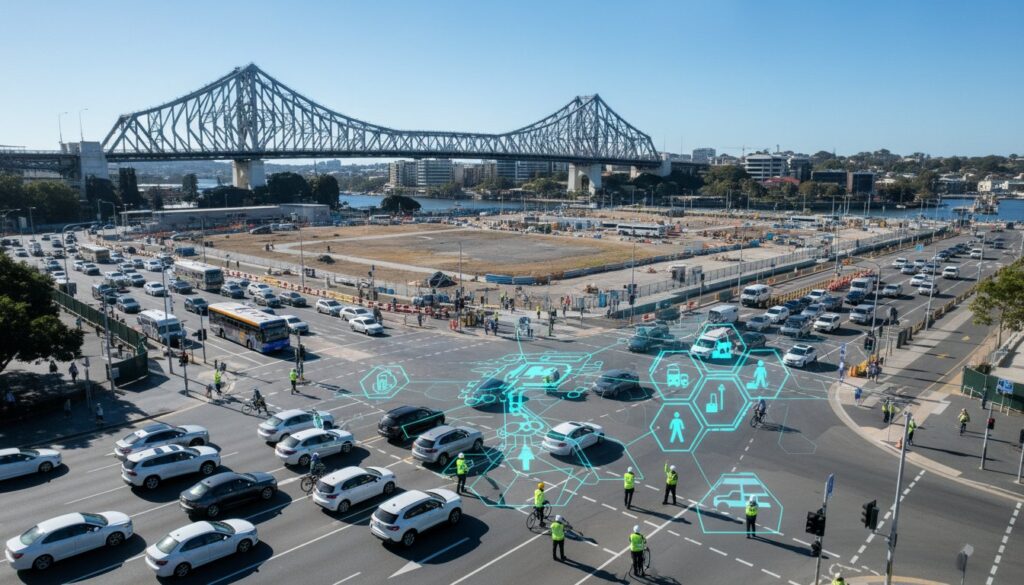
In Brisbane’s dynamic construction and events landscape, a single oversight in your traffic management can lead to significant project delays, council rejections, and unacceptable safety risks. The complexity of local regulations often leaves project managers feeling uncertain, concerned about compliance, and struggling to budget accurately. This uncertainty is a liability you cannot afford. We believe that safety and project efficiency are not mutually exclusive; they are the result of meticulous planning and expertise.
This comprehensive guide is built on our commitment to delivering excellence and protection. We will walk you through every critical component of developing a compliant and effective traffic management plan brisbane. You will gain a clear understanding of the specific requirements, learn how to mitigate risks effectively, and discover how to ensure your project proceeds safely, on schedule, and on budget. Consider this your roadmap to achieving total control and peace of mind for your Brisbane worksite.
Key Takeaways
- Discover why a compliant TMP is a legal necessity in Brisbane, essential for securing permits from Brisbane City Council and TMR without delay.
- Master the core components authorities demand for approval, ensuring your plan is compliant and effective from the very start.
- Learn how investing in a professional traffic management plan brisbane mitigates the costly project delays and safety liabilities often caused by generic templates.
- Equip yourself with a clear framework to confidently select a TMP partner with proven experience navigating Brisbane’s unique permit system.
What is a Traffic Management Plan in Brisbane? (And Why You Need One)
A Traffic Management Plan (TMP) is a formal document that meticulously outlines every procedure, control measure, and contingency required to manage vehicle and pedestrian flow around a work site. For any project that interacts with public roads or pathways, a traffic management plan in Brisbane is not just best practice-it is a legal and operational necessity. Its purpose is twofold: to provide absolute protection for your workers and the public, and to minimise disruption to the community, ensuring traffic moves as efficiently and safely as possible through or around your site.
The complexity of a TMP is directly proportional to the risk and impact of the work. A minor footpath closure for utility maintenance may require a straightforward plan focusing on pedestrian diversion. In contrast, a major infrastructure project involving lane closures on a key arterial road demands a highly detailed TMP, potentially including night work schedules, community notifications, and coordination with public transport services. This scalability ensures that safety measures are always appropriate for the task at hand, delivering a compliant and secure environment every time.
The principles of managing disruption apply across various activities. While a formal TMP might not be required for a simple relocation, a large residential or commercial move still involves significant logistical planning to ensure vehicles and pedestrians can navigate safely around the operation. For those curious about how experts in a different logistical field handle such challenges, you can discover All American Moving And Storage and see their approach to complex relocations.
Key Differences: TMP vs. Traffic Guidance Scheme (TGS)
It’s crucial to understand the distinction between a TMP and a TGS. Think of the TMP as the comprehensive strategy document; it answers the ‘what’ and ‘why’ of the traffic control setup. It details risk assessments, compliance standards, and overall objectives. Within the TMP sits the Traffic Guidance Scheme (TGS), the tactical diagram showing the ‘how’. The TGS is the visual blueprint illustrating the precise placement of signs, cones, and traffic controllers. To put it simply: the TMP is the business plan; the TGS is the detailed blueprint for execution.
Who Regulates TMPs in Brisbane?
In Brisbane, the responsibility for reviewing and approving TMPs is divided between two key authorities, and engaging the correct one is vital for project compliance and scheduling.
- Brisbane City Council (BCC): For all works on local council-controlled roads, streets, and pathways.
- Department of Transport and Main Roads (TMR): For works affecting state-controlled roads, such as motorways and major arterials (e.g., Gympie Road, Ipswich Motorway).
Identifying the correct road authority is a critical first step, as each has specific submission requirements and approval timelines. These bodies are responsible for overseeing all aspects of safe traffic management on their respective networks, ensuring compliance and public safety. Submitting your plan to the wrong authority can lead to significant project delays, which is why our commitment is to ensure this foundational step is handled with precision from the very beginning.
The Anatomy of a Compliant Brisbane TMP: Key Components for Approval
Submitting a Traffic Management Plan in Brisbane is more than a formality; it is a critical step in ensuring public safety and project efficiency. Both Brisbane City Council (BCC) and the Department of Transport and Main Roads (TMR) scrutinise these documents for specific, non-negotiable components. A compliant plan is built on a foundation of detailed schematics, proactive risk mitigation, and clear communication protocols, including comprehensive emergency procedures and contact lists.
Traffic Guidance Schemes (TGS): The Visual Core
At the heart of any TMP are the Traffic Guidance Schemes (TGS). These are not mere sketches; they are precise, to-scale diagrams illustrating the exact placement of every sign, cone, barrier, and traffic controller. Each TGS must be meticulously designed for full compliance with Queensland’s Manual of Uniform Traffic Control Devices (MUTCD). It is essential to develop separate, detailed TGS diagrams for each distinct phase of your project, including specific plans for day works, night works, and any significant changes in setup.
Risk Assessment: Beyond Just Checking a Box
A generic risk assessment is one of the fastest routes to having your traffic management plan brisbane rejected. Your plan must demonstrate a deep understanding of the specific site risks. This involves a systematic process:
- Identify Hazards: Pinpointing potential dangers such as nearby school zones, active bus routes, high-volume pedestrian footpaths, or dedicated cyclist lanes.
- Assess Risk Level: Evaluating the likelihood and severity of an incident for each identified hazard.
- Outline Control Measures: Detailing the specific mitigation strategies you will implement to protect workers and the public.
This section must be customised and comprehensive, proving you have actively considered and planned for the unique challenges of your work zone.
Meeting Brisbane’s Specific Permit Requirements
Approval for your TMP is intrinsically linked to local council mandates. For high-impact works, BCC often requires documented proof of community and stakeholder notification, such as letterbox drops. The plan must also explicitly detail provisions for pedestrian management and maintaining vehicle access for residents and businesses. Aligning your TMP with your Road Corridor Permit application is crucial; the official Brisbane City Council traffic management guidelines provide the definitive framework for these local requirements, ensuring your submission meets all necessary criteria for a swift approval.
The Hidden Costs of a ‘Cheap’ TMP: A Strategic Plan vs. a Template
In project management, the temptation to cut upfront costs is always present. Opting for a generic template or the cheapest quote for a traffic management plan in Brisbane might seem like a quick win, but it’s a false economy. A professionally developed TMP is not an expense; it is a critical investment in project continuity, safety, and your company’s reputation. It is the difference between proactive control and reactive crisis management.
The consequences of an inadequate plan extend far beyond a rejected application. They manifest in costly delays, on-site hazards, and lasting damage to your brand. Here is a clear comparison of the outcomes.
A ‘Cheap’ Template Plan
- Outcome: Likely rejection by Brisbane City Council or TMR.
- Financial Impact: Resubmission fees, crew and equipment standby costs (often A$2,500+ per day), and project timeline blowouts.
- Safety: Vague instructions create on-site confusion, increasing the risk of incidents.
- Reputation: Causes public complaints, frustrates stakeholders, and positions your brand as unprofessional.
A Strategic, Professional TMP
- Outcome: High likelihood of first-time approval.
- Financial Impact: Predictable project start, maximised productivity, and avoidance of non-compliance fines.
- Safety: Clear, compliant, and site-specific controls that demonstrate due diligence and protect everyone.
- Reputation: Smooth traffic flow, minimal community disruption, and a brand known for integrity and excellence.
Risk 1: Project Delays and Council Rejections
A vague or non-compliant TMP will be rejected by Brisbane City Council, halting your project instantly. This isn’t just an administrative hurdle; it’s a direct financial drain. You face not only resubmission fees but, more significantly, the crippling cost of an idle crew and machinery. A strategic plan is designed for approval, anticipating council requirements and providing the necessary detail to ensure your project starts on time, every time.
Risk 2: On-Site Incidents and Insurance Premiums
A poorly designed TMP is a direct threat to safety. When plans fail to account for specific site risks, the potential for accidents involving workers or the public escalates dramatically. An incident not only has devastating personal consequences but also leads to investigations, insurance claims, and increased premiums. A professional plan serves as your proof of due diligence, creating a verifiably safer work environment that aligns with official standards like the Queensland Police Service TMP guidelines and protecting your business from litigation.
Risk 3: Reputational Damage
Poorly managed traffic creates public frustration. Excessive delays, confusing signage, and unsafe conditions lead directly to complaints to council and negative attention on social media. For any public-facing company, this can inflict serious brand damage. A thorough traffic management plan for Brisbane worksites considers community impact, ensuring minimal disruption. This protects your most valuable asset: your reputation as a considerate and professional operator.
How to Choose Your Brisbane TMP Provider: A 5-Point Checklist
Selecting the right partner to develop and implement your traffic management plan in Brisbane is a critical decision. It directly impacts project timelines, public safety, and legal compliance. A cheap quote can often lead to costly delays and unacceptable risks. Use this checklist to evaluate potential providers and ensure you engage a partner with the integrity and capability to protect your project, your people, and the public.
-
Proven Experience with Brisbane City Council & QLD TMR
A provider’s track record is their most valuable asset. Ask for specific examples of recently approved Traffic Management Plans (TMPs) for projects within the Brisbane City Council region. Do they understand the unique traffic flow of the CBD versus the logistical challenges of a site in Brendale? A partner with deep local experience can navigate the permit process with TMR and BCC efficiently, preventing costly delays. -
In-House, Accredited TMP Designers
Confirm that the provider employs their own accredited designers, not freelancers or outsourced agencies. An in-house team ensures accountability, seamless communication, and a plan built with practical, on-the-ground knowledge. Verify that their designers hold the current TMR Traffic Management Design qualification, which is mandatory for creating compliant plans for Queensland roads. -
Integrated Services: From Plan to On-Road Control
The most significant point of failure in traffic management occurs when planning, equipment supply, and on-road control are handled by separate companies. This creates communication gaps and blame-shifting. Ask a simple question: ‘Can the same company that designs our plan also supply the equipment and provide the traffic controllers to implement it?’ An integrated provider delivers a seamless, accountable solution from start to finish. This concept of a seamless, end-to-end service is a hallmark of quality in many industries. In the transport sector, for instance, premium providers like Executive Cars of Sussex manage every aspect of a client’s journey to ensure a flawless experience, demonstrating the value of an integrated approach. -
Comprehensive Accreditation and Insurance
Your chosen partner must operate as a shield for your project, not a liability. Request to see their Certificate of Currency for both Public Liability and Professional Indemnity insurance. This is non-negotiable. Proper insurance protects your project from significant financial risk in the event of a planning error or on-site incident. -
Commitment to Safety and 24/7 Support
A professional provider’s commitment extends beyond the 9-to-5. Your work site may operate around the clock, and incidents can happen at any time. Ensure your provider has a clear system for 24/7 support and emergency response. This demonstrates a genuine commitment to safety and operational excellence, providing peace of mind that they are ready to act when you need them most.
Choosing a partner who can confidently tick every box on this list is fundamental to delivering a safe and successful project. For a provider that integrates every aspect of a compliant traffic management plan in Brisbane, from expert design to flawless on-road execution, contact the team at Acquired Awareness.
Partner with Acquired Awareness for Your Brisbane TMP
Choosing the right partner for your traffic management is the final, critical step in ensuring your project’s success. At Acquired Awareness Traffic Management (AATM), we don’t just provide a service; we deliver a complete, end-to-end solution built on deep local expertise and an unwavering commitment to safety. Our integrated model means you have one point of contact for design, council permits, equipment hire, and on-site traffic controllers, guaranteeing a seamless and compliant outcome for your project.
We have extensive, practical experience navigating the complexities of Brisbane City Council and the Department of Transport and Main Roads (TMR) permit systems. Our in-house team of accredited designers understands the specific challenges of Brisbane’s road network, from high-volume arterial roads to complex inner-city laneways. This local insight ensures we develop a traffic management plan for your Brisbane site that is not only compliant but also practical and efficient.
Our Proven Brisbane TMP Design Process
Our process is designed for clarity, compliance, and efficiency, removing the administrative burden from your team. We manage every stage with professional diligence to ensure your project proceeds without delay.
- Step 1: Initial Consultation. We begin by thoroughly understanding your project scope, site-specific requirements, and key timelines to establish a clear framework for success.
- Step 2: Professional Design. Our accredited designers draft a comprehensive Traffic Management Plan (TMP) and detailed Traffic Guidance Schemes (TGS) that adhere to all relevant standards and regulations for your review.
- Step 3: Council Submission & Approval. We handle the entire council submission process on your behalf, managing all communications and requirements to secure timely approval for your works.
Local Depots, Local Knowledge
Our operational strength in South East Queensland is backed by strategically located depots in Brendale and Yatala. This allows for rapid deployment of personnel and equipment across the entire Brisbane region, from the Northside to the Logan and Gold Coast corridor. We aren’t just a national company with a local address; we are a dedicated SEQ specialist. Our teams possess invaluable local knowledge of unique traffic patterns and community expectations, ensuring minimal disruption and maximum safety on every site.
When you need a reliable, expert partner to deliver a safe and effective traffic management plan in Brisbane, trust the team at Acquired Awareness Traffic Management. Our commitment is to protect your people, the public, and your project’s integrity.
Get a detailed quote for your Brisbane project.
Your Next Step Towards a Safe and Compliant Brisbane Project
Navigating Brisbane’s complex road network requires more than a document; it demands a strategic safety framework. As we’ve covered, a compliant Traffic Management Plan (TMP) is non-negotiable for project approval, and the hidden risks of a generic template far outweigh any initial savings. The success and safety of your operation depend on a meticulously crafted traffic management plan brisbane authorities and contractors can trust.
At Acquired Awareness, we provide that certainty. Our commitment to excellence is backed by decades of direct experience with Brisbane City Council and a team of in-house, TMR-accredited designers. We offer a fully integrated service, from initial consultation and design to the final implementation of on-road traffic control, ensuring seamless compliance and uncompromising safety at every stage.
Protect your project, your team, and the community. Request a Consultation for Your Brisbane Traffic Management Plan today and let our experts deliver the peace of mind your project deserves.
Frequently Asked Questions
How much does a Traffic Management Plan cost in Brisbane?
The cost of a Traffic Management Plan in Brisbane typically starts from A$350 for a simple, low-impact project on a local road. For more complex jobs involving major arterial roads, multiple stages, or significant pedestrian management, the price can increase to A$1,000 or more. The final cost is determined by the project’s complexity, the road authority involved (Council or TMR), and the level of detail required for compliance and public safety.
How long does it take to get a TMP designed and approved by Brisbane City Council?
The design phase for a standard TMP can be completed within 2-4 business days. However, obtaining approval from Brisbane City Council requires a formal application process. The council typically requires a minimum of 10 business days to assess a standard application. For complex projects or those requiring road closures, this lead time can be significantly longer. It is critical to factor this approval window into your project timeline to avoid costly delays.
Do I need a new TMP for each stage of my construction project?
Yes, if the traffic control setup changes between stages, a new or amended TMP is required. Each distinct phase that alters lane closures, pedestrian routes, or site access points presents a new set of risks that must be professionally assessed and mitigated. A comprehensive initial plan can sometimes outline multiple stages, but any deviation from the approved design necessitates a formal update to ensure continued compliance and the safety of workers and the public.
What happens if my Traffic Management Plan is rejected by the council?
If your plan is rejected, the council will provide feedback detailing the areas of non-compliance or specific concerns that must be addressed. Your traffic management designer must then revise the plan accordingly and resubmit it for another review. This process can lead to significant project delays and additional costs. Engaging an experienced provider from the outset is the most effective way to ensure your traffic management plan brisbane is approved on the first submission.
Can I create my own Traffic Management Plan for a small job?
No, you cannot. Under Queensland regulations, a Traffic Management Plan must be developed and signed by a person holding a current Traffic Management Design qualification. This is a legal requirement designed to ensure all plans meet strict safety and compliance standards. Attempting to create your own TMP without the necessary accreditation will result in immediate rejection by the road authority and puts workers and the public at unacceptable risk.
Is a TMP required for events as well as construction?
Absolutely. A TMP is required for any activity that alters the normal operating conditions of a road, footpath, or public space. This includes public events like street festivals, marathons, parades, and markets, not just construction or utility works. The core purpose of the plan remains the same: to guarantee the safe and efficient movement of all road users-vehicles, cyclists, and pedestrians-while the event is taking place, minimising disruption and ensuring public protection.
What is the difference between a TMP for a local road versus a TMR-controlled road?
The primary difference lies in the governing authority and its specific requirements. A traffic management plan brisbane for a local or suburban street is submitted to Brisbane City Council. In contrast, a plan for a major arterial road, motorway, or state highway must be submitted to the Department of Transport and Main Roads (TMR). TMR’s standards are often more stringent, requiring a higher level of detail, risk assessment, and a more complex approval process.