
Blog
Recent Articles
Traffic Management Risk Assessment in QLD: A Practical Step-by-Step Guide
September 28, 2026
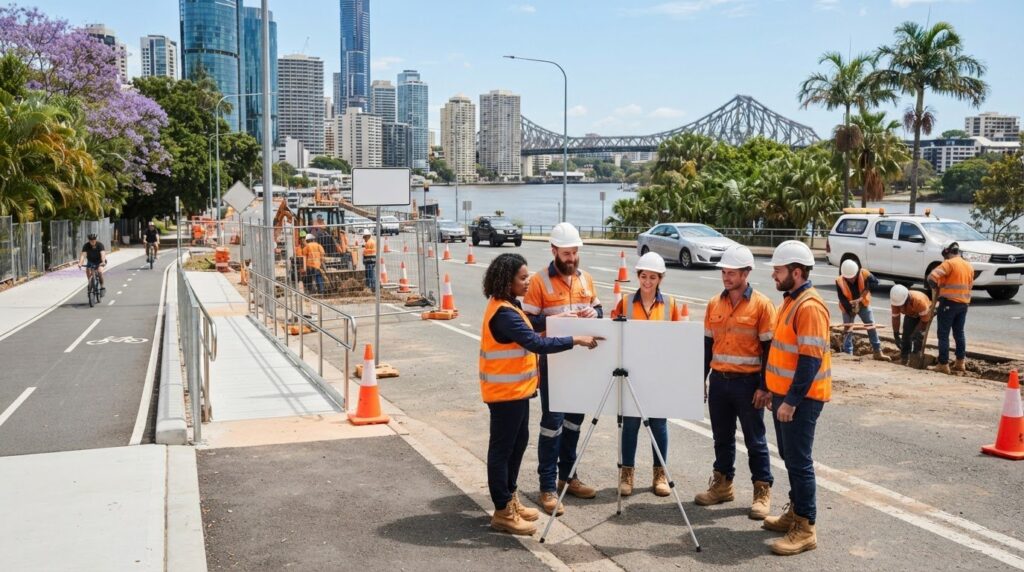
A traffic plan can look complete on paper and still miss a hazard that matters at the worksite. A practical traffic management risk assessment qld starts with the actual location, work activity and people moving through it. It then connects each identified risk to a control that can be put in place.
If you’re unsure which hazards to assess, how the assessment differs from a Traffic Management Plan (TMP) or Traffic Guidance Scheme (TGS), or what a road authority may require, you’re not alone. These documents serve different purposes, and getting the site-specific details right is central to protecting workers and the public.
This guide explains how to identify traffic hazards before work begins, assess the risks and select controls suited to Queensland projects. It also covers what to document, what to check against current requirements for the road and project, and when to review the assessment as conditions change. The aim is to make the assessment useful on site, not just complete on paper.
Key Takeaways
- Use a step-by-step traffic management risk assessment qld process to connect the planned work and site conditions with hazards, risk decisions and practical controls.
- Involve workers and others with relevant site knowledge so access, traffic movements and changing work stages are considered.
- Assess impacts on workers and all road users, including pedestrians, cyclists and people with accessibility needs. Match controls to the specific location and activity.
- Record the assessment scope, site conditions, hazards, decisions, controls and responsible people. Check how the findings inform any required TMP, TGS or permit application.
- Consider specialist support when work involves complex interfaces, constrained access or uncertain controls. Clarify responsibilities for site review, design and implementation.
What a traffic management risk assessment in QLD should establish
A traffic management risk assessment is a systematic review of hazards created by planned work, the risks those hazards pose to workers and road users, and the controls suited to the site and activity.
A traffic management risk assessment in QLD helps the project team plan safer work, but it doesn’t automatically replace a required Traffic Management Plan (TMP), Traffic Guidance Scheme (TGS), permit or road-authority approval. Requirements depend on the work, road and relevant authority. Confirm what applies before work begins rather than treating the assessment as approval to proceed.
Prioritise risks by considering who could be exposed, how likely harm is and how serious the consequences could be. Even a brief interaction with fast-moving traffic may warrant strong controls if the potential consequences are serious. The assessment needs to reflect actual site conditions, not just a generic activity description.
Which projects and work activities need traffic risk assessment?
Consider traffic risks for roadworks, utility works, construction access, events, and temporary lane or footpath impacts. Work beside live traffic creates direct exposure, while work separated from public roads may still involve risks at site entrances, delivery routes or pedestrian interfaces. The scale of a job alone doesn’t determine its risk. Location, duration, visibility, access and the people affected all matter. For organisations managing site deliveries and vehicle movements, overall safety also relies on driver behaviour, where corporate safety providers like Driving Sense illustrate how driver training complements physical site controls.
Risk assessment, TMP and TGS: how do they differ?
The assessment identifies hazards and supports decisions about controls for the proposed activity. Where applicable, a TMP records broader traffic management arrangements, including how the work will be managed and communicated. A TGS shows the traffic guidance layout for a particular arrangement and supports practical direction on site. Check current Queensland and road-authority terminology for your project, as local requirements determine which documents are needed. For general background on directing traffic around disruptions, see Road traffic control.
Keep the relationship clear: the assessment findings should inform the relevant TMP and TGS, rather than being mistaken for either document. For example, identifying a conflict between delivery vehicles and pedestrians is a risk finding. The project’s plans and any required approvals then need to show how that conflict will be managed.
How to complete a traffic management risk assessment step by step
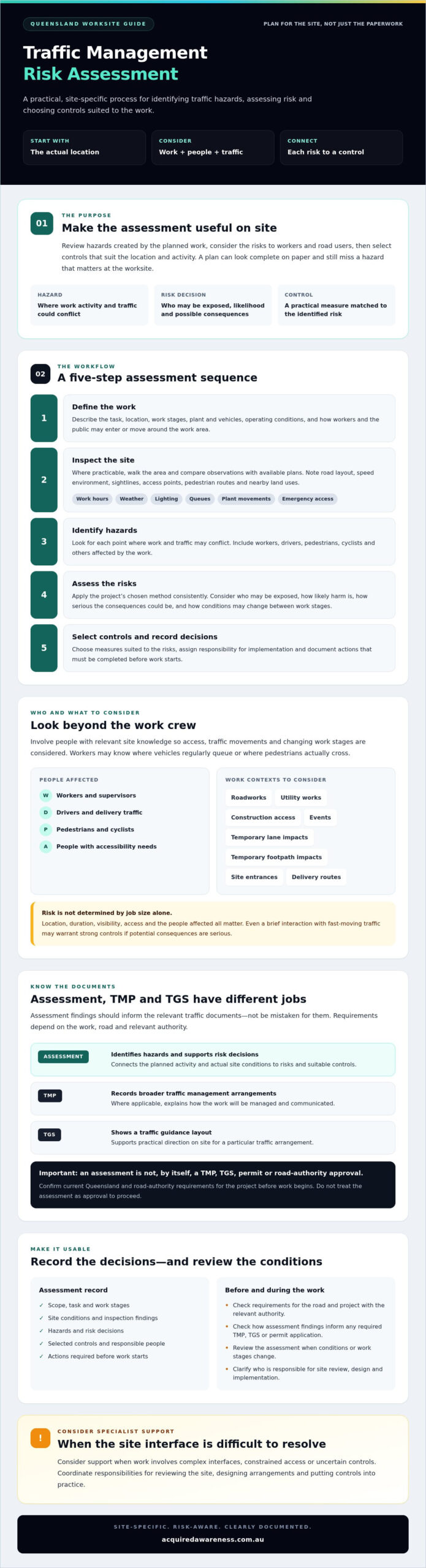
Use a consistent sequence, then check the terminology and document requirements against current Queensland guidance and the relevant road authority before using the assessment. Define the work, inspect the site, identify hazards, assess risks, select controls and record decisions.
- Define the work. Describe the task, location, work stages, plant and vehicles involved, and expected operating conditions. Include how workers and the public may enter or move around the work area.
- Inspect the site. Walk the area where practicable and compare your observations with available site plans. Note the road layout, speed environment, sightlines, access points, pedestrian routes and nearby land uses. Consider work hours, weather, lighting, queues, plant movements and emergency access.
- Identify hazards. Look for each point where work activity and traffic could conflict. Include risks to workers, drivers, pedestrians, cyclists and others affected by the work.
- Assess the risks. Apply the project’s chosen method consistently. Consider who may be exposed, how likely harm is and the potential consequences, including how conditions could change between work stages.
- Select controls and record decisions. Choose measures suited to the identified risks, assign responsibility for implementing them, and document any actions that must be completed before work starts.
The person leading the assessment should understand the work and coordinate input from people with relevant site knowledge. Involve supervisors, workers doing the task and, where appropriate, contractors or stakeholders familiar with nearby access and road use. Workers may identify practical issues a plan alone won’t reveal, such as where vehicles regularly queue or where pedestrians actually cross.
What information should the site inspection capture?
Record conditions that could affect visibility, movement or safe access, not just the physical road layout. Check sightlines from vehicle exits, pedestrian routes past the work, and whether nearby businesses, homes or facilities influence movement. Verify observations on site because plans may not show current obstructions, changed access or temporary conditions.
How should teams rate and record traffic risks?
Use the project’s risk-rating method, but don’t assume one matrix is mandatory for every Queensland worksite. For each hazard, record who may be exposed, existing controls, the risk decision, any further action, the responsible person and a review date. Check current Queensland and road-authority requirements for any specific documentation or retention rules that apply to the project.
For example, a work vehicle entering near a live traffic lane may conflict with passing vehicles and people walking past the access. Record who could be exposed and the possible consequences, then specify the controls and who will put them in place. A traffic management design provider can help turn assessment findings into workable arrangements. Explore traffic management design support when specialist input would help.
Which Queensland worksite traffic hazards and controls need attention?
A useful traffic management risk assessment qld considers how the work could affect everyone moving through or living near the site. That includes workers, drivers, pedestrians, cyclists, nearby residents and people with accessibility needs. A control that protects one group must not create a new hazard for another, such as diverting pedestrians onto an uneven surface or blocking access to a driveway.
Controls must reflect actual site conditions. Queensland’s road traffic management references include the Queensland Guide to Traffic Management (QGTM) and Queensland Manual of Uniform Traffic Control Devices (MUTCD), which take precedence over national Austroads guides where Queensland requirements apply. Check current guidance and the relevant road authority’s requirements before finalising arrangements.
- Vehicle conflict or site access: Consider separation, managed entry and exit points, or a traffic controller where the assessment indicates they’re suitable.
- Pedestrian or cyclist interaction: Consider a clear, continuous alternative route, appropriate separation and guidance that accounts for accessibility needs.
- Reduced visibility or queues: Review sign placement, sightlines and timing. Scheduling work outside peak periods may be an option if it suits the project and authority requirements.
- Worker exposure to moving plant: Consider separating plant movements from pedestrian work areas and coordinating vehicle movements with the work sequence.
These are examples, not prescribed solutions. Check that each control is visible, accessible and workable at the location, then verify it during the work. Low light, poor weather, peak traffic, queuing or a change in work stage may make an otherwise suitable arrangement ineffective.
How do Queensland location and road authority affect the assessment?
First establish whether the work affects a state-controlled road, a local council road or another authority’s network. TMR is responsible for state-controlled roads, while local councils manage local roads; requirements and approval processes can differ. In Brisbane, assess how an intersection, bus route, driveway access or busy pedestrian movement may interact with the work. Confirm current TMR or council requirements for the specific location. The same approval pathway won’t necessarily apply to every road.
What controls address vehicle, pedestrian and worker exposure?
Choose controls that address the identified conflict, not just the presence of traffic. Signs, barriers, traffic controllers, access management, separation and scheduling may all be options, depending on the site and work activity. Check that the arrangement remains effective as conditions change, and assign responsibility for responding to issues observed on site.
For operational support with planning or on-site traffic management, review this traffic management services guide.
How to document controls, check requirements and review the assessment
A well-kept assessment makes decisions clear to the people putting controls in place. It should show what was considered, why particular controls were selected and who is responsible for each action. For a traffic management risk assessment qld, check current Queensland, project and road-authority requirements rather than assuming one record format or retention period applies everywhere.
What should the assessment record include?
Capture enough information for someone implementing the controls to understand the work and its risks without relying on verbal explanations. A practical record should include:
- Assessment details: date, location, work scope, work stages, contributors and key assumptions.
- Site conditions: relevant observations and references to site plans or other supporting documents.
- Risk decisions: each significant hazard, who may be exposed, the assessment outcome and any existing controls considered.
- Actions: additional controls, the person responsible, completion status and any follow-up or review date.
Keep supporting observations and plan references accessible to supervisors and others responsible for implementing or checking the controls. If an assumption changes, such as the work area or access arrangement, update the record so it reflects conditions on site.
Assessment findings should inform the relevant Traffic Management Plan (TMP), Traffic Guidance Scheme (TGS) and permit applications where these are required. Check that the documents describe compatible arrangements. For example, if the assessment identifies a pedestrian access conflict, the relevant plan or application should reflect the control selected to manage it. Confirm application requirements with the authority responsible for the affected road.
When should a traffic risk assessment be reviewed?
Review the assessment before work begins, then revisit it whenever conditions or planned controls change. Triggers include a new work stage, altered site layout, changed traffic conditions, an incident or near miss, a complaint, or evidence that a control isn’t working as intended.
Check the controls at the worksite, not just on the page. If signs, barriers, access routes or other arrangements don’t match the assessment, pause to resolve the gap and record any revised decision. Confirm review intervals and reporting duties against current Queensland and project requirements.
Clear documentation helps turn assessment decisions into practical arrangements. For support with traffic management design and planning in South East Queensland, discuss your traffic management requirements.
When to engage a QLD traffic management provider for assessment support
Specialist input may help when a worksite has complex interfaces, constrained access, several work stages or controls the project team is unsure how to implement. A provider can help turn assessment findings into practical arrangements, but engaging one doesn’t remove the need to confirm project requirements, permits or approvals with the relevant road authority.
Acquired Awareness Traffic Management supports South East Queensland projects with traffic management design, traffic control, equipment hire and permit application support. The right service scope depends on the project location, road authority and work requirements. Confirm availability for your location and clarify who is responsible for each part of the work.
How to compare traffic management support options
Ask prospective providers questions that show how their proposed support connects planning with implementation:
- Can you review the site conditions and help identify practical control options?
- Can you design the relevant Traffic Management Plan (TMP) or Traffic Guidance Scheme (TGS), if required?
- What permit application support is available, and which approvals must the project team obtain?
- Who will implement, communicate and check the controls on site?
- How will arrangements be reviewed if work stages or traffic conditions change?
- What project-specific qualifications, availability and responsibilities should we confirm before proceeding?
Compare the answers with your assessment and the requirements of the authority responsible for the road. Don’t assume one provider covers every stage or that a proposed plan itself grants approval. Clear responsibilities help prevent gaps between design, permit applications and on-site traffic control.
What to prepare before requesting project support
Give the provider enough context to understand the work and its constraints. Prepare the project location, work scope, schedule, access needs, known traffic impacts and planned work stages. Share available site plans, previous assessments, permit information and the proposed work method. Flag uncertainties, such as a restricted vehicle entrance or a footpath that may need to remain accessible, so they can be considered early.
If the project may need traffic control devices, review this South East Queensland equipment hire guide as part of planning. Confirm what equipment is suitable and available for the specific job rather than assuming a standard set will fit every site.
A careful traffic management risk assessment qld gives a provider a stronger basis for recommending workable support. For a Brisbane or South East Queensland project, discuss traffic management support with Acquired Awareness Traffic Management.
Put Your Assessment Into Practice
A sound traffic management risk assessment qld connects site-specific hazards to controls workers can implement and check. Define the work, consider how the site affects everyone using it, and make sure your records and any required TMPs, TGSs or permit applications reflect the actual arrangements. Review the assessment when conditions change or controls aren’t working as intended.
For complex interfaces, restricted access or multiple work stages, specialist input can help turn assessment findings into practical planning and on-site support. Acquired Awareness is a South East Queensland provider offering traffic management design, permit application support, traffic control and equipment hire. Confirm that the required services, project location and responsibilities align with your work.
Discuss traffic management support for your project with Acquired Awareness. A clear plan and active review help your team protect workers and the community as work progresses.
Frequently Asked Questions
What is a traffic management risk assessment in Queensland?
A traffic management risk assessment in Queensland systematically identifies worksite traffic hazards, considers the risks they create and selects suitable controls. It should reflect the planned activity and conditions at the actual location, including who may be exposed and the possible consequences. The findings support safer work planning, but don’t automatically replace any required Traffic Management Plan, Traffic Guidance Scheme, permit or road-authority approval.
Is a traffic management risk assessment the same as a TMP or TGS?
No. The assessment identifies hazards and informs decisions about controls. A Traffic Management Plan (TMP), where required, documents broader traffic management arrangements, while a Traffic Guidance Scheme (TGS) shows the traffic guidance layout for the work. The assessment can inform both documents, but it isn’t automatically a substitute for them. Confirm current terminology and documentation requirements with the relevant Queensland road authority.
Who is responsible for completing a traffic risk assessment?
The project team should ensure the assessment is completed by someone with appropriate knowledge of the work and site, with relevant workers and others contributing practical information. The person leading it can coordinate the review, record decisions and assign control actions. Responsibility for approvals and implementation should be confirmed for each project. For work in Brisbane, also check which authority manages the affected road and its requirements.
What hazards should a Queensland traffic risk assessment include?
Consider hazards where work activity may conflict with road or site movements. These can include vehicles entering or leaving the site, moving plant, restricted sightlines, temporary lane or footpath impacts, queues and pedestrian access. Assess impacts on workers, drivers, pedestrians, cyclists, nearby residents and people with accessibility needs. In Brisbane, consider nearby intersections, driveways and bus routes where they interact with the proposed work.
When should a traffic management risk assessment be reviewed?
Review the assessment before work starts and whenever site conditions or planned arrangements change. Triggers can include a new work stage, a changed site layout, altered traffic conditions, an incident or near miss, a complaint, or evidence that a control isn’t working. Check the controls on site and update the record when its assumptions no longer match reality. Confirm any project-specific review intervals and reporting requirements.
Do I need a TMP or TGS as well as a risk assessment?
Possibly. Whether a TMP, TGS or permit is required depends on the work, location and road-authority requirements. The assessment supports decisions but doesn’t itself provide approval or replace required documents. A TMP sets out broader arrangements where applicable; a TGS shows the traffic guidance layout. For a Brisbane project, establish whether the road is managed by Brisbane City Council, TMR or another authority, then confirm the applicable requirements.
Can a traffic management provider help with a QLD risk assessment?
A provider may help turn assessment findings into practical design and on-site arrangements, particularly where the work involves complex interfaces or uncertain controls. Acquired Awareness Traffic Management supports projects in South East Queensland with traffic management design, permit application support, traffic control and equipment hire. Confirm the provider’s project-specific scope, location availability and responsibilities, and check approvals with the relevant road authority.