Blog
Recent Articles
Understanding the Traffic Guidance Scheme (TGS) in Brisbane: A 2026 Guide
May 6, 2026

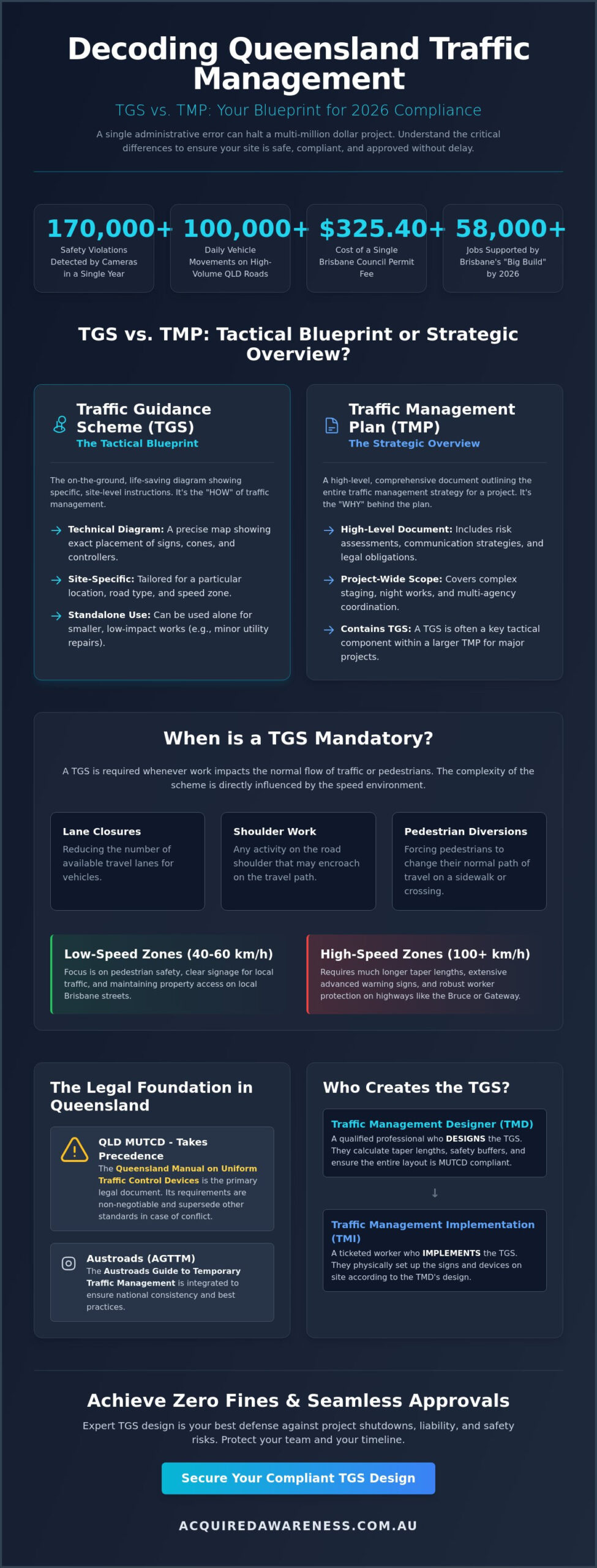
In 2026, a single administrative error on your traffic guidance scheme can cost more than just a $325.40 Brisbane City Council permit fee; it can halt a multi-million dollar infrastructure project overnight. With Queensland authorities catching over 170,000 drivers for safety violations via detection cameras in a single year, the pressure to maintain a compliant site has never been higher. Many project managers in South East Queensland find the distinction between a TGS and a Traffic Management Plan confusing, which often leads to the fear of permit rejections and site liability.
We know that keeping your team safe while meeting the rigorous standards of the Queensland Manual of Uniform Traffic Control Devices (MUTCD) is your top priority. This guide provides the clarity you need to master Traffic Guidance Schemes and ensure your site remains incident-free and fully compliant. We’ll walk through the specific 2026 TMR requirements, permit cost structures, and the technical layouts necessary to secure fast approvals for your Brisbane projects. By understanding these blueprints, you can protect your staff and the public while keeping your project on schedule.
Key Takeaways
- Understand the critical distinction between tactical diagrams and strategic plans to ensure your site meets 2026 Queensland standards.
- Master the technical elements of a traffic guidance scheme, including signage tapers and device tallies, to guarantee a compliant site footprint.
- Learn how to navigate the specific permit requirements for both Brisbane City Council and TMR to prevent project shutdowns.
- Discover why expert traffic management design is essential for reducing liability and protecting your workforce in high-risk environments.
- Gain the knowledge needed to achieve zero fines and seamless approvals for all your infrastructure projects across South East Queensland.
What is a Traffic Guidance Scheme (TGS)?
A traffic guidance scheme is a technical diagram that serves as the life-saving blueprint for any South East Queensland work site. It isn’t a vague suggestion of where to place equipment. Instead, it’s a precise map showing the exact location of every sign, bollard, and traffic controller. While many people still use the term ‘Traffic Control Plan’, Queensland has transitioned to the TGS terminology to align with broader national standards. This document works as the tactical component of a Traffic Management Plan (TMP). The TMP provides the high-level strategy and risk mitigation; the TGS provides the specific, site-level instructions.
The primary objective of a TGS is the protection of life. With Brisbane’s “Big Build” projected to support over 58,000 jobs by 2026, our roads are busier than ever. High-volume zones like the CBD or the Gateway Motorway see upwards of 100,000 vehicle movements every day. A well-designed scheme ensures these drivers, along with pedestrians and our roadside workers, remain safe from the moment a site is established until the final cone is removed. We take this responsibility seriously because we know that a clear plan is the best defense against the chaos of high-speed traffic.
As the infrastructure sector expands to support this growth, many companies are seeking to scale through strategic acquisitions; to ensure your next move is financially sound, visit creditte for expert guidance on buying a business.
The Legal Foundation: MUTCD and AGTTM
In Queensland, the legal framework for traffic management is governed by the Queensland Manual on Uniform Traffic Control Devices (MUTCD). This document takes precedence over Australian Standards whenever there’s a discrepancy. We also integrate the Austroads Guide to Temporary Traffic Management (AGTTM) to ensure our Brisbane sites meet national consistency benchmarks. Compliance with these standards is non-negotiable. If a scheme doesn’t meet these rigorous technical requirements, it won’t just face a permit rejection from the Brisbane City Council. It’ll expose the project to significant liability and safety risks that no business can afford to ignore.
Who is Responsible for Creating a TGS?
Creating a compliant scheme requires specialized expertise and current certification. Only a qualified Traffic Management Designer (TMD) can develop these technical diagrams. It’s vital to understand the difference between ‘Implementation’ and ‘Design’ certifications in Queensland. While a Traffic Management Implementation (TMI) ticket allows a person to set up a site, the TMD qualification is required to design the actual layout. This ensures that every taper length and safety buffer is calculated correctly for the specific speed zone and road type. A Traffic Management Designer takes full ownership of the site’s safety by translating complex legislative requirements into a clear, actionable visual blueprint.
TGS vs. TMP: Decoding Queensland’s Traffic Management Requirements
Understanding the hierarchy of documentation is critical for site compliance in South East Queensland. Many contractors mistakenly use the terms interchangeably, but they serve distinct functions under Queensland’s temporary traffic management standards. A Traffic Management Plan (TMP) is a strategic, high-level document. It outlines the project’s risk assessments, public communication strategies, and legislative obligations. In contrast, a traffic guidance scheme is the tactical diagram used on the ground. It shows exactly where every piece of equipment sits to manage the flow of vehicles and people safely.
A TGS is often a component of a larger TMP, but it can stand alone for smaller, low-impact works. For instance, a minor utility repair on a local street in Chermside might only require a single traffic guidance scheme to manage a sidewalk diversion. However, major infrastructure upgrades on the Gateway Motorway require a comprehensive TMP that addresses complex staging, night works, and multi-agency coordination. We ensure every plan integrates seamlessly with your site’s specific risk profile to prevent costly delays or safety breaches. Our approach focuses on delivering solutions that are both compliant and practical for your crew.
When is a TGS Mandatory?
A TGS is required whenever work impacts the normal flow of traffic or pedestrians. Common triggers include lane closures, shoulder work, or any activity that forces a pedestrian to change their path. Speed zones play a major role in design complexity. On low-speed Brisbane roads (40-60 km/h), the focus is often on pedestrian safety and property access. On high-speed corridors like the Bruce Highway, the scheme must account for much longer taper lengths and advanced warning signs to protect workers from vehicles traveling at 100 km/h. If your project involves these high-risk environments, professional traffic management design is the most reliable way to ensure total compliance.
The Relationship Between TGS and Permit Approvals
The Brisbane City Council (BCC) requires a detailed TGS before they’ll issue a ‘Road Corridor Permit’. This is especially true for the $325.40 standard permit application for temporary road impacts. The council uses your TGS to verify that your proposed layout won’t cause gridlock or endanger the public. Once approved, the TGS becomes a legal document. It must be physically present on-site at all times. Traffic controllers use it daily to ensure the site is set up exactly as designed. If an inspector arrives and the site doesn’t match the diagram, you risk immediate shutdowns and heavy fines. We help our partners avoid these outcomes by delivering precise, council-ready schemes from the outset.
The Anatomy of a Compliant Traffic Guidance Scheme
A compliant traffic guidance scheme is a precise inventory of safety hardware and spatial geometry. It acts as a set of instructions for the physical environment, detailing exactly how many cones, bollards, and signs are required. To keep track of this inventory, many site managers use durable paint markers from PoscART to label equipment for easy identification. For high-impact Brisbane sites, this inventory often extends to Variable Message Signs (VMS) and trailer-mounted arrow boards to provide advanced warning to motorists. Every device must be placed with mathematical accuracy. We don’t leave site safety to guesswork; we use these schemes to ensure that every piece of equipment serves a specific purpose in the mitigation of risk.
Beyond the hardware, the scheme must account for the logistical needs of a modern city. This includes maintaining clear paths for Translink bus routes and ensuring emergency vehicles can navigate through or around the work zone without delay. For more information on the technical specifications required for these layouts, you can refer to Queensland’s official Temporary Traffic Management resources. A well-designed scheme balances the needs of the construction crew with the continuous movement of Brisbane’s transport network.
Signage and Delineation Standards
Signage is the primary communication tool between the work site and the public. In South East Queensland, every scheme must begin with ‘Roadwork Ahead’ and conclude with ‘End Roadwork’ signs to clearly define the site boundaries. Taper lengths are particularly critical for safety. In a 40 km/h suburban street, a lateral shift might only require 15 meters of delineation. However, on a 100 km/h highway upgrade, that same shift demands over 180 meters to allow for safe driver reaction times. Incorrect sign spacing is the primary reason schemes fail during audits because it denies motorists the necessary time to process information and react safely. We calculate these distances based on the actual operating speed of the road to ensure maximum protection.
Addressing Vulnerable Road Users
Designing a traffic guidance scheme for urban areas like the Brisbane CBD or South Bank requires a heavy focus on vulnerable road users. Pedestrians and cyclists must have access that is just as safe and logical as the path provided for vehicles. This involves adhering to Disability Access Requirements (DAA), ensuring that temporary footpaths are level, stable, and wide enough for wheelchairs or prams. In high-footfall zones, we often implement physical barriers to separate active transport corridors from heavy machinery. Protecting everyone who interacts with our sites is a core value, and we ensure that no one is left behind in the planning process.
In high-footfall areas, safety for pedestrians often includes those walking their pets; for residents looking to ensure their companions are secure and identifiable, you can learn more about Pet ID Tags Australia.
Navigating Brisbane Council and TMR Permit Approvals
Securing a permit in South East Queensland requires navigating two distinct regulatory bodies. For local roads, the Brisbane City Council (BCC) is your primary contact. For state-controlled corridors, you must deal with the Department of Transport and Main Roads (TMR). A high-quality traffic guidance scheme is the common denominator required by both. Without a compliant diagram, your application will likely be rejected, leading to costly project delays and potential fines. We take the lead on this process to ensure your site meets every technical hurdle before the first cone is placed.
Rejections often stem from technical oversights. These include using outdated versions of the MUTCD or failing to account for specific peak-hour clearway restrictions. We’ve seen applications stalled because the designer didn’t consider the 6:30 am to 6:30 pm construction work zone charges, which currently sit at $650.85 per lineal meter of kerb length for 2026. Precision in the planning phase is the only way to ensure your project stays on track. Our team focuses on getting the details right the first time so you don’t have to deal with the frustration of repeated lodgements.
The BCC Road Corridor Permit Process
The process begins with a detailed site assessment. Once we design your traffic guidance scheme, we lodge the application via the BCC portal. The standard application fee for a temporary road closure or impact is $325.40 as of the 2025-2026 schedule. If your project is complex, you might require a Traffic and Transport Package, which costs $3,146.00 and includes a pre-lodgement meeting. Lodging early is vital. During peak construction seasons, lead times can extend to 20 business days. We recommend seeking professional traffic management design early to avoid these bottlenecks and ensure your documentation is flawless.
TMR Requirements for State-Controlled Roads
State-controlled roads like the Inner City Bypass or Gympie Road have even stricter requirements. You can’t simply set up a site; you need a Memorandum of Authorisation (MoA) from TMR. This document proves that the authority has reviewed your scheme and agrees to the proposed impacts. TMR focuses heavily on high-speed safety and regional connectivity. We manage this entire liaison process, ensuring that the MoA is secured and all conditions are met before your crew steps onto the bitumen. Our experience with TMR standards means we know exactly what their assessors are looking for, which significantly reduces the risk of rejection and keeps your project moving.
Professional TGS Design: Why Expert Implementation Matters
Choosing a generic template for your traffic management is a gamble with your project’s timeline and the safety of the public. While “cookie-cutter” diagrams might seem cost-effective initially, they rarely account for the unique variables of a specific Brisbane street. A non-compliant traffic guidance scheme can lead to immediate site shutdowns, heavy regulatory fines, and increased liability in the event of an incident. We believe that every site deserves a bespoke approach that addresses real-world conditions like hidden driveways, local school zones, and high-volume pedestrian corridors. This level of site-specific care is also essential for property upkeep; for instance, Latrobe Heritage Property Services provides the specialized fencing and maintenance required to keep properties secure and well-managed during infrastructure works.
Our commitment to excellence extends beyond the drawing board. Professional design must integrate seamlessly with high-quality traffic control Brisbane services to be effective. Because we operate as both a service provider and a Registered Training Organization (RTO), our designs are informed by the latest industry standards and practical field experience. This dual identity allows us to provide a level of technical depth that ensures your site is not just compliant on paper, but safe in practice. We take pride in being a reliable partner that understands the specific challenges of Queensland’s infrastructure.
Risk Mitigation and Liability Protection
A robust TGS serves as a primary defense for the Person Conducting a Business or Undertaking (PCBU). Under Queensland law, the responsibility for site safety is absolute. By utilizing professional traffic management design, you demonstrate a proactive commitment to risk mitigation. Our designers carry professional indemnity insurance, providing an extra layer of security for your project. We maintain a “Safety First” mantra as our North Star, ensuring that every decision made during the planning phase prioritizes the well-being of your staff and the Brisbane community. This disciplined approach minimizes the risk of accidents and the legal complications that follow.
Getting Started with Acquired Awareness
Our design process is methodical and thorough. It begins with a comprehensive site visit to identify physical hazards and traffic patterns that a satellite map might miss. From there, we develop a site-specific traffic guidance scheme and manage the entire approval process with the relevant authorities. We offer a total solution that includes:
- Technical design and drafting by accredited Traffic Management Designers.
- Coordination of equipment hire, including VMS boards and specialized signage.
- Deployment of highly trained, accredited traffic controllers who understand how to implement the plan correctly.
- Ongoing site audits to ensure compliance as project conditions change.
Protecting your project and the public is a responsibility we don’t take lightly. If you’re planning a project in South East Queensland and need a partner who prioritizes integrity and results, contact our Brisbane team for a consultation. We’ll ensure your site meets every standard, from the first permit application to the final pack-up.
Securing Your Project’s Future with Compliant Design
Mastering the technical details of a traffic guidance scheme ensures your South East Queensland project remains safe, compliant, and legally sound. By distinguishing between tactical diagrams and strategic plans, you protect your crew and avoid the common pitfalls of permit rejection. We’ve established that precise taper calculations and device inventories are essential for preventing the costly delays that often plague unmanaged sites. These blueprints are the foundation of a site that meets the rigorous 2026 standards set by local and state authorities.
Acquired Awareness Traffic Management brings a deep sense of professional responsibility to every project we manage. We have spent over 20 years serving the South East Queensland community, developing a reputation for calm authority and technical excellence. As TMR Pre-qualified Designers with RTO-accredited training expertise, we bridge the gap between complex legislation and site-level reality. We take full ownership of the environments we manage, ensuring that every safety mandate is met with precision. Secure Your Site with a Compliant Traffic Guidance Scheme – Contact Us Today. Let’s work together to build a safer, more efficient Brisbane for everyone.
Frequently Asked Questions
What is the difference between a TGS and a TCP in Queensland?
The primary difference is terminology; a traffic guidance scheme is the current, official term used in Queensland under the Austroads Guide to Temporary Traffic Management (AGTTM). While other states or legacy documents might refer to a Traffic Control Plan (TCP), Queensland authorities like TMR and Brisbane City Council now strictly require TGS documentation. This shift ensures that all South East Queensland sites remain consistent with national safety standards and modern terminology.
Do I need a TGS for a short-term work site in Brisbane?
Yes, you must have a TGS for any work that impacts the normal flow of traffic or pedestrians, regardless of the duration. Even if the work lasts only one hour, the Queensland MUTCD mandates a compliant layout to protect road users and staff. Operating without a plan on “quick” jobs is a common cause of accidents and can lead to immediate site shutdowns by council inspectors.
How long does it take to get a Traffic Guidance Scheme approved by BCC?
Standard permit approvals from the Brisbane City Council typically take between 10 and 20 business days. This timeframe can fluctuate depending on the complexity of the road and current construction demand in 2026. We recommend lodging your application at least four weeks in advance for high-impact projects. This lead time allows for any technical adjustments required by the council’s congestion management team.
Can I draw my own TGS for a small project?
You can only design a traffic guidance scheme if you hold a current Queensland Traffic Management Design (TMD) qualification. Authorities will not accept diagrams drawn by unqualified personnel, as they lack the technical verification required for public safety. Using an uncertified designer risks permit rejection and places the full legal liability of a site failure on your business. We ensure every design is signed off by an accredited expert to mitigate these risks.
What happens if I operate without an approved TGS in SEQ?
Operating without an approved scheme results in immediate site closure and heavy financial penalties from the Brisbane City Council or TMR. In 2026, enforcement is stricter than ever, with inspectors frequently auditing sites across high-density zones like South Bank and the CBD. Beyond fines, you face massive liability if an incident occurs. Your insurance will likely be void if you haven’t followed the mandatory legislative planning process. To ensure your business remains protected and to review your current policies, you can visit Putney Insurance Group for professional advisory services.
How often does a TGS need to be reviewed or updated?
A TGS must be reviewed daily by the on-site Traffic Management Implementation (TMI) holder to ensure it still matches the physical environment. If site conditions change significantly, such as a new excavation or a shift in lane geometry, the plan must be formally updated by a qualified designer. Keeping a site diary that reflects these daily checks is a critical part of your compliance and safety obligations.
Does a TGS include pedestrian management plans?
Yes, a compliant scheme must include specific provisions for pedestrians and cyclists. This is especially vital in Brisbane’s active transport corridors where foot traffic is high. The plan must detail safe detours, stable walking surfaces, and Disability Access Requirements (DAA). Ensuring that a person in a wheelchair or with a pram can navigate the site safely is a non-negotiable part of our design process.
What qualifications are required to implement a TGS on-site?
To physically set up the signs and devices shown on a TGS, you must hold a Traffic Management Implementation (TMI) ticket. This is distinct from a basic Traffic Control (TC) ticket, which only permits a person to direct traffic with a stop-slow bat. In Queensland, these certifications must be renewed every three years to remain valid. We provide these courses through our RTO to ensure all personnel are competent in the latest 2026 safety protocols.