Blog
Recent Articles
Traffic Management Design Brisbane: Expert Plans & Permit Solutions
April 15, 2026
Last Tuesday, a Brisbane site supervisor named Mark discovered that a minor technical oversight in a traffic plan could halt a A$20,000-a-day operation instantly. You already know that your project is only as reliable as the planning behind it. In a high-risk environment, a single compliance gap doesn’t just delay the schedule; it compromises the safety of every person on your site. Mastering the complexities of traffic management design brisbane requires a focus on precision and a deep understanding of Department of Transport and Main Roads standards.
We’ll show you how to secure permits faster with compliant, safety-first designs that protect your crew and your budget. Our focus is on delivering zero-friction approvals and ensuring that your site remains a controlled, secure environment. This guide provides a clear roadmap for achieving maximum site safety and cost-effective resource allocation for your next Queensland infrastructure project. We believe that professional responsibility means leaving nothing to chance.
Key Takeaways
- Learn how expert traffic management design in Brisbane integrates QGTTM standards to create a safety-first blueprint for your project.
- Identify whether your worksite requires a Traffic Guidance Scheme (TGS) or a full Traffic Management Plan (TMP) based on specific risk assessments.
- Streamline your approval process by mastering the distinct permit requirements for both Brisbane City Council and TMR Queensland road networks.
- Discover the professional drafting process that transforms initial site consultations into compliant, high-precision designs ready for immediate implementation.
- Leverage the “RTO Advantage” to ensure your traffic plans are designed by industry leaders who teach the safety standards others simply follow.
What is Traffic Management Design in Brisbane?
Traffic management design brisbane is the foundation of every safe work site. It serves as a detailed blueprint for safety and efficiency on our roads. In Queensland, every plan must strictly follow the Queensland Guide to Temporary Traffic Management (QGTTM). This guide ensures that every temporary change to road conditions meets rigorous safety standards. We view these designs as more than just drawings. They’re comprehensive risk mitigation strategies that protect lives.
Generic plans often fail in high-density areas like the Brisbane CBD or Fortitude Valley. These locations demand a higher level of precision. A cookie-cutter approach cannot account for the 24-hour bus lanes or the high volume of pedestrians near the Queen Street Mall. We take the “Expert Protector” approach. This means we balance the heavy requirements of construction with the constant flow of public transit. Safety is our North Star. We leave nothing to chance. Our team understands that a delay in the city doesn’t just affect one street; it ripples across the entire metropolitan network.
The Core Components of a Compliant Design
A compliant design begins with a detailed site analysis. We assess traffic volumes on specific Brisbane corridors to understand peak flow periods. Identifying “vulnerable road users” is a priority. This includes the growing number of cyclists using the inner-city cycleway network. Every plan integrates three vital stages:
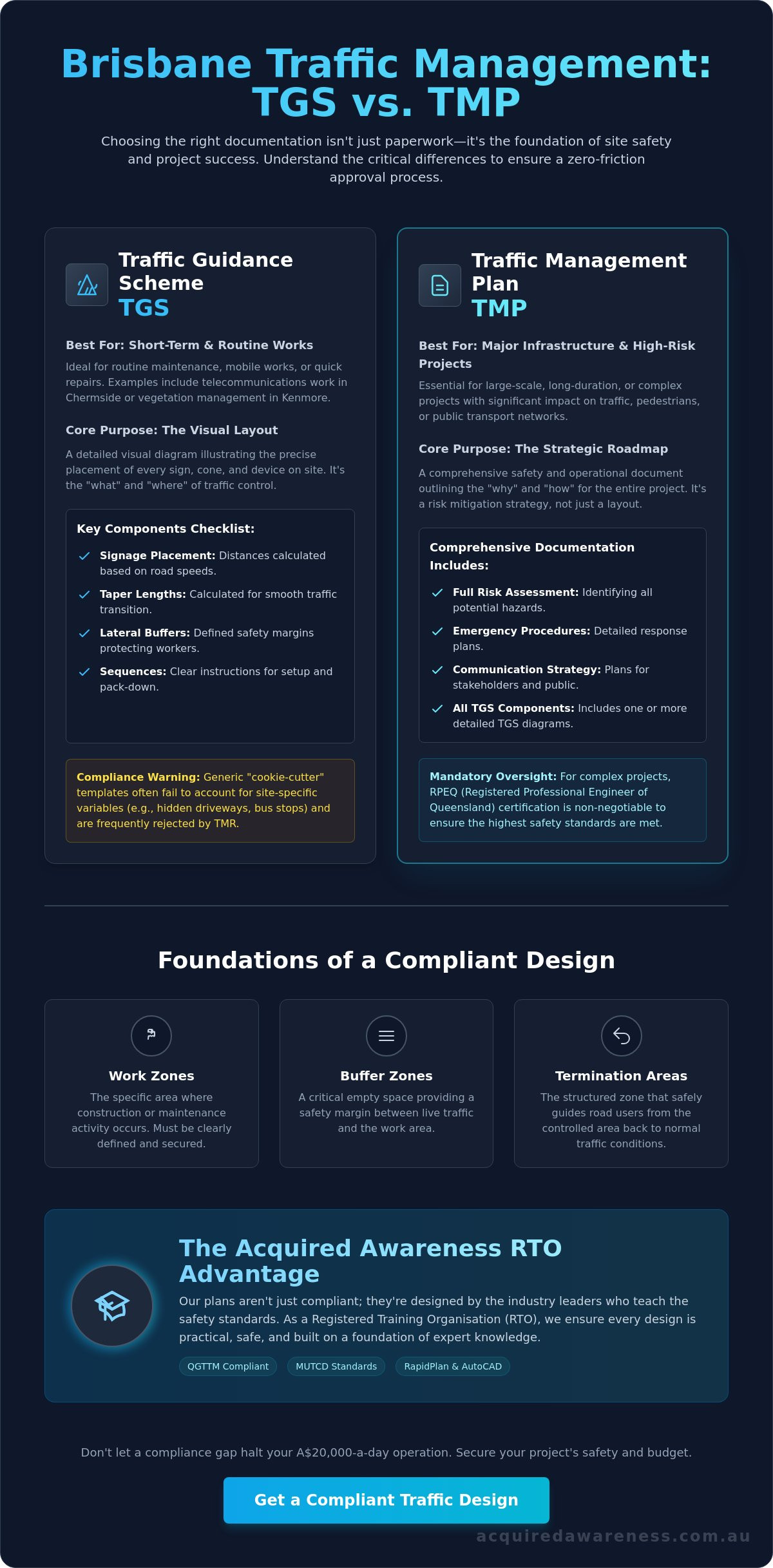
- Work zones: The specific area where construction or maintenance activity occurs.
- Buffer zones: Critical spaces that provide a safety margin for both workers and drivers.
- Termination areas: The structured zones that guide traffic safely back to normal conditions.
TMD vs. TMI: Knowing the Difference
It’s vital to distinguish between Traffic Management Design (TMD) and Traffic Management Implementation (TMI). TMD is the strategic planning phase. TMI is the physical setup on the road. A designer must understand the practicalities of Road traffic control to create a plan that’s actually workable. If a plan looks good on paper but can’t be safely deployed by a crew in heavy rain or low visibility, it’s a failure.
Acquired Awareness provides both the technical design and the accredited training. As a Registered Training Organization (RTO), we ensure our designers have the technical depth to protect the public and your workforce. We don’t just deliver a document. We deliver a safety outcome. Our dual identity as a service provider and an educator means we speak with authority. We’ve managed thousands of sites across Queensland, ensuring that every project stays compliant and every worker returns home safely.
Understanding TGS vs. TMP: Which Does Your Project Require?
Every successful project begins with the correct documentation. Choosing between a Traffic Guidance Scheme (TGS) and a Traffic Management Plan (TMP) isn’t just a matter of preference; it’s a critical safety and compliance decision. Our expert traffic management design brisbane teams determine the appropriate document based on the project’s scale, duration, and inherent risk levels. A TGS provides the specific visual layout of signs and devices, while a TMP acts as the comprehensive strategic roadmap for the entire site.
We use industry-leading software like RapidPlan and AutoCAD to produce precision diagrams that leave no room for error. For complex or high-risk projects, RPEQ (Registered Professional Engineer of Queensland) oversight is mandatory. This ensures that every design meets the rigorous safety standards set by the Queensland Manual of Uniform Traffic Control Devices (MUTCD). Safety is our priority. We don’t take shortcuts with compliance.
Traffic Guidance Schemes (TGS) for Short-Term Works
A TGS is the standard requirement for routine maintenance or mobile works within Brisbane suburbs. Whether it’s a quick telecommunications repair in Chermside or vegetation management in Kenmore, a TGS illustrates exactly where every cone and sign must stand. You shouldn’t rely on “cookie-cutter” or generic templates. These often get rejected by the Department of Transport and Main Roads (TMR) because they fail to account for site-specific variables like hidden driveways or local bus stops. Each TGS we develop includes:
- Precise signage placement distances based on approach speeds.
- Calculated taper lengths to transition traffic smoothly.
- Defined lateral buffers to protect workers from live traffic lanes.
- Clear instructions for setup and pack-down sequences.
Comprehensive Traffic Management Plans (TMP) for Major Infrastructure
Major infrastructure projects require a full TMP. This document is mandatory for long-term works that significantly alter traffic flow. Consider the impact of construction on a major arterial like Gympie Road, which carries over 70,000 vehicles daily. A TMP doesn’t just look at the work zone; it analyzes the broader network. We address how the project affects local residents, businesses, and emergency service response times. It’s about total environment control.
For developers and engineering teams looking to manage other environmental impacts such as noise on large-scale projects, you can discover Focus Acoustics, a specialist consultancy providing expert solutions for the built environment.
Contingency planning is a core component of a TMP. We develop specific strategies for peak-hour congestion and vehicle breakdowns within the work zone. This level of detail is integral to high-quality traffic management design brisbane, ensuring that even the most complex projects remain on schedule and incident-free. If you’re unsure which document your next project needs, reach out for a professional design consultation to ensure you’re fully compliant from day one.
Our role as an “Expert Protector” means we take full ownership of these documents. We don’t just deliver a drawing; we deliver a safety guarantee. By integrating technical expertise with local knowledge, we protect your crew and the Brisbane community.
Navigating Brisbane Council and TMR Permit Requirements
Brisbane’s infrastructure landscape operates under a dual-layer regulatory system. You can’t start work without knowing if the Brisbane City Council (BCC) or the Department of Transport and Main Roads (TMR) Queensland holds jurisdiction. We use TMR’s official road network maps to pinpoint ownership immediately. This step is vital. Submitting to the wrong authority can waste weeks of project time. Our team identifies the correct stakeholder before the first draft of a plan is even started.
Most urban works require a Road Use Authority (RUA) or specific Lane Closure Permits. The most frequent delays occur when applications lack site-specific detail or fail to address peak-hour clearways. High-quality traffic management design brisbane services eliminate these gaps. We provide the technical evidence required to prove that your project won’t cause gridlock or compromise public safety. Our focus is on getting the permit approved the first time, every time.
Brisbane City Council (BCC) Specifics
BCC oversees a massive network governed by the Brisbane City Plan. If your site is near the Brisbane Metro or active bus priority lanes, the requirements become significantly more complex. Council lead times for permit approvals generally range from 10 to 20 business days depending on the impact level. We manage this timeline for you. Our team ensures your submission meets every local ordinance; this protects you from avoidable fines and project stoppages.
TMR Queensland and State Controlled Roads
State-controlled assets like the Pacific Motorway (M1) and the Gateway Motorway require a Memorandum of Consent (MoC). These high-speed environments demand strict compliance with the Australian Guide to Temporary Traffic Management (AGTTM). As a registered training organization (RTO), we understand these standards better than anyone. We create traffic management design brisbane solutions that TMR assessors can approve quickly. This professional approach keeps your project moving while maintaining our “Safety First” commitment on Queensland’s busiest highways.
Common pitfalls often involve failing to account for the physical space required for advanced warning signs or missing the specific “No Work” periods during public holidays. We cross-reference every design against the TMR traffic sensitivity calendar. This methodical process ensures your project isn’t caught off guard by a last-minute rejection. We take full ownership of the compliance process so you can focus on the construction at hand.
The Step-by-Step Process of Professional Traffic Planning
Effective traffic management design brisbane relies on a disciplined, sequential approach. We don’t leave safety to chance. Our process begins with a comprehensive site consultation to define the project scope and identify latent risks. This initial phase allows us to understand the unique constraints of the Brisbane road network, from narrow inner-city lanes to high-speed arterial corridors. Once the data is collected, our designers use industry-leading software to draft a Traffic Guidance Scheme (TGS) or a broader Traffic Management Plan (TMP). Every draft undergoes a rigorous internal audit and quality assurance check against the Queensland Guide to Temporary Traffic Management (QGTTM) standards.
After the design meets our internal benchmarks, we manage the submission process to relevant Brisbane authorities. This includes coordinating with the Brisbane City Council or the Department of Transport and Main Roads (TMR) to secure necessary permits. The process concludes with a formal handover and briefing for the onsite Traffic Management Implementation (TMI) team. This ensures the vision on paper translates perfectly to the safety of the street.
Stage 1: Site Analysis and Risk Assessment
Our team conducts a granular evaluation of the physical environment. We assess current speed limits, sight distances, and existing road geometry to identify potential conflict points. In the context of Brisbane traffic, risk mitigation is the proactive identification and neutralisation of potential hazards to ensure zero harm for road users and workers. We pay particular attention to pedestrian-heavy zones such as South Bank or the Queen Street Mall, where high foot traffic volumes require specialised separation strategies. We look at the data, identify the dangers, and build the solution around them.
Stage 2: Design and Compliance Verification
Precision is mandatory in every plan we produce. We ensure all signage and equipment layouts strictly adhere to Australian Standards (AS 1742.3). For projects involving heavy vehicles or large construction machinery, we perform “Swept Path” calculations to guarantee vehicles can navigate the work zone without compromising safety barriers. As an RTO-accredited organisation, our designers bring a level of expertise that ensures every plan is implementable. They don’t just understand the theory; they understand the reality of the road. This technical depth prevents costly delays and ensures the protection of the public and your crew.
Our commitment to safety ensures your project remains compliant and your workers stay protected. Contact us today to discuss your traffic management design brisbane requirements.
Why Choose Acquired Awareness for Your Brisbane Traffic Design?
Selecting a partner for traffic management design brisbane requires more than just technical proficiency. It demands a deep understanding of local road networks and an unwavering commitment to public safety. Since our inception, Acquired Awareness Traffic Management has managed South East Queensland’s most complex environments with a steady, disciplined hand. We’ve spent over 20 years refining our processes to ensure every plan we produce meets the highest standards of compliance and operational efficiency.
Our status as a Registered Training Organisation (RTO) provides a unique advantage that sets us apart from standard consultancy firms. We don’t just apply industry standards; we teach them to the industry. This educational foundation means our designers possess an intimate, expert-level knowledge of the Queensland Guide to Temporary Traffic Management (QGTTM) and the Manual of Uniform Traffic Control Devices (MUTCD). We maintain a “Safety First” culture that acts as a North Star for every project. This approach protects your project from legal liability while ensuring your workforce and the public remain safe at all times.
The Benefit of an Integrated Traffic Solution
Having your designer and your traffic controllers within the same firm eliminates the communication gaps where errors often occur. When the team creating the plan is the same team executing it on the bitumen, the transition is seamless. If site conditions change unexpectedly, we facilitate real-time plan adjustments without the delays associated with third-party consultants. This synergy is why many clients choose our Traffic Control Brisbane services alongside our design expertise. We provide a complete, end-to-end safety solution that leaves nothing to chance.
Commitment to Excellence and Integrity
We’ve built a formidable reputation with Brisbane City Council (BCC) and the Department of Transport and Main Roads (TMR) as a reliable, high-compliance partner. Our track record includes the successful delivery of complex urban projects, such as major intersection upgrades and high-density infrastructure works where precision is non-negotiable. We take full ownership of the environments we manage, projecting an unflappable image that reassures our clients. We don’t just deliver a service; we act as a guardian of your site’s integrity. Our team is ready to bring this level of discipline to your next project. Contact our design team for a consultation to discuss your specific traffic management design brisbane requirements.
Secure Your Project with Expert Brisbane Traffic Planning
Navigating the complexities of local infrastructure requires more than just a map. It demands a deep understanding of the differences between a Traffic Guidance Scheme (TGS) and a comprehensive Traffic Management Plan (TMP). Getting these technical details right ensures your project remains fully compliant with both Brisbane City Council and Department of Transport and Main Roads (TMR) requirements. Mistakes in permit applications often lead to costly delays that stall progress. By investing in professional traffic management design brisbane, you mitigate site risks and maintain a safe environment for your crew and the public.
Acquired Awareness brings over 20 years of South East Queensland infrastructure experience to every site plan. As a Registered Training Organisation (RTO #40905), we speak with the authority of educators who understand the life-saving importance of precision. Our designs are fully compliant with current QGTTM and upcoming AGTTM 2026 standards, ensuring your project meets the highest safety benchmarks. We don’t leave safety to chance. We take pride in being the expert protectors of our local roads, delivering stable solutions that keep Brisbane moving safely.
Request a Professional Traffic Design Consultation
We’re ready to help you deliver a successful and safe project for the community.
Frequently Asked Questions
How long does it take to get a traffic management permit in Brisbane?
Obtaining a traffic management permit from the Brisbane City Council typically takes between 10 and 20 business days. This timeframe depends on the complexity of your project and the specific road hierarchy involved. For works on state-controlled roads, Department of Transport and Main Roads (TMR) approvals might require additional lead time. It’s best to submit your applications at least 4 weeks before your scheduled start date to ensure all compliance checks are completed without delaying your site launch.
What is the difference between a TGS and a TMP in Queensland?
A Traffic Guidance Scheme (TGS) is a visual diagram that shows the specific placement of signs, cones, and bollards on the road. A Traffic Management Plan (TMP) is a broader, strategic document that outlines the entire approach to risk mitigation for a project. While the TGS provides the onsite instructions for controllers, the TMP details the project’s scope, impact assessments, and safety protocols. Both documents are essential for professional traffic management design Brisbane projects to meet QGTTM requirements.
Do I need an RPEQ engineer to sign off on my traffic management design?
You require a Registered Professional Engineer of Queensland (RPEQ) to sign off on designs that deviate from standard QGTTM templates or involve complex engineering risks. This mandate ensures that high-risk traffic scenarios are backed by rigorous technical validation. Most routine short-term works can be signed off by a qualified Traffic Management Designer (TMD). However, projects involving permanent changes or structural impacts always demand RPEQ certification to maintain legal compliance and public safety.
What are the current QGTTM standards for 2026?
By 2026, the QGTTM mandates full alignment with the Austroads Guide to Temporary Traffic Management (AGTTM) standards. This transition prioritises the safety of vulnerable road users and requires all practitioners to hold current, nationally recognised units of competency. The 2026 standards also emphasise the use of Multi-Message Signs and specific longitudinal buffer zones based on 85th percentile travel speeds. Staying compliant means adhering to the latest Part 3 and Part 8 amendments issued by the state government.
Can I design my own traffic management plan for a Brisbane road?
You can’t legally design a traffic management plan unless you hold a current Traffic Management Design (TMD) qualification. Brisbane City Council and TMR require all submitted plans to be prepared by a certified professional who understands the QGTTM framework. Attempting to submit a DIY plan will result in immediate rejection and project delays. Our team provides expert traffic management design Brisbane services to ensure your project meets every regulatory hurdle from the first submission.
For developers who require specialized transport planning and traffic engineering documentation for planning applications in other jurisdictions, you can learn more about ML Traffic Engineers.
What happens if my project doesn’t have a compliant traffic design?
Operating without a compliant traffic design exposes you to immediate site shutdowns and significant fines under the Work Health and Safety Act 2011. In Queensland, individual penalties for Category 1 breaches can exceed A$600,000 or even involve imprisonment for serious negligence. Beyond financial costs, non-compliance increases the risk of onsite accidents. This leaves your company liable for any injuries to workers or the public. Professional oversight is the only way to mitigate these critical risks effectively.
How much does a traffic management plan cost for a small Brisbane project?
The cost of a traffic management plan depends on the road’s complexity and the required permit types. For a basic TGS on a low-volume local road, industry rates in Brisbane often start between A$250 and A$500. More complex projects requiring full TMPs, RPEQ signatures, and council liaison will see higher costs. We provide detailed quotes based on the specific safety requirements and infrastructure impacts of your site to ensure total transparency for your budget.
Does Acquired Awareness handle the council permit application process?
Yes, Acquired Awareness manages the entire permit application process with the Brisbane City Council and TMR. We act as your liaison to ensure all technical documentation meets the necessary standards for approval. This end-to-end service includes site inspections, design creation, and the submission of all required paperwork. We take the administrative burden off your shoulders so you can focus on the core objectives of your construction or maintenance project.