Blog
Recent Articles
Brisbane Construction Site Safety: A Comprehensive 2026 Compliance Guide
August 31, 2026
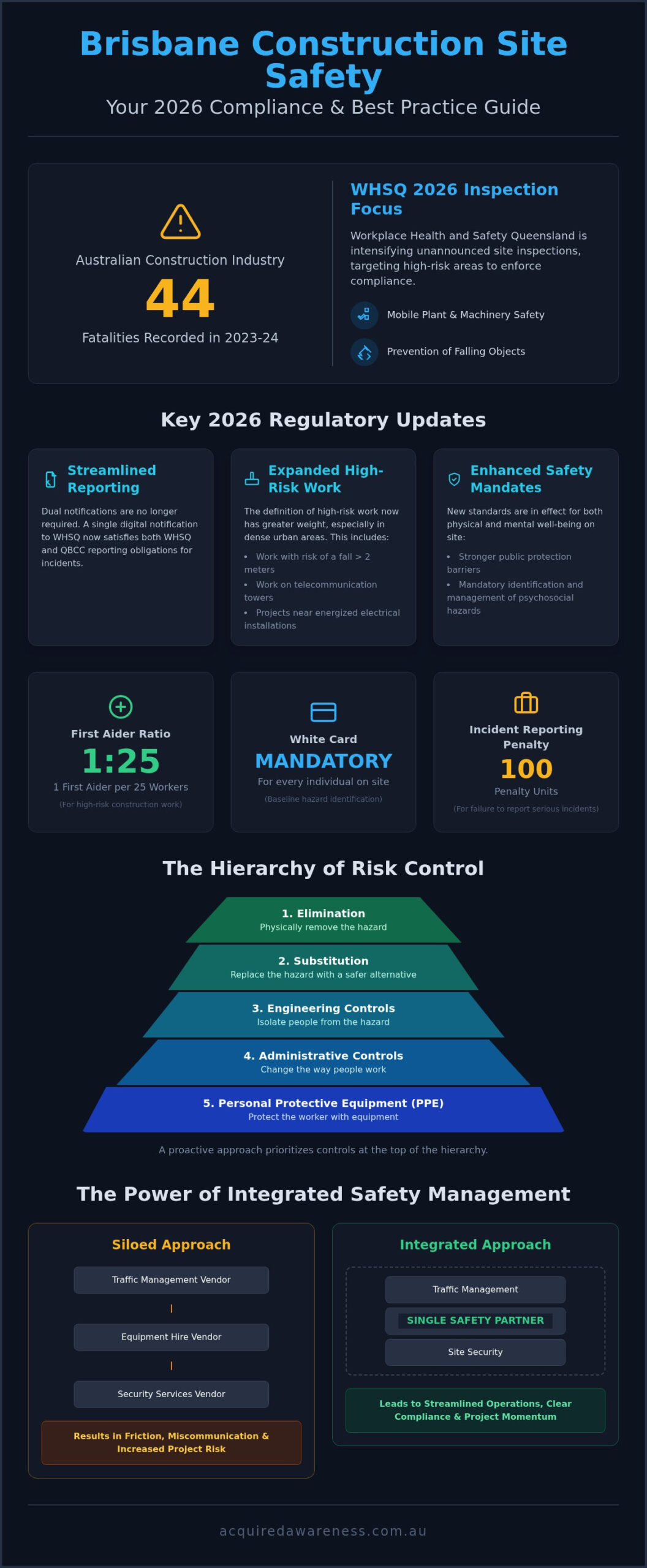
In 2023-24, the Australian construction industry recorded 44 fatalities, a stark reminder of the inherent risks present on every project. As we move through 2026, the regulatory landscape for brisbane construction site safety has become more rigorous, with Workplace Health and Safety Queensland intensifying inspections on mobile plant and falling objects. We understand that coordinating multiple safety vendors while keeping up with shifting reporting requirements can feel overwhelming. It’s a heavy responsibility to protect your team while mitigating the threat of increased penalties or site shutdowns.
You deserve a clear path to compliance that doesn’t compromise your project’s momentum. This guide provides the essential knowledge to master the latest safety regulations, traffic management protocols, and site security standards required across South East Queensland. We’ll examine the 2026 legislative updates, including streamlined incident reporting and mandatory first aider ratios, to ensure your site remains a zero-harm environment. From securing a White Card to implementing complex traffic management designs, you’ll find the technical depth and local expertise needed to lead your site with total composure.
Key Takeaways
- Understand the 2026 updates to the Work Health and Safety Act and how streamlined incident reporting through WHSQ simplifies your compliance duties.
- Identify high-risk construction work specific to the SEQ region to maintain brisbane construction site safety and the required 1:25 first aider ratio.
- Develop Traffic Management Plans (TMPs) that meet the rigorous standards of Brisbane City Council and TMR for complex urban environments.
- Secure the mandatory foundation for your workforce by integrating RTO-accredited White Card training with live site traffic control protocols.
- Streamline project operations by consolidating traffic management, equipment hire, and security under a single, integrated safety partner.
Navigating Brisbane’s Construction Safety Regulations in 2026
The Work Health and Safety Act 2011 remains the bedrock of operational standards in Queensland. However, 2026 has introduced pivotal shifts that demand your attention. As Brisbane prepares for significant infrastructure milestones, the definition of high-risk construction work now carries greater weight within our dense urban corridors. This category includes any activity involving a risk of a person falling more than two meters, work on telecommunication towers, or projects near energized electrical installations. The Work Health and Safety (High Risk Plant) Amendment Regulation 2026, effective from March 29, 2026, has also updated how high-risk machinery is classified, ensuring that definitions keep pace with modern engineering.
Workplace Health and Safety Queensland (WHSQ) has shifted its proactive compliance program to target falling objects throughout early 2026. Their inspectors are authorized to enter sites without notice to verify that brisbane construction site safety protocols meet current legislative mandates. Failure to comply is costly. As of February 1, 2026, penalties for failing to report serious incidents increased to 100 penalty units. Beyond financial loss, stop-work orders can freeze project timelines and damage your reputation within the South East Queensland community. We view compliance not as a hurdle, but as a disciplined commitment to the people who build our city.
The Legal Framework for Brisbane Site Managers
Under Queensland law, a Person Conducting a Business or Undertaking (PCBU) holds the primary duty of care to ensure, so far as is reasonably practicable, the health and safety of workers and others. This duty is non-transferable and requires a proactive approach to hazard management. In the Brisbane CBD and surrounding suburbs, site managers must also account for Brisbane City Council local laws regarding site perimeters and footway permits. Effective management relies on the hierarchy of risk control, a systematic approach often detailed in global construction safety standards, which prioritizes the elimination of hazards over administrative controls or personal protective equipment.
2026 Safety Standards: What Has Changed?
The most significant administrative change in 2026 is the streamlining of incident reporting. You’re no longer required to submit dual notifications to both the QBCC and WHSQ; a single digital notification to WHSQ now satisfies both agencies. This reduction in red tape allows managers to focus on physical site integrity. To support this administrative efficiency, ensuring your site office is stocked with essentials from Mega Office Supplies can help keep your documentation and reporting workflows seamless. New standards for public protection barriers are also in effect, requiring enhanced structural stability for sites bordering heavy pedestrian traffic. Additionally, there’s a renewed mandate to address psychological safety. Managing brisbane construction site safety now involves identifying psychosocial hazards, ensuring that the mental well-being of the crew is protected alongside their physical health.
Every construction project in South East Queensland begins with a commitment to fundamental standards. The most critical entry point for any worker is the white card qld. This induction ensures that every individual stepping onto your site possesses a baseline understanding of hazard identification and risk management. Without this mandatory foundation, site integrity is compromised from the outset. We believe that safety isn’t just a requirement; it’s a professional responsibility that protects our community and our workforce.
Establishing a baseline of brisbane construction site safety requires more than just ticking boxes. It requires an integrated approach where traffic control is seamlessly woven into site entry and exit protocols. When traffic controllers and site managers work in unison, vehicle movements become predictable and controlled. This coordination reduces the risk of collisions and ensures that heavy plant machinery doesn’t disrupt the flow of public transport or local commuters. Managing these elements through a single partner eliminates the friction often found when coordinating multiple safety vendors.
Accredited Training as a Safety Foundation
Quality training is the cornerstone of a zero-harm environment. RTO-accredited traffic control courses provide your team with the technical skills to manage volatile road environments with total composure. There’s a significant difference between a basic site induction and specialized safety certifications delivered by professionals who manage live sites daily. As an RTO (Registered Training Organisation #40905), we ensure that all personnel and sub-contractors meet the highest Brisbane safety benchmarks. This educational authority allows us to lead by example, transforming compliance into a disciplined operational culture.
Proactive Site Security and Asset Protection
Site security acts as the silent guardian of your project’s bottom line. Professional static guards do more than watch the gate; they manage visitor logs, verify credentials, and act as a primary deterrent against opportunistic theft and vandalism. In Brisbane’s active residential and commercial hubs, unsecured sites are frequent targets for equipment theft, which can lead to significant project delays. By coordinating security patrols with traffic management schedules, you maintain 24/7 site integrity. This proactive stance ensures that even after the tools are down, your site remains under total control. If you’re looking to streamline your site oversight, consider how an integrated safety partner can reduce your administrative burden while enhancing protection.
High-Risk Work: Managing Traffic and Public Interaction in SEQ
To further support site oversight and real-time data management, having a robust technical infrastructure is essential. For accredited installation of networking, WiFi, and Starlink connectivity on your project, DJC Engineering Pty Ltd offers specialized services to keep construction sites across South East Queensland fully connected.
Traffic management is often the most volatile component of brisbane construction site safety. Unlike internal site hazards, public interaction involves unpredictable variables: frustrated drivers, distracted pedestrians, and heavy transit flows. Managing this interface requires a disciplined approach to ensure that heavy machinery and public commuters coexist without incident. In dense urban areas like the Brisbane CBD or Fortitude Valley, the visibility of your safety protocols directly reflects your professional standards and commitment to public welfare. We take full ownership of these environments, ensuring that even the most chaotic traffic scenarios remain under total control.
Developing a Traffic Management Plan (TMP) that satisfies Brisbane City Council or the Department of Transport and Main Roads (TMR) is a technical necessity. These authorities demand rigorous standards to minimize disruption to the SEQ road network. Beyond the paperwork, the success of a project relies on the presence of accredited traffic controllers. These professionals act as the frontline guardians of your site, managing the delicate balance between construction progress and public mobility. Their expertise is particularly vital as South East Queensland undergoes rapid infrastructure growth in preparation for the 2032 Olympic Games.
Traffic Management Plans (TMP) vs. Traffic Guidance Schemes (TGS)
A Traffic Management Plan (TMP) is a strategic safety document that identifies all potential traffic risks and outlines the broad objectives for managing them throughout the project lifecycle. While the TMP provides the high-level strategy, a Traffic Guidance Scheme (TGS) provides the granular, technical layout of signs and devices required for specific road occupancy permits. Professional Traffic Management Design reduces project liability by ensuring every cone, sign, and barrier is placed according to current QLD standards. This methodical planning improves traffic flow and prevents the logistical bottlenecks that often lead to costly site delays.
Essential Equipment for Brisbane Roadworks
Clear communication is the most effective tool for managing driver behavior. Variable Message Signs (VMS) provide real-time updates to commuters, reducing confusion and enhancing compliance in active work zones. Utilizing high-quality traffic control equipment hire ensures that your site maintains maximum visibility during both day and night operations. We prioritize the deployment of physical protection, such as water-filled or concrete barriers, to shield workers from high-speed traffic on major SEQ arterials. Having the right equipment on hand isn’t just about compliance; it’s about providing your team with a secure environment where they can focus on the task at hand.
Creating a Site Safety Plan: A Step-by-Step Implementation Guide
Implementing a robust safety plan is a methodical process that begins long before the first excavator arrives. A comprehensive site risk assessment serves as your blueprint, identifying every potential hazard from underground services to overhead powerlines. In the context of brisbane construction site safety, this assessment must also account for the specific logistical challenges of the South East Queensland urban environment. Once hazards are identified, securing the necessary permits from Brisbane City Council or the Department of Transport and Main Roads (TMR) becomes the priority. These permits are not mere administrative hurdles; they are essential legal frameworks that define how your project interacts with the public domain.
The transition from planning to action relies on the quality of your site induction. Every individual on-site must have their training records verified, with a current White Card serving as the non-negotiable entry requirement. We bridge the gap between mandatory training and operational reality by establishing clear communication channels between traffic controllers, security personnel, and site management. This integrated approach ensures that safety protocols are not just documented but actively practiced. Regular safety audits and iterative plan updates are necessary as the project moves through different phases, ensuring that your safety measures evolve alongside the site’s physical changes.
Pre-Start Safety Checklists
Before daily operations commence, a disciplined pre-start checklist ensures that every safety layer is intact. This includes verifying traffic controller licences for all personnel managing vehicle movements to confirm their credentials are current and valid. All safety signage and equipment must be inspected for visibility and compliance, particularly after weather events common to SEQ. We also test site security protocols and emergency response plans to ensure that in the event of an incident, every team member knows their role. This level of meticulousness maintains a steady, unflappable environment where risks are managed proactively.
Managing Ongoing Site Compliance
Maintaining brisbane construction site safety is a continuous effort that requires daily reinforcement. ‘Toolbox Talks’ are the most effective way to keep safety top-of-mind, allowing managers to communicate daily goals and address specific site hazards. Documenting every safety incident and ‘near miss’ is mandatory under 2026 WHSQ reporting standards, providing the data needed to prevent future accidents. Furthermore, scheduling renewal training ensures that your staff maintain their safety tickets and remain up-to-date with the latest industry standards. If you require expert assistance in developing or executing your site safety plan, our team at Acquired Awareness provides the integrated oversight needed for total site control.
Why Integrated Safety Management is the Key to Project Success
Project success in the modern construction landscape is measured by more than just meeting deadlines; it’s defined by the integrity of the environment you manage. Adopting a ‘Guardian’ approach to brisbane construction site safety means taking total ownership of every operational variable. This disciplined oversight protects your bottom line by preventing the cascading costs of incidents, equipment damage, and regulatory fines. When safety is treated as an integrated operational discipline rather than a fragmented checklist, you create a stable foundation where progress is predictable and risks are neutralized before they manifest.
Consolidating your safety requirements under a single partner significantly reduces the administrative burden on site managers. Instead of coordinating disparate vendors for security, training, and traffic control, you gain the efficiency of a unified strategy. This synergy ensures that your Traffic Management Plan (TMP) aligns perfectly with your site security protocols and personnel training levels. Utilizing comprehensive traffic management services in South East Queensland allows for a seamless flow of information and resources. This level of organization doesn’t just improve compliance; it builds a professional culture that attracts top-tier Brisbane construction talent who value a secure and well-managed workplace.
The Acquired Awareness Advantage
Our dual identity as both an elite service provider and a Registered Training Organisation (RTO# 40905) sets us apart in the SEQ region. We don’t just follow safety rules; we teach them. This means the experts managing your live site are the same professionals who deliver our RTO-accredited training. We combine high-level technical expertise with a deep commitment to South East Queensland’s community safety and regional growth. Our pride in our work is reflected in our proactive attitude and steady, unflappable presence on-site. By choosing a partner with deep regional heritage, you ensure your project benefits from local knowledge and a steadfast dedication to public welfare.
Next Steps for Brisbane Site Managers
Preparing for your next project requires a compliant and robust Safety Plan that addresses the specific challenges of the 2026 regulatory environment. We recommend requesting a comprehensive safety and traffic management consultation during the pre-planning phase to identify potential bottlenecks early. Our team provides the technical depth and operational excellence required to manage even the most complex urban site scenarios with total control. When you’re ready to elevate your project standards and ensure full regulatory compliance, Contact Acquired Awareness for a professional site safety assessment. Let us take ownership of the environment so you can focus on building Brisbane’s future.
Leading the Standard for Brisbane Site Safety
Success on a modern construction site is built on a foundation of meticulous preparation and disciplined execution. Mastering brisbane construction site safety means integrating RTO-accredited training, professional traffic management, and robust security into a single, cohesive strategy. This approach doesn’t just satisfy 2026 regulatory mandates; it creates a zero-harm environment where your personnel can perform at their peak with total confidence. We’ve seen that when safety is treated as a core operational value, project flow remains steady and predictable.
As your regional safety partner, we provide the calm authority and technical depth needed to navigate South East Queensland’s most complex operational scenarios. Our RTO #40905 accredited training ensures your team is prepared, while our professional TMP and TGS design experts manage the interface with the public with total composure. Secure your Brisbane site with Acquired Awareness Traffic Management to benefit from comprehensive SEQ traffic and security solutions. We take pride in protecting our community, ensuring every project is a steadfast success. Let’s work together to build a safer future for Brisbane.
Frequently Asked Questions
What are the mandatory safety signs for a Brisbane construction site?
Mandatory signage includes site entry boards displaying the PCBU details, emergency contact numbers, and required personal protective equipment. You must also clearly mark exclusion zones, high-risk hazards, and authorized access points. In urban South East Queensland environments, signs must be highly visible and meet Australian Standards to maintain brisbane construction site safety. Clear communication through signage is the first line of defense in protecting both your workforce and the general public.
How many traffic controllers do I need for a standard road closure in SEQ?
The number of traffic controllers depends on the complexity of the road environment and the specific requirements of your Traffic Management Plan. A simple suburban street closure might only require two controllers, whereas a major arterial road in Brisbane often requires a larger team to manage intersections and pedestrian crossings. We assess these needs during the Traffic Management Design phase to ensure every vehicle movement remains under total, disciplined control.
Is a White Card obtained in another state valid on Brisbane sites in 2026?
Yes, a White Card issued by any Australian state or territory is nationally recognized and remains valid for work on Brisbane construction sites. However, you must ensure the card is in good condition and that the holder’s safety knowledge aligns with current 2026 Queensland legislation. Many site managers encourage workers to review local WHSQ standards to ensure they understand the specific high-risk protocols relevant to the South East Queensland region.
What is the difference between a Traffic Management Plan and a Traffic Guidance Scheme?
A Traffic Management Plan (TMP) is a strategic document outlining how traffic risks will be managed throughout a project’s lifecycle. A Traffic Guidance Scheme (TGS) is a technical diagram showing the exact placement of signs, cones, and barriers for a specific work area. Both are essential for securing permits from Brisbane City Council or TMR. We provide professional design for both to ensure your site meets every technical and legal benchmark.
Does my Brisbane construction site require a full-time security guard?
While not a universal legal requirement, employing static security guards is a proactive way to protect high-value assets and prevent unauthorized access. In active Brisbane suburbs, unsecured sites are often targets for opportunistic theft and vandalism. Providing a professional security presence after hours ensures your project’s bottom line is protected. Coordinating security with your traffic management partner allows for a seamless, integrated approach to site oversight and asset protection.
What happens if a worker is found on-site without a valid White Card?
Allowing an uncertified worker on-site is a serious breach of the Work Health and Safety Act 2011 and can result in immediate site shutdowns. As of February 2026, penalties for safety non-compliance have increased, placing greater financial and legal risk on the PCBU. You must verify all training records during the site induction process. We provide accredited White Card courses to help you ensure every person on your site meets the mandatory foundation.
How often do traffic control tickets need to be renewed in Queensland?
Traffic control industry authorities in Queensland generally require renewal every three years. Controllers must complete a Traffic Control Course – Renewal to maintain their accreditation and stay current with the latest TMR safety standards. Regularly updating these certifications is vital for maintaining brisbane construction site safety. Our RTO-accredited training center ensures your personnel possess the up-to-date technical skills required to manage volatile road environments with total composure and authority.
Who is responsible for safety if a subcontractor is injured on my site?
The primary duty of care rests with the Person Conducting a Business or Undertaking (PCBU), typically the principal contractor or site manager. This legal responsibility cannot be transferred to subcontractors or third parties. You are responsible for providing safe work systems, adequate supervision, and ensuring all personnel are properly trained. Maintaining a disciplined, integrated safety culture is the most effective way to protect your workers and fulfill your professional obligations under Queensland law.