Blog
Recent Articles
Traffic Management Renewal Course QLD: Your 2026 Guide to Staying Accredited
August 24, 2026
Your traffic management accreditation is the most critical tool in your kit, serving as your primary link to Queensland’s $116.8 billion infrastructure program. Letting your ticket lapse doesn’t just mean a trip to a government office. It means an immediate halt to your ability to work on-site during a period of record demand. If you’re searching for a traffic management renewal course qld, you likely understand that staying compliant is about more than just a three-year cycle. It’s about maintaining the high safety standards required to protect both the public and your crew on the road.
We know that the pressure of tracking logbook hours and deciphering TMR renewal notices can be overwhelming. It’s easy to feel anxious about whether your 32 hours of traffic control experience or your three TMI implementations meet the strict evidence criteria. This guide provides a clear, methodical path to securing your 2026 accreditation. We’ll walk you through the mandatory online modules, the necessary industry currency evidence, and the specific steps to ensure your TMR Industry Authority card remains valid. By the end of this article, you’ll have a robust plan to refresh your skills and return to the field with total confidence.
Key Takeaways
- Understand the mandatory three-year renewal cycle and the critical difference between training expiry and your TMR Industry Authority card validity.
- Identify whether you need to refresh your Traffic Control or Traffic Management Implementation accreditation based on your specific role and 2026 unit requirements.
- Learn how to streamline your accreditation process by enrolling in a traffic management renewal course qld that recognizes your existing skills and industry experience.
- Discover exactly what evidence is required to prove your currency, including the mandatory 32-hour work history for Traffic Controllers.
- Gain practical insights from seasoned safety mentors at our specialized training facilities located in Brendale and Yatala.
Understanding the QLD Traffic Management Renewal Cycle (2026)
Queensland roads are governed by strict compliance frameworks designed to protect lives. Every person working in traffic management must understand that their accreditation has a shelf life. In 2026, the standard remains a three-year cycle. This isn’t a suggestion; it’s a legal requirement. If you work on a live site with an expired ticket, you aren’t just risking a fine. You’re operating without valid insurance and putting your employer at massive liability risk. Compliance is the foundation of site safety.
The 2026 standards have evolved to meet the demands of a record infrastructure boom. There is now a much sharper focus on risk management units. This reflects the increasing complexity of South East Queensland’s roadworks. Completing a traffic management renewal course qld ensures you’re up to speed with these updated safety protocols before you step back onto the asphalt. It’s about maintaining a high level of professional competence that matches the risks of the environment.
The 3-Year Rule: When Should You Start the Process?
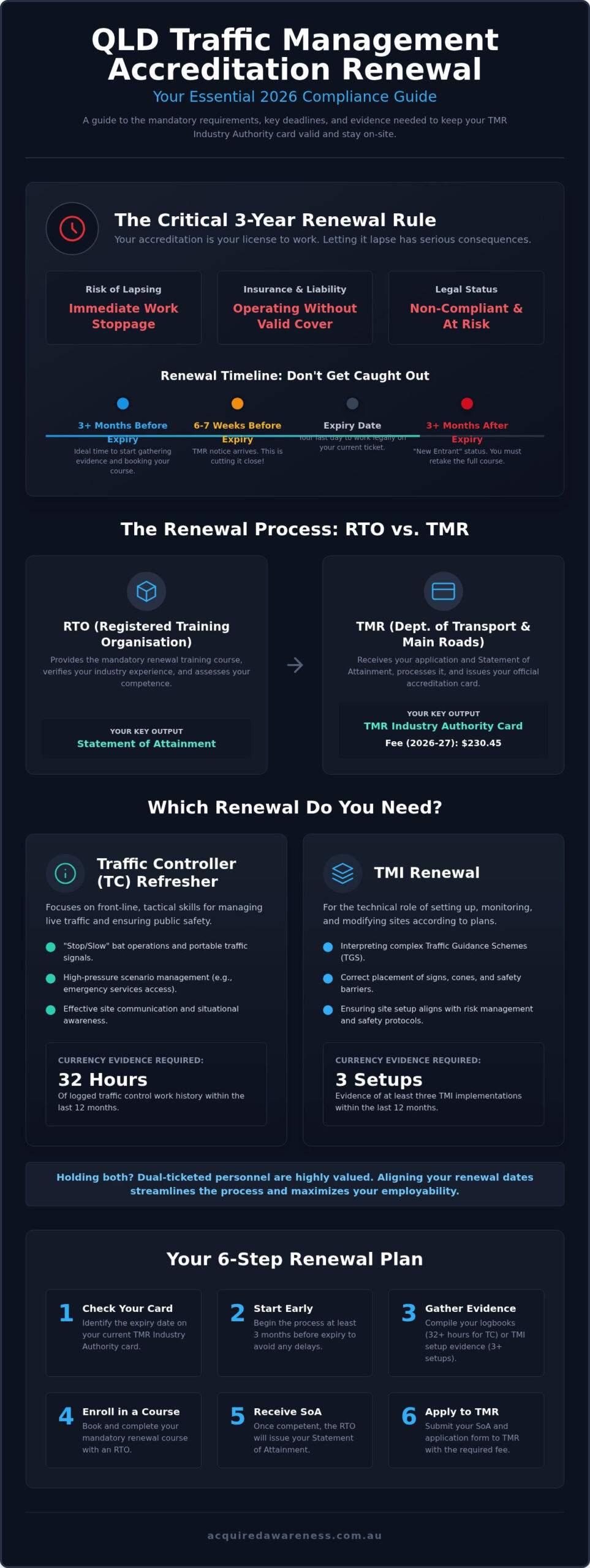
Don’t wait for the Department of Transport and Main Roads (TMR) to send a reminder. While they typically mail notices six to seven weeks before expiry, that’s often too late to organize training and gather your evidence. We recommend starting the process at least three months before your card expires. Check the date on your current Industry Authority card today. It’s the only way to avoid the “New Entrant” trap. If you let your accreditation lapse for more than three months past the expiry date, you’ll be forced to sit the full initial course again. This costs more time and more money.
TMR vs. RTO: Who Does What?
Confusion often arises regarding who actually renews your ticket. A Registered Training Organisation (RTO) like AATC is responsible for the educational component. We verify your industry currency and provide the necessary traffic management renewal course qld to issue a Statement of Attainment. This document is your proof of competence. However, the RTO does not issue the plastic Industry Authority card. Once you have your Statement of Attainment, you must submit an application to TMR and pay the required fee. For the 2026-27 period, this fee is $230.45. You cannot have the card without the training, and you cannot work with the training alone. Both steps are essential for a successful renewal.
Traffic Control vs. TMI: Which Renewal Do You Need?
Queensland road safety relies on two distinct yet interconnected professional streams. Choosing the right traffic management renewal course qld depends entirely on your current responsibilities and the specific authority you need to maintain. While many workers begin their careers in one area, the record infrastructure demand in 2026 has led to an increase in dual-ticketed personnel. Understanding the nuances of each renewal pathway is essential for staying compliant under the Traffic Controller Accreditation Scheme.
If you hold both accreditations, managing your renewal cycle requires a bit more foresight. You don’t always need to treat these as separate, isolated events. Aligning your training dates allows you to refresh your entire skill set in a more streamlined fashion. This dual-ticket approach is highly valued by employers who need flexible teams capable of both directing traffic and implementing complex site setups. It’s a proactive way to ensure you’re always ready for any role on the project.
The Traffic Controller (TC) Refresher
The TC refresher targets the tactical, front-line skills required for safe road user interaction. It isn’t just a basic review of “Stop-Slow” bat operations. Instead, it’s a verification of your ability to manage high-pressure scenarios, such as clearing a path for emergency services or de-escalating conflicts with frustrated motorists. We focus on site communication and situational awareness to ensure you remain a guardian of public safety. For a deeper look at how this fits into your long-term career, you can read our guide to traffic control courses in QLD.
The Traffic Management Implementation (TMI) Renewal
The TMI renewal has evolved into a sophisticated safety role that demands more than just mechanical cone placement. Modern implementation requires the technical ability to interpret complex Traffic Guidance Schemes (TGS) and ensure they align with the overarching Traffic Management Plan (TMP). A significant part of this process involves the RIIRIS301E unit, which focuses on applying risk management processes. This unit is mandatory for site supervisors because it empowers you to make real-time safety adjustments when site conditions change. Completing a traffic management renewal course qld that addresses these modern risks is the best way to protect your career and your crew.
As both a top-tier service provider and an educational authority, we see the real-world impact of these qualifications every day. If you’re ready to secure your ticket for the next three years, we can help you book your renewal training at one of our specialized facilities in Brendale or Yatala.
Proving Your Currency: Logbooks and Evidence Requirements
Proving your competence requires more than just a memory of your last shift. The Department of Transport and Main Roads (TMR) demands a verified record of your active participation in the industry. This “Evidence of Currency” is a non-negotiable part of the traffic management renewal course qld. It serves as a guarantee that you are still familiar with the evolving safety standards and operational protocols used on Queensland roads. Without this documentation, your RTO cannot certify that you are ready to return to a live site.
If you’re renewing a Traffic Controller accreditation, you must demonstrate at least 32 hours of work experience within the previous 12 months. For those in the TMI stream, the requirement is different. You must provide evidence of having implemented traffic guidance schemes on at least three separate occasions within that same 12-month window. If you cannot meet these minimums, you won’t qualify for a standard traffic management renewal course qld. In these cases, you may be required to complete the full new entrant course to ensure your skills are up to 2026 standards.
What Makes a Valid Logbook Entry?
A logbook is a legal document. Each entry must be precise, detailing the date, the exact work location, and the specific tasks you performed. A qualified supervisor must sign off on every entry to verify its accuracy. Vague descriptions or missing signatures are the most frequent causes for evidence rejection by TMR. Precision in your record-keeping reflects your professional attitude toward site safety. Currency of Industry Practice is the active application of skills within the last 12 months.
Third-Party Reports and Employer Verification
Your employer can provide significant support during the renewal process. Official letters on company letterhead or third-party reports can often satisfy currency requirements if a personal logbook isn’t available. For TMI personnel, site diaries and TGS records provide excellent supporting evidence of your field experience. These documents prove you’ve been actively managing risks and interpreting plans in real-world scenarios. If you find yourself unable to prove your currency due to a long break from the industry, you may need to review how to get your traffic controller licence in QLD. Restarting as a new entrant ensures you’re fully prepared for the responsibilities outlined in the Traffic Controller Accreditation Scheme.
Step-by-Step Guide to Renewing Your QLD Industry Authority
Renewing your accreditation is a sequence of mandatory compliance checkpoints. It requires meticulous preparation to ensure your transition from one accreditation period to the next is seamless. This focus on structured compliance and professional support is a hallmark of many specialized fields; for instance, Canavan Byrne provides similar essential services and software for the early childhood education sector in Ireland, showing how dedicated resources can simplify complex professional requirements. Following a structured path prevents the administrative delays that often lead to lost shifts. Our instructors emphasize a methodical approach to these five essential steps.
- Compile your evidence: Ensure your logbook or employer letters are signed and ready for verification.
- Select your training date: Book your traffic management renewal course qld with a provider that understands the local SEQ landscape.
- Demonstrate competence: Complete both the written theory and the practical assessments designed to test your 2026 safety knowledge.
- Secure documentation: Obtain your Statement of Attainment and your Certificate of Currency immediately following successful completion.
- Submit to TMR: Lodge your application through the official TMR channels to trigger the issuance of your new Industry Authority card.
Enrolling in the Right Course
Choosing a training provider is about more than proximity. You need an RTO that’s deeply embedded in the industry. Training with a provider like AATC (RTO #40905) ensures your certification carries the weight of 20 years of experience in Brisbane and South East Queensland. When you arrive at our Brendale or Yatala facilities, you’ll need to bring your current Industry Authority card, your gathered evidence, and your standard PPE, including high-visibility clothing and steel-capped boots. For those who also work in other trades and require specialized gear, you can visit White Wear for professional-grade painters workwear. This preparation allows us to focus entirely on the technical updates and safety protocols required for your 2026 renewal.
Once you’ve completed your training, the final step lies with the Department of Transport and Main Roads. The TMR online portal is the most efficient way to lodge your application, often resulting in a faster turnaround than in-person service centres. For the 2026-27 period, the fee for a 3-year traffic controller accreditation renewal is $230.45. It’s vital to remember that your Statement of Attainment isn’t a license to work on its own. You must complete the TMR application to be legally accredited. While waiting for your physical card to arrive in the mail, keep a digital or physical copy of your application receipt and your Statement of Attainment with you at all times on-site.
Ready to maintain your accreditation with South East Queensland’s safety leaders? You can view our upcoming course dates and secure your spot today.
Why AATC is South East Queensland’s Trusted Training Partner
AATC isn’t just a training provider. We are an operational leader in the field. This dual identity is what sets our traffic management renewal course qld apart from generic training centers. When you train with us, you’re learning from mentors who manage high-stakes environments every single day. We understand the specific challenges of the South East Queensland road network because our crews are out there on it. This real-world experience ensures that our training is grounded in current site realities, not just outdated textbooks.
Our instructors bring over 20 years of industry experience to the classroom. They’ve seen how site conditions can shift in an instant and how critical clear communication becomes in those moments. This expertise allows us to offer a streamlined renewal process that respects your time as a working professional. We focus on the high-level safety standards and technical updates that matter most for your 2026 accreditation. Our goal is to return you to the workforce with a heightened sense of situational awareness and professional pride.
Brendale and Yatala: Accessible Training for SEQ
Location matters for busy professionals. We’ve strategically placed our training facilities in Brendale and Yatala to serve the entire Brisbane, Gold Coast, and Sunshine Coast corridors. These aren’t just classrooms. They feature dedicated on-site practical training areas designed to mirror the actual roadwork conditions you face daily. This hands-on environment allows you to practice implementing traffic guidance schemes in a controlled, safe setting before returning to live traffic. It’s about building muscle memory and confidence under the guidance of seasoned experts.
We also recognize the demands of shift work. Our schedules are designed to be flexible, ensuring you can find a time that fits your roster without sacrificing income. Whether you’re based in the northern suburbs or the southern growth corridor, our facilities are accessible and equipped with the latest industry equipment. We maintain a steady, methodical pace in our training to ensure every student feels well-prepared and highly organized.
The Acquired Awareness Difference
Our organizational culture is built on a central “Safety First” mantra. This principle guides every decision we make, from the way we manage our operational sites to the way we instruct our students. We take full ownership of the environments we manage, projecting a steady, unflappable image that reassures our stakeholders. This lack of ego and total focus on the mission ensures that our training remains the gold standard in the industry.
Choosing AATC means supporting a regional partner with a deep commitment to the local community. We take pride in providing high-quality, local employment and fostering the next generation of safety leaders in SEQ. If you’re ready to secure your professional future, now is the time to act. Book your seat in our next renewal course and experience the AATC standard of excellence.
Secure Your Professional Future on Queensland Roads
Maintaining your accreditation is about more than just avoiding a lapsed ticket. It’s a commitment to the safety of your crew and the Queensland public. By understanding the three-year renewal cycle and meticulously documenting your industry currency, you protect your career in a high-demand sector. This proactive approach ensures you’re always ready to meet the rigorous standards of our state’s road networks with total composure. We take full ownership of the environments we manage, and we bring that same level of discipline to your training.
Enrolling in a traffic management renewal course qld with a trusted provider is the final step in this process. As an RTO (#40905) with over 20 years of SEQ industry leadership, we offer the expert mentorship you need to stay compliant. Our training facilities in Brendale and Yatala are equipped to help you master 2026 requirements while recognizing your existing field experience. Don’t let your authority expire during this period of record infrastructure growth.
Book Your Traffic Management Renewal Course with AATC Today
We look forward to seeing you at our next session. Stay safe, stay accredited, and continue leading the way in operational excellence on our roads.
Frequently Asked Questions
How long does a QLD traffic management renewal course take?
Most renewal courses are completed within a single day, typically taking between four and eight hours. The exact duration depends on whether you’re refreshing your Traffic Control or Traffic Management Implementation accreditation. These sessions focus on technical updates and safety protocols rather than basic operations. Our streamlined process ensures that experienced professionals can verify their skills and return to work without unnecessary downtime on the road.
Can I renew my traffic control ticket if it has already expired?
You can renew your accreditation up to three months after the expiration date listed on your Industry Authority card. If you fall within this period, you remain eligible for a renewal pathway. However, if your ticket’s been expired for more than three months, TMR policy requires you to complete the full new entrant course again. It’s vital to track your dates to avoid the additional time and cost of starting over.
Do I need a logbook to renew my TMI accreditation?
Yes, providing evidence of currency is a mandatory requirement for all TMI renewals. You must demonstrate that you’ve implemented traffic guidance schemes on at least three separate occasions within the last 12 months. This evidence can take the form of a personal logbook, employer letters, or verified site records. Without this documentation, we cannot certify your industry practice, which is essential for a successful traffic management renewal course qld.
Is the QLD renewal course valid for work in other Australian states?
Accreditation issued in Queensland is specific to the Department of Transport and Main Roads (TMR) standards. While other states may recognize your training through mutual recognition, you’ll generally need to apply for a local equivalent card if you’re working permanently outside QLD. Always check the specific regulatory requirements of the local road authority in the state where you intend to work to ensure your insurance and accreditation remain valid.
What happens if I lose my Industry Authority card before it expires?
If your card is lost, stolen, or damaged, you must apply for a replacement directly through TMR. This process doesn’t require you to sit another training course if your current accreditation is still valid. You’ll need to complete the appropriate application form and pay a replacement fee. It’s a good practice to keep a digital scan of your card on your phone to provide proof of accreditation if challenged on-site.
How much does it cost to renew my traffic controller accreditation in 2026?
For the 2026-27 financial year, the mandatory fee payable to TMR for a three-year traffic controller accreditation renewal is $230.45. This fee is separate from the cost of your training course. You should also account for the cost of mandatory online awareness modules if you’re renewing a TMI ticket. Always verify the most current figures on the official TMR website before submitting your application to avoid processing delays.
Can I do my traffic management renewal course online?
While TMR requires certain online awareness modules for TMI renewals, the core traffic management renewal course qld typically involves an in-person assessment. This ensures your practical skills and situational awareness meet current safety standards. Some theory components may be delivered through digital platforms, but a face-to-face component is often necessary to verify your competency. This balanced approach maintains the high safety standards required for high-stakes environments in South East Queensland.
What unit of competency is required for TMI renewal in QLD?
The primary unit of competency required for TMI renewal is RIIRIS301E, which focuses on applying risk management processes. You must also demonstrate competence in RIIWHS302E for implementing traffic management plans. These units ensure that site supervisors possess the technical depth to manage complex roadwork scenarios safely. Staying current with these specific units is essential for maintaining your professional standing and ensuring total control over the operational environments you manage.