
Blog
Recent Articles
How to Get a Traffic Control Licence in QLD: 2026 Guide
October 19, 2026

Completing a traffic control course is one step towards working on Queensland roads. If you’re searching for how to get a traffic control license qld, the key distinction is that training and Queensland accreditation are separate stages. You’ll need to complete the relevant training, then apply to the Department of Transport and Main Roads (TMR) for Traffic Controller Accreditation.
A clear checklist can help you prepare before enrolling. The pathway includes checking requirements, completing training and assessments, meeting any practical experience requirements for new entrants, and submitting an application with the supporting evidence TMR requests. Completing a course alone doesn’t mean you’re accredited to work as a traffic controller.
This guide sets out the general sequence, what to check against current TMR guidance and how new entrant requirements differ from renewal. It also covers local training in Brisbane and across South East Queensland through Acquired Awareness Traffic Management (AATC), a Registered Training Organisation (RTO 40905). AATC offers a Traffic Control Course – New Entrant and a Traffic Control Course – Renewal to support the training stage.
Key Takeaways
- Learn how to get a traffic control license qld by separating course completion from applying for Queensland Traffic Controller Accreditation.
- Organise your training prerequisites, course assessments and application evidence, then use current TMR guidance to confirm what applies.
- Compare courses by scope, assessment, practical learning and alignment with current requirements. New entrant and renewal courses serve different needs.
- Follow a clear sequence: verify requirements, complete suitable training, prepare evidence, submit your application and follow the outcome.
- In Brisbane and across South East Queensland, Acquired Awareness Training Centre Pty Ltd, RTO 40905, offers Traffic Control Course – New Entrant and Traffic Control Course – Renewal.
What does a traffic control licence mean in Queensland?
“Traffic control licence” is common shorthand, but Queensland’s official term is Traffic Controller Accreditation. The Queensland Department of Transport and Main Roads (TMR) grants this accreditation through the Traffic Controller Accreditation Scheme (TCAS). It is a government accreditation, not a card or certificate issued simply for attending a training course.
The distinction matters if you’re preparing for traffic controller work on Queensland roads. Training and accreditation are separate milestones: a course provides learning and assessment, while TMR considers your accreditation application. Completing training alone does not mean you have approval to work as an accredited traffic controller. The pathway to how to get a traffic control license qld includes both stages.
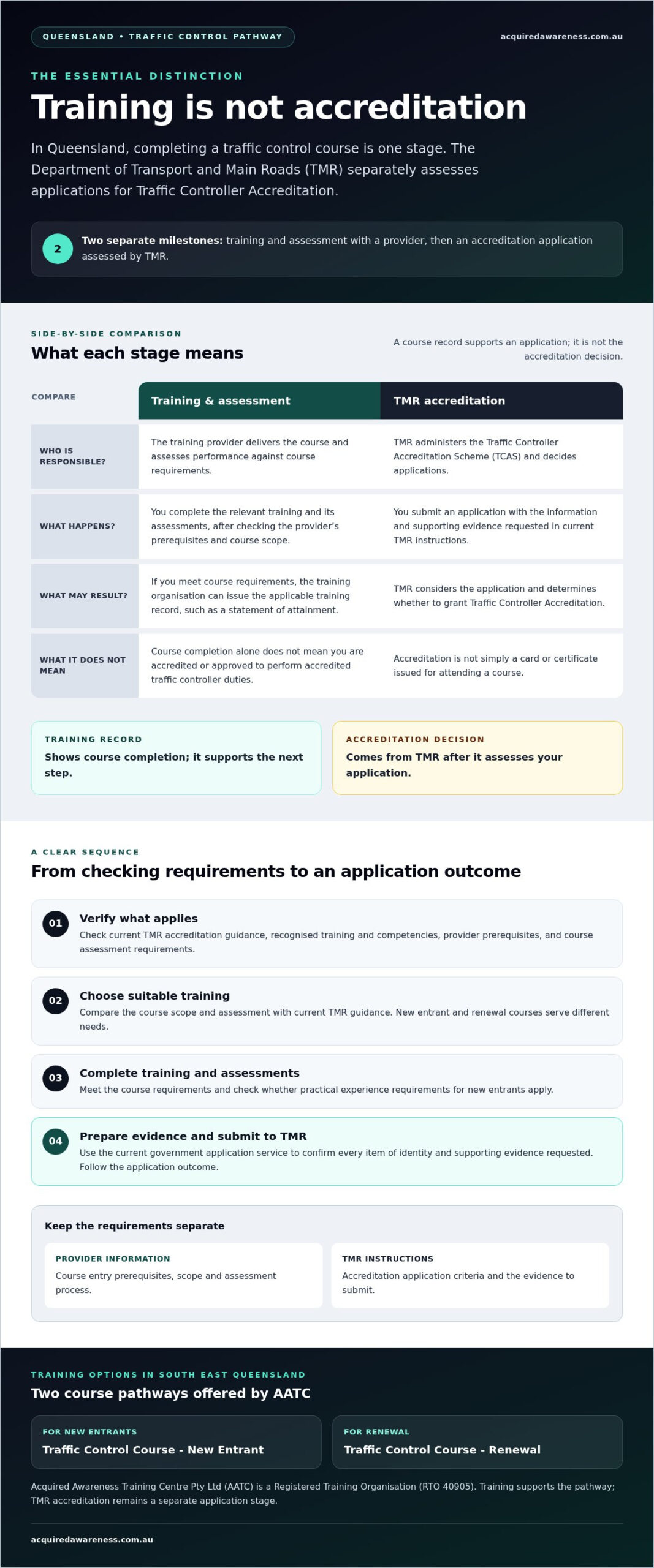
In Queensland, TMR grants traffic controller accreditation after assessing an application. A training record shows course completion, but does not grant accreditation.
A traffic controller helps direct vehicles and other road users through or around work areas. For a general overview of the role, see Traffic controller. Anyone planning to control traffic at Queensland worksites or events needs to understand the state accreditation pathway and follow its current requirements. Road users and work crews depend on clear, consistent control.
Is a traffic control course the same as a Queensland licence?
No. A relevant course provides training and assessment against the course requirements. If you meet those requirements, the training organisation can issue the applicable training record, such as a statement of attainment. That record supports the next step, but it is not TMR’s accreditation decision.
The training provider delivers the course and assesses your performance against its requirements. TMR administers the accreditation scheme and decides applications. Keep the roles distinct as you plan: confirm current training requirements, complete the appropriate course, then follow TMR’s application instructions. A course certificate or statement of attainment is not permission to undertake accredited traffic controller duties.
Who needs traffic controller accreditation in Queensland?
This pathway is relevant if you’re seeking work as a traffic controller on Queensland roads, including at worksites or events where traffic control is required. Check TMR’s current guidance for the circumstances that apply to your intended duties. Don’t assume another qualification, job title or previous experience automatically replaces the accreditation process.
Traffic Controller Accreditation is also different from traffic management implementation training. Accreditation relates to an individual’s authority to work as a traffic controller under the Queensland scheme. Implementation training prepares learners for a separate traffic management function. Choose training based on the work you intend to perform, and use current TMR guidance to confirm the requirements.
QLD Traffic Controller Accreditation Requirements
Before booking training or preparing an application, separate three things: training prerequisites, course assessments and the evidence TMR requires. They serve different purposes. A training provider sets course entry and assessment requirements, while the Queensland Government sets the requirements for a Traffic Controller Accreditation application. Check both, using current TMR accreditation guidance and the government application service to confirm what applies to your situation.
Before submitting, verify current training prerequisites, course competencies and assessments, and every item of identity or supporting evidence TMR requires. This helps avoid a common mix-up: assuming a provider’s enrolment conditions are also government eligibility rules, or that finishing a course completes the accreditation application.
Which training and competency requirements should you check?
Start with TMR’s current Traffic Controller Accreditation Scheme guidance. Confirm which training course and competencies it recognises for your application, then compare that information with the course’s published scope and assessment requirements. Requirements can change, so don’t rely on an old certificate description or a general course summary alone.
Next, review the training provider’s prerequisites and assessment process. These explain what you need before enrolment and what you must demonstrate to complete the course. They are not automatically the same as TMR’s application criteria. Acquired Awareness Training Centre Pty Ltd (AATC), RTO 40905, offers a Traffic Control Course – New Entrant and a Traffic Control Course – Renewal. Choose the pathway that fits your circumstances, then compare its current course information with the requirements TMR publishes.
What information should you prepare for the application?
Use the current government application service to identify the information and evidence it requests. Check the instructions directly before submitting, rather than relying on an informal checklist or documents prepared for a different application. Keep the sources distinct: the provider’s information covers course entry and assessment, while TMR’s instructions cover accreditation.
Organise your preparation under three headings:
- Training prerequisites: confirm the provider’s current entry conditions before enrolling.
- Course completion: understand the competencies and assessments you must complete, and what training record is issued.
- Application evidence: follow current TMR instructions for identity, competency and any other required information or supporting material.
Check that your details are accurate and each item matches the application instructions. Missing, inconsistent or unsuitable information can delay progress or affect how the application proceeds. Don’t assume a course record alone covers every evidence requirement.
Getting the sequence right is a practical first step in understanding how to get a traffic control license qld. For Brisbane and South East Queensland learners, AATC’s traffic control training includes new entrant and renewal courses. After training, use TMR’s current guidance to prepare the separate accreditation application.
How should you compare Queensland traffic control training options?
Compare courses by more than their title or advertised duration. Review the scope, how competency is assessed, what practical learning is included and how the provider describes alignment with current Queensland requirements. Delivery details and course duration can vary between providers. Don’t treat a feature offered by one provider, such as a particular placement arrangement, as a statewide requirement unless TMR says it applies.
The right pathway depends on whether you’re entering traffic control or renewing existing accreditation. Use the comparison below to identify what to review, then confirm current accreditation and renewal requirements through TMR.
| Comparison point | Traffic Control Course – New Entrant | Traffic Control Course – Renewal |
|---|---|---|
| Course scope | A listed starting pathway for learners new to the role. Compare the current course outline with the competencies TMR requires. | A pathway for learners whose existing accreditation requires renewal. Confirm that renewal applies to your circumstances. |
| Assessment | Review the provider’s assessment requirements and the training record issued on successful completion. | Check the course’s current assessment requirements and how they relate to renewal. |
| Practical learning | Compare the practical learning and assessment included in the course. Don’t assume another provider’s placement model is universal. | Review the practical learning specified for this course rather than assuming it matches a new entrant program. |
| Alignment | Check the provider’s RTO status and whether its published course information reflects current industry and Queensland accreditation requirements. | Check the same details, and verify current renewal rules separately with TMR. |
New entrant or renewal course: which pathway fits?
If you’re new to traffic control, the Traffic Control Course – New Entrant is the listed starting pathway. The Traffic Control Course – Renewal is for people whose existing accreditation requires renewal, not simply anyone who has attended training before. Your accreditation history and current TMR rules matter. Confirm which pathway applies before enrolling, especially if your circumstances have changed since your last accreditation.
How can you judge whether training aligns with QLD requirements?
Check that the provider is a Registered Training Organisation and review the course’s current scope, assessment information and stated alignment with industry and legislative accreditation requirements. Acquired Awareness Training Centre Pty Ltd (AATC) is RTO 40905 and offers both courses in South East Queensland, including Brisbane. Course completion supports your preparation, but it doesn’t guarantee employment or replace TMR’s separate accreditation decision.
To review local training pathways, explore AATC traffic control training. Keep course selection and the government accreditation process distinct as you plan how to get a traffic control license qld.
How to Apply for QLD Traffic Controller Accreditation
Follow a clear sequence: confirm current rules, complete the relevant training, prepare the requested evidence, submit through the correct channel, then follow the government’s instructions while your application is assessed. TMR makes the accreditation decision. A training record is one part of the pathway, not a substitute for applying.
The pathway runs from checking current requirements to completing suitable training, lodging a supported application and following it through to a TMR decision. Requirements and service instructions can change, so use official information at the time you apply rather than relying on an old checklist.
- Verify current requirements. Read TMR’s Traffic Controller Accreditation Scheme guidance and check the eligibility, training and evidence requirements for your application type. If you’re renewing, confirm the current renewal rules before choosing a course.
- Complete suitable training. Select the course pathway that matches your circumstances and complete its required assessments. Keep your training record and any course information the application service asks you to provide.
- Prepare the requested evidence. Review the application instructions carefully. Organise identity and competency information, along with any other evidence specifically requested. Check that names and details are consistent across your documents.
- Submit through the correct channel. Follow the current directions in the Queensland Government application service. The service explains whether an application can be completed online or must be lodged another way.
- Monitor the outcome. Keep a record of your submission and follow the service’s instructions for checking progress. Respond to requests for more information using the method and timeframe specified by the government.
How do you use the Queensland Government application service?
Before starting, read the service notices and restrictions. They explain whether the online process is available for your application type and what to do if it isn’t. Current guidance states that a new application may be lodged online if TMR already holds your photo ID; otherwise, apply in person at a TMR customer service centre. Renewal applications must be lodged in person. Follow the current on-screen instructions, including any identity checks or supporting information requirements. A saved form or previous application may not reflect today’s process.
What happens after you submit an application?
Submission begins the government assessment; it doesn’t guarantee approval. Use the application service’s current instructions to check progress and look for requests or notices. If TMR asks for further information, provide it as directed. Processing time and outcomes depend on the assessment, so don’t plan around an assumed decision date or treat an application receipt as accreditation.
If you’re preparing for the training stage in South East Queensland, explore AATC’s traffic control courses. Acquired Awareness Training Centre Pty Ltd, RTO 40905, offers new entrant and renewal pathways. Training prepares you for the next step, while TMR remains responsible for the accreditation decision. Keeping those stages clear is central to understanding how to get a traffic control license qld.
Where can you complete traffic control training in South East Queensland?
For learners in South East Queensland, Acquired Awareness Training Centre Pty Ltd (AATC) provides a local pathway into traffic control training. AATC is a Registered Training Organisation (RTO) with number 40905. Its training locations include Brendale in northern Brisbane, Yatala and Bells Creek, giving learners options across the region. Review the current course information for the location and details that apply to the course you’re considering.
Training is one stage of the wider Queensland pathway. Completing a course does not itself grant Traffic Controller Accreditation; that decision rests with the Queensland Department of Transport and Main Roads. AATC’s courses align with current industry and legislative accreditation requirements, helping learners prepare for the training stage before following the separate government application process.
What training does Acquired Awareness Training Centre provide?
AATC offers two traffic control courses for different learner circumstances. The Traffic Control Course – New Entrant is the starting pathway for learners new to the role. The Traffic Control Course – Renewal is intended for people whose existing accreditation requires renewal. The courses are not interchangeable, so consider your experience and accreditation status when choosing a pathway.
Course scope, assessment and delivery details can differ between pathways. Read the current course information to understand what each course covers and how assessment works. If you’re unsure which course fits your situation, review TMR’s current accreditation and renewal guidance before enrolling. This keeps provider course requirements distinct from the government’s accreditation requirements.
What is the next step after choosing a course?
Review the latest course details and enrolment instructions before making plans. Check the listed training location, course-specific requirements and any information needed for enrolment. Use the current listing rather than relying on an older notice or a general description.
For course enquiries, contact AATC on (07) 3881 3008. Course enrolment and the TMR application are separate steps. After training, follow current government instructions to prepare and submit your accreditation application. Neither course completion nor enrolment confirms that TMR has granted accreditation.
If you’re working out how to get a traffic control license qld, first identify whether you need the new entrant or renewal pathway, then review its current course information. View AATC traffic control training information for the listed courses and enrolment details. Choose the training that matches your circumstances and use current TMR guidance for the separate accreditation process.
Take your next step with a clear plan
Working towards traffic control accreditation is a practical commitment to safety, communication and readiness for work around live traffic. Take time to understand the pathway, select training that fits your circumstances and prepare for the separate government application. An organised start can help you approach each stage with confidence.
Acquired Awareness Training Centre is licensed by the Queensland Department of Transport and Main Roads and provides traffic control training in South East Queensland, including Brisbane. Review its current course information to identify the training pathway that fits your next step. For how to get a traffic control license qld, keep the distinction clear: training supports your preparation, while TMR determines accreditation.
Explore traffic control training with Acquired Awareness Training Centre and review the new entrant and renewal course information.
Frequently Asked Questions
How do I get a traffic control licence in QLD?
To understand how to get a traffic control license qld, first identify whether you’re a new entrant or need to renew existing accreditation. Check current Queensland Department of Transport and Main Roads (TMR) requirements, complete the relevant training and assessments, then prepare and submit the required application. For Brisbane-based applicants, organise training and application evidence as separate steps. The training record supports your application, but only TMR can decide whether to grant Traffic Controller Accreditation.
Is a traffic control course enough to work as a traffic controller in Queensland?
No. Completing a course doesn’t, by itself, grant Queensland Traffic Controller Accreditation. The course assesses your training against its requirements and provides a training record if you successfully complete it. TMR makes the separate accreditation decision. For example, finishing the course without lodging an application leaves the government step outstanding. Check the latest scheme guidance before accepting work that requires accreditation.
What training do I need to become a traffic controller in QLD?
New entrants generally need to complete a current TMR-approved traffic control course through a Registered Training Organisation. The training pathway includes the competency unit RIIWHS205E, “Control traffic with stop-slow bat”; verify current unit and assessment requirements with TMR and the provider before enrolment. Practical experience requirements may also apply to new entrants. A White Card is relevant for working on construction sites, so check the requirements for your intended work.
How do I apply for traffic controller accreditation in Queensland?
After confirming current requirements and completing suitable training, follow TMR’s application instructions and prepare the information and evidence requested for your application type. New applicants can use the government’s Traffic Controller Accreditation Application service where eligible, or follow TMR’s in-person instructions. Review all entries before submitting and keep a record of your lodgement. If the government requests further information, respond using its stated process.
Can I apply for Queensland traffic controller accreditation online?
Some new applicants can apply online if TMR already has their photo ID on file. If it doesn’t, follow current TMR instructions for lodging an application in person at a customer service centre. Renewals must be lodged in person, rather than online. Before starting, read the application service’s notices and restrictions to confirm whether your application type can use the online process.
How long does it take to get traffic controller accreditation in QLD?
Allow time for the application assessment, training and preparation of your evidence. TMR’s processing may take up to six weeks, including checks of criminal and traffic history, but this isn’t a guaranteed decision timeframe. An incomplete application or a request for further information may affect progress. Check current government service instructions and avoid planning around an assumed approval date.
How do I know whether I need a new entrant or renewal traffic control course?
Choose a new entrant course if you’re starting in traffic control and haven’t previously held the relevant accreditation. A renewal course is for people whose existing accreditation is due for renewal under current TMR rules. If your accreditation has expired or your circumstances have changed, don’t assume which pathway applies. Check your status and the latest renewal guidance, then match the course to the requirements for your application.