Blog
Recent Articles
Civil Construction Traffic Control Brisbane: The 2026 Safety & Compliance Guide
August 2, 2026
Civil construction traffic control in Brisbane is no longer a line item you sort out the week before works begin. In 2026, with infrastructure investment reshaping corridors from the inner city to the outer suburbs, it’s a precision requirement that determines whether your project runs on schedule or grinds to a costly halt. Getting it wrong doesn’t just mean fines. It means delays, liability exposure, and real danger to workers and the public.
If you’ve faced the frustration of navigating Brisbane City Council and Transport and Main Roads permit approvals, scrambling to source adequately trained traffic controllers, or lying awake wondering about your liability exposure on a high-speed corridor, you’re not alone. These are the pressures that civil project managers across South East Queensland deal with every day.
This guide cuts through the complexity. You’ll walk away with a clear understanding of compliance requirements, what professional traffic management planning actually involves, and how to structure your approach for zero incidents and predictable project timelines. From permit acquisition to on-site execution, here’s what you need to know to get it right in 2026.
Key Takeaways
- Civil construction traffic control in Brisbane demands site-specific planning — not template solutions — as Brisbane City Council and Transport and Main Roads have distinct permit requirements that can stall your project if mishandled.
- Understanding the difference between a Traffic Management Plan (TMP) and a Traffic Guidance Scheme (TGS) is fundamental to compliance; this guide breaks down exactly what each requires and when you need them.
- Cutting costs on civil construction traffic control in Brisbane is a false economy — discover the real financial and legal exposure that comes from under-resourced traffic management on active corridors.
- Operational logistics matter as much as paperwork; learn the step-by-step implementation process that keeps heavy machinery moving and project timelines intact.
- Working with an RTO-accredited traffic management provider means every controller on your site is trained to the same standard set by industry educators — a distinction that directly reduces your liability exposure.
The 2026 Brisbane Infrastructure Landscape and Traffic Management
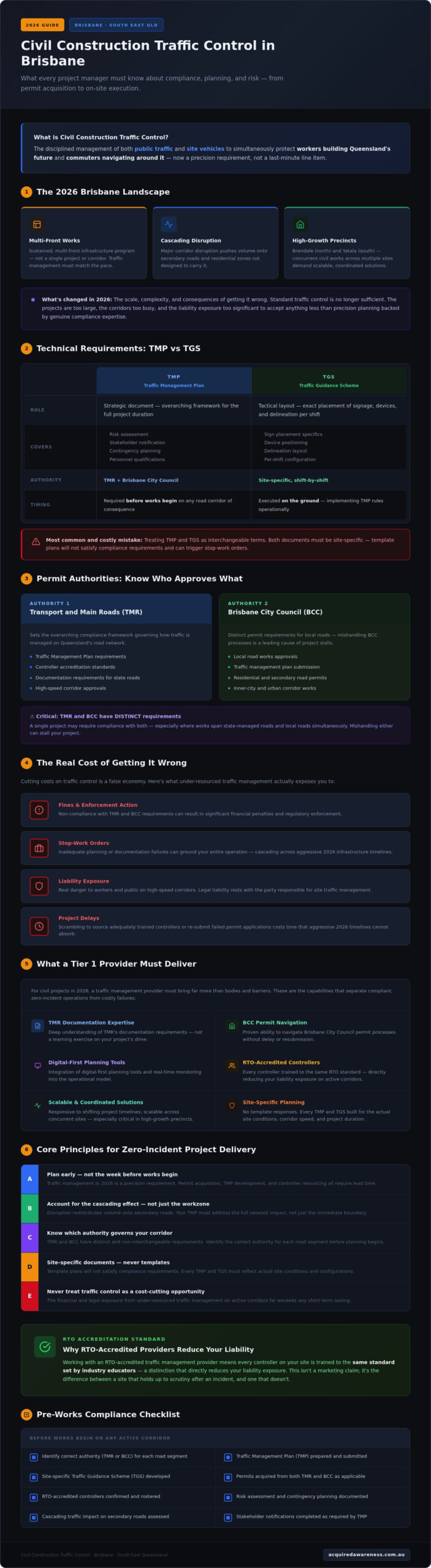
Civil construction traffic control, at its core, is the disciplined management of both public and site traffic to protect two groups simultaneously: the workers building Queensland’s future, and the commuters navigating around it. That definition hasn’t changed. What has changed is the scale, the complexity, and the consequences of getting it wrong.
Brisbane in 2026 is a city mid-transformation. The infrastructure investment reshaping South East Queensland isn’t a single project or a single corridor. It’s a sustained, multi-front program of works that demands traffic management solutions built for real conditions, not template responses.
As the scale of these developments grows, you can discover McMahons Civil and Contracting PTY LTD to see how specialized civil and rail infrastructure services support the delivery of high-stakes Queensland projects.
Major 2026 Projects Impacting Brisbane Traffic
Continued rail and road upgrade programs across the greater Brisbane network have fundamentally increased urban traffic density on key arterials. When a major corridor is disrupted, the pressure doesn’t disappear. It redistributes, pushing volume onto secondary roads and into residential zones that weren’t designed to carry it. Civil construction traffic control in Brisbane must account for this cascading effect, not just the immediate workzone boundary.
High-growth industrial precincts are where this pressure becomes most acute. Areas like Brendale in the north and Yatala in the south are experiencing sustained development activity, with civil works running concurrently across multiple sites. Traffic management in these zones can’t be static, and neither can site communications; DJC Engineering Pty Ltd provides the accredited networking, WiFi, and Starlink installations needed to keep these projects connected and responsive to shifting project timelines that don’t wait for paperwork to catch up.
The practical implication for project managers is straightforward: 2026 infrastructure timelines are aggressive, and the traffic management schedules that support them must match that pace. A solution designed for a quieter corridor or a less congested era simply won’t hold.
Evolving Compliance Standards in QLD
The Department of Transport and Main Roads sets the compliance framework that governs how traffic is managed on Queensland’s road network. Requirements around Traffic Management Plans, Traffic Guidance Schemes, and controller accreditation aren’t static. They reflect the growing complexity of the environments in which civil works now take place.
This is precisely why traffic management services South East Queensland providers are increasingly expected to bring more than bodies and barriers to a site. Tier 1 civil projects require providers who understand TMR’s documentation requirements, who can navigate Brisbane City Council permit processes without delay, and who are integrating digital-first planning tools and real-time monitoring into their operational model.
Standard traffic control is no longer sufficient. The projects are too large, the corridors too busy, and the liability exposure too significant to accept anything less than precision planning backed by genuine compliance expertise.
Technical Requirements: TMPs, TGSs, and Permit Acquisition
There’s a distinction that separates compliant civil construction traffic control in Brisbane from the kind that attracts stop-work orders: the difference between a Traffic Management Plan and a Traffic Guidance Scheme. They’re not interchangeable terms, and treating them as such is one of the most common and costly mistakes on Queensland civil sites.
A Traffic Management Plan (TMP) is the strategic document. It establishes the overarching framework for how traffic, pedestrians, and site vehicles will be managed across the full duration of a project. It addresses risk assessment, stakeholder notification requirements, contingency planning, and the qualifications of personnel responsible for implementation. TMR and Brisbane City Council both require this document before works begin on any road corridor of consequence.
A Traffic Guidance Scheme (TGS) is the tactical layout that specifies the exact placement of signage, devices, and delineation for a particular worksite configuration. Where the TMP sets the rules, the TGS executes them on the ground, shift by shift.
Both documents must be site-specific. Template plans pulled from a previous project introduce risk the moment site conditions diverge from the original context, and they will diverge. Road geometry, pedestrian volumes, adjacent land uses, and traffic density all vary. A TMP or TGS that doesn’t reflect those variables isn’t just inadequate; it’s a liability instrument waiting to be activated.
Designing for High-Risk Civil Sites
High-speed road closures and complex detour routes demand a level of design precision that goes well beyond placing cones and signs. Lane transitions on arterials with speed limits above 70 km/h require specific taper lengths, advance warning distances, and device spacing that must be calculated against actual traffic volumes and sight lines, not assumed from a standard template.
Pedestrian movement plans are equally non-negotiable on urban civil sites. When footpaths are disrupted, the TGS must account for compliant alternative routes, accessible crossing points, and clear wayfinding that protects both pedestrians and workers operating heavy machinery nearby. Overlooking this element is a common gap that creates both safety exposure and compliance breaches.
Streamlining the Permit Process
Brisbane City Council and TMR operate distinct permit pathways, and conflating them causes avoidable delays. Council applications govern local roads and require specific documentation sets, including traffic impact assessments for higher-volume corridors. TMR’s process governs state-controlled roads and introduces the Road Occupancy Licence (ROL), a mandatory approval for any works that occupy a declared road network, particularly on major infrastructure projects.
Common pitfalls include submitting incomplete TGS documentation, failing to account for minimum notice periods, and underestimating the review timelines during peak infrastructure delivery periods. A pre-approved traffic management design developed by practitioners with direct Council and TMR experience cuts through this friction, compressing the approval timeline and reducing the risk of project commencement delays.
If you want to understand how professional design translates directly into faster project starts and reduced stop-work exposure, it’s worth reviewing what a qualified traffic management provider brings to the documentation phase before you commit to a procurement approach.
Risk Mitigation: Why Quality Traffic Control Prevents Site Delays
Every project manager knows the feeling: a stop-work order lands, a controller is out of position, and suddenly a $400-per-hour excavator sits idle while the problem gets sorted. That’s the real cost of under-resourced civil construction traffic control in Brisbane. Not just the fine. The cascade of delays, the rescheduled subcontractors, the contractual exposure, and the reputation damage that follows a preventable incident on an active corridor.
Cheap traffic control isn’t a saving. It’s a deferred liability. The providers who compete purely on price are typically the ones delivering template solutions, undertrained controllers, and reactive problem-solving on sites that demand the opposite. When something goes wrong, the project manager wears it.
The financial logic is straightforward: a well-resourced traffic management deployment costs a known, budgeted amount. An incident, a regulator intervention, or a public liability claim costs an unknown amount that is almost always larger.
The ‘Safety-First’ Operational Mantra
Professional traffic control changes how drivers behave. Clear, consistent signage, confident controller positioning, and logical traffic flow communicate authority to road users before they reach the workzone. Drivers slow down, merge correctly, and move through without hesitation. That’s not an accident. It’s the result of disciplined site leadership that treats every shift as a high-stakes environment, because it is.
The alternative, which some in the industry call the “solar cowboy” mentality, is traffic management treated as a box-ticking exercise. A controller on a phone, signs placed approximately right, a TGS that hasn’t been reviewed since the site conditions changed two weeks ago. It creates uncertainty for drivers, and uncertainty on a 70 km/h arterial is dangerous. Seasoned site leadership eliminates that uncertainty before it becomes an incident.
Proactive traffic management also keeps heavy machinery moving. When traffic flow is fluid and predictable, delivery vehicles hit their windows, plant operators work without interruption, and project timelines hold. Safety isn’t separate from productivity on a civil site. It’s the foundation of it.
Safety is the foundation of productivity on any civil site; for those requiring specialized hazardous material handling such as asbestos removal, click here to learn more about professional standards.
To maintain this productivity, project managers must look at the entire equipment lifecycle; for those importing heavy plant or specialized materials, MTF Logistics offers the freight forwarding and customs expertise needed to navigate complex transport requirements before the machinery reaches the local Brisbane network.
In addition to logistics, large-scale industrial and mining projects depend on robust electrical infrastructure; you can learn more about Banner Power for specialized electrical services that support the commercial and industrial sectors.
Equipment Reliability and Site Security
The physical tools deployed on a workzone carry their own compliance obligations. Variable Message Signs (VMS boards), Truck-Mounted Attenuators (TMAs), and delineation devices must meet current Manual of Uniform Traffic Control Devices (MUTCD) standards as adopted in Queensland. Equipment that doesn’t meet those standards doesn’t just create compliance risk; it undermines the entire safety architecture the TGS was designed to deliver.
Sourcing high-specification traffic control equipment hire from a provider who maintains their fleet to current standards removes a significant variable from your site risk profile. Beyond operational hours, site security matters. Civil sites with unprotected plant, materials, and signage infrastructure are targets. Integrating site security protocols into the broader traffic management framework protects your assets during non-operational hours and ensures the site is correctly configured when the next shift begins.
Operational Logistics: Implementing Traffic Control in Brisbane
Knowing what compliance requires is one thing. Executing it across a live civil site, on schedule, with the right people and equipment in place, is where projects are won or lost. Civil construction traffic control in Brisbane follows a clear operational sequence, and understanding each step removes the uncertainty that causes delays.
The five-step implementation process works as follows:
- Step 1: Initial site consultation and risk assessment. Before any documentation is drafted, a qualified practitioner assesses the specific site conditions: road geometry, speed environment, pedestrian exposure, adjacent land uses, and proximity to intersections or driveways. This assessment drives every decision that follows.
- Step 2: Drafting and approval of TMPs and TGSs. Site-specific documents are developed against current TMR standards and Brisbane City Council requirements. Every taper length, sign placement, and device specification is calculated for the actual site, not adapted from a previous project.
- Step 3: Permit acquisition from relevant authorities. Applications are submitted to the correct authority, Council or TMR, with complete documentation. Minimum notice periods are tracked and submissions are timed to avoid approval bottlenecks during peak delivery periods.
- Step 4: Mobilisation of accredited personnel and compliant equipment. Controllers, supervisors, and equipment are deployed according to the approved TGS. Every element is confirmed against the plan before the first vehicle enters the workzone.
- Step 5: Ongoing monitoring and adjustment. Site conditions change. Traffic volumes shift, works progress, and weather intervenes. Active monitoring ensures the TGS reflects real conditions throughout the project’s duration, not just at commencement.
Selecting the Right Personnel
There’s a meaningful difference between a traffic controller and a Traffic Management Implementer (TMI). A standard controller manages traffic flow at a specific point. A TMI-qualified professional holds the authority to set up, supervise, and modify a TGS on site, a distinction that matters enormously on complex civil projects where conditions evolve between shifts.
Civil construction environments demand controllers who’ve completed traffic control courses with a specific focus on implementation in high-risk settings, not just the foundational bat-holder qualification. Beyond traffic-specific credentials, every person working on a civil site must hold a valid QLD White Card. It’s a baseline requirement, and gaps in this area create immediate compliance exposure.
Managing Community and Stakeholder Impact
Civil construction traffic control in Brisbane doesn’t operate in isolation. Residents, local businesses, emergency services, and public transport operators all have a stake in how works are managed, and professional traffic management accounts for each of them.
Advance community notification for significant disruptions, clear signage directing customers to affected businesses, and coordinated access windows for emergency vehicles are operational standards, not optional courtesies. Night works introduce additional obligations: light spill management, noise minimisation protocols, and clear communication with residents about expected duration and access impacts. Getting this right protects the project’s social licence as much as it protects its timeline.
If you’re ready to move from planning to implementation, speak with a qualified provider about what a structured deployment looks like for your specific site. Contact Acquired Awareness to discuss your project requirements.
The Acquired Awareness Advantage: RTO Standards on Every Site
Most traffic management providers can put controllers on a site. Fewer can guarantee those controllers were trained by the same experts who design the compliance frameworks they’re expected to follow. That distinction is what separates Acquired Awareness Traffic Management (AATM) from the field.
As a Registered Training Organisation (RTO #40905), AATM doesn’t source its workforce from the broader labour market and hope the training stacks up. The people deployed on your site are trained by the same practitioners who understand Queensland’s regulatory environment from the inside. When a controller sets up a TGS on a live corridor, they’re applying knowledge built by instructors who’ve operated in exactly that environment. That’s not a marketing claim. It’s a structural advantage that directly reduces your exposure on every civil construction traffic control Brisbane project we support.
The industry calls it the “seasoned mentor” approach. In practice, it means continuous professional development isn’t a box-ticking exercise at AATM. It’s embedded in how the organisation operates. As TMR updates its standards and Brisbane City Council refines its permit requirements, that knowledge flows directly into training delivery and onto the sites where it matters. Your workforce isn’t working from last year’s playbook.
Beyond Labour Hire: A Strategic Partnership
Tier 1 civil contractors don’t need another subcontractor managing headcount. They need a partner who brings technical depth to complex infrastructure environments. AATM’s dual identity as both a service provider and an RTO means the organisation bridges the gap between classroom theory and on-site reality in a way that pure labour hire firms structurally cannot. Local knowledge of Brisbane’s road network, built through years of operational delivery across South East Queensland, informs every TMP and TGS produced. That regional grounding isn’t incidental. It’s what allows AATM to anticipate the conditions that catch template-based providers off guard.
Ready for 2026: Scaling with Your Project
Project scope changes. Timelines compress. Civil construction traffic control in Brisbane demands a provider who can scale resource allocation without compromising the compliance standards that protect your licence to operate. AATM’s integrated service model covers the full project lifecycle, from traffic management design and permit acquisition through to equipment hire and on-site implementation, under a single accountable provider.
- Flexible personnel deployment scaled to your project phase and corridor complexity
- Compliant equipment hire including VMS boards and TMA trucks maintained to current MUTCD standards
- End-to-end documentation from TMP development through to ROL submissions
- RTO-backed training standards applied consistently across every controller on every shift
If your project requires a traffic management partner who holds themselves to the same standard they teach, the conversation starts here. Request a Traffic Management Quote for Brisbane and SEQ and speak directly with a practitioner about what structured, compliant deployment looks like for your specific site.
Your Next Civil Site Deserves Better Than a Template Response
Civil construction traffic control in Brisbane in 2026 is a precision discipline. The projects are larger, the corridors are busier, and the compliance expectations from both TMR and Brisbane City Council leave no room for improvisation. What this guide has made clear is that documentation, personnel quality, and operational execution are all load-bearing elements. Weaken any one of them and the whole structure becomes a liability.
Three things matter most: your TMP and TGS must reflect actual site conditions, not borrowed templates; your controllers must be trained to the standard the environment demands; and your provider must be accountable across the full project lifecycle, not just at mobilisation.
AATM brings all three together as a TMR pre-qualified provider and RTO #40905 accredited training organisation, with deep operational experience across South East Queensland’s most demanding civil infrastructure environments.
Your next project deserves that level of certainty. Secure your site with Brisbane’s civil construction experts and request a quote today.
Frequently Asked Questions About Civil Construction Traffic Control in Brisbane
What is the difference between a Traffic Management Plan (TMP) and a Traffic Guidance Scheme (TGS)?
A TMP is the strategic document that governs how traffic, pedestrians, and site vehicles will be managed across the full duration of a project, covering risk assessment, stakeholder obligations, and personnel qualifications. A TGS is the tactical execution document that specifies exact sign placement, device positioning, and delineation for each specific worksite configuration, shift by shift.
Think of the TMP as the rulebook and the TGS as the on-ground playbook. Both are required by TMR and Brisbane City Council for works on road corridors, and both must be site-specific. A TGS borrowed from a previous project introduces compliance risk the moment site geometry or traffic conditions differ from the original context.
How long does it take to get a road occupancy permit in Brisbane?
Processing times vary depending on the authority involved, the complexity of the works, and how complete your documentation is at the time of submission. TMR’s Road Occupancy Licence process for state-controlled roads typically requires more lead time than a Brisbane City Council local road application, particularly during periods of peak infrastructure delivery when review queues are longer.
Incomplete TGS documentation and missed minimum notice periods are the most common causes of avoidable delays. Engaging a provider with direct experience navigating both Council and TMR permit pathways, and who submits complete documentation from the outset, is the most reliable way to compress your approval timeline and protect your project start date.
Are your traffic controllers TMR accredited for civil construction sites?
Every controller AATM deploys holds current Queensland accreditation appropriate to their role. As a Registered Training Organisation (RTO #40905), AATM trains its own workforce, which means the people on your site have been prepared by practitioners who understand TMR’s compliance requirements from direct operational experience, not just classroom theory.
Civil construction environments also require personnel beyond standard bat-holder level. Where site conditions demand it, AATM deploys Traffic Management Implementer (TMI) qualified professionals who hold the authority to set up, supervise, and modify a TGS on site. Every controller also holds a valid QLD White Card as a baseline site entry requirement.
Can you provide Truck Mounted Attenuators (TMAs) for high-speed roadworks?
Yes. AATM’s equipment hire offering includes TMA trucks maintained to current Manual of Uniform Traffic Control Devices (MUTCD) standards as adopted in Queensland. TMAs are a non-negotiable requirement on high-speed corridors where workers are exposed to live traffic, and the equipment must meet compliance specifications, not just be physically present on site.
Equipment that doesn’t meet current standards undermines the entire safety architecture your TGS is designed to deliver. AATM maintains its fleet to the standards required for the environments it operates in, removing equipment compliance as a variable your project team needs to manage independently.
Do you handle the entire permit application process with Brisbane City Council?
AATM manages the documentation and submission process for both Brisbane City Council local road applications and TMR permit pathways, including Road Occupancy Licence submissions for state-controlled roads. This includes preparing the traffic impact assessments, TGS documentation, and supporting materials each authority requires.
The practical value of this is timeline certainty. Knowing which authority governs which road, what documentation each requires, and how to time submissions around review periods is operational knowledge built through years of delivery across South East Queensland. Contact AATM directly to discuss the specific permit requirements for your project corridor.
What equipment is essential for a standard civil construction traffic setup?
A compliant civil construction traffic setup typically requires variable message signs (VMS boards) for advance warning, delineation devices including cones, bollards, and barriers, appropriate regulatory and warning signage calculated to the site’s speed environment, and a TMA truck where works are adjacent to live traffic lanes on higher-speed roads.
The specific configuration is determined by the approved TGS, not by a standard checklist. Taper lengths, sign placement distances, and device spacing are all calculated against actual site geometry and speed limits. What’s essential on a 60 km/h urban corridor differs from what’s required on a 100 km/h arterial, and the equipment deployed must reflect that distinction.
How do you ensure safety compliance on night-time construction sites?
Night works introduce conditions that require specific operational responses: reduced visibility for both drivers and workers, altered traffic volume patterns, and additional obligations around light spill and noise management for adjacent residents. AATM’s approach treats night shifts as distinct operational environments, not as standard shifts that happen to start later.
In practice, this means TGS configurations are reviewed for night-specific visibility requirements, retroreflective devices and illuminated signage are deployed where required, and community notification protocols are observed for works that affect residential access. The same compliance standards that apply during daylight hours apply at night, and the site setup must reflect that without compromise.
Why should I choose an RTO-affiliated traffic management company for civil construction traffic control in Brisbane?
An RTO-affiliated provider brings a structural advantage that pure labour hire firms can’t replicate: the people on your site are trained by the same organisation delivering them. When TMR updates its standards or Brisbane City Council refines its requirements, that knowledge flows directly into training delivery and onto the sites where it matters. Your workforce isn’t operating from an outdated playbook.
For civil construction traffic control in Brisbane specifically, this matters because the compliance environment is active and the consequences of gaps are significant. AATM’s dual identity as both a service provider and RTO #40905 means it holds itself to the standard it teaches, and that accountability is built into every deployment, not just the documentation phase.