
Blog
Recent Articles
How to choose and apply for a road closure permit in Brisbane
November 9, 2026
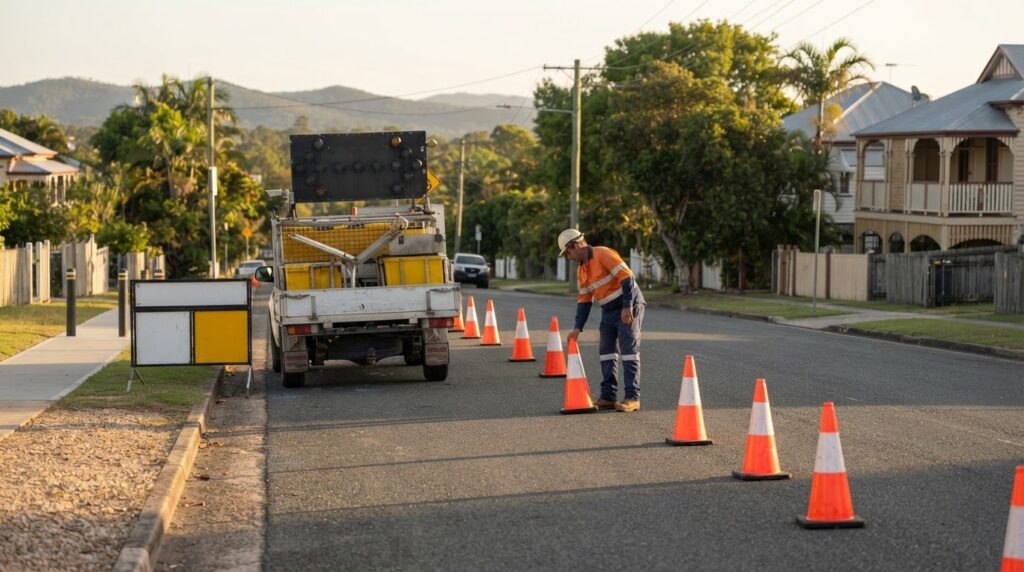
A Brisbane road closure can require both Brisbane City Council assessment and a Queensland Police permit. Getting a road closure permit in Brisbane starts with an application through Council’s Road Corridor Permit System. You’ll need to explain the closure and how you’ll minimise its effects on the community. Only the Queensland Police Service can authorise a temporary road closure.
It’s easy to assume one approval covers every part of a closure. The right application depends on the activity and the road, so identifying the permit pathway early helps you plan the work and the required notifications. Local residents must be notified at least 48 hours before work that restricts access or involves overnight or weekend work.
This guide explains how to apply through the Road Corridor Permit System, identify the relevant approvals and prepare the information Council needs to assess your application. It also covers traffic management planning and resident notification, helping you plan for safety, access and the surrounding community.
Key Takeaways
- Choose the application pathway based on the road authority and activity. Temporary closures of Council-controlled roads, lanes or parking bays require Council assessment.
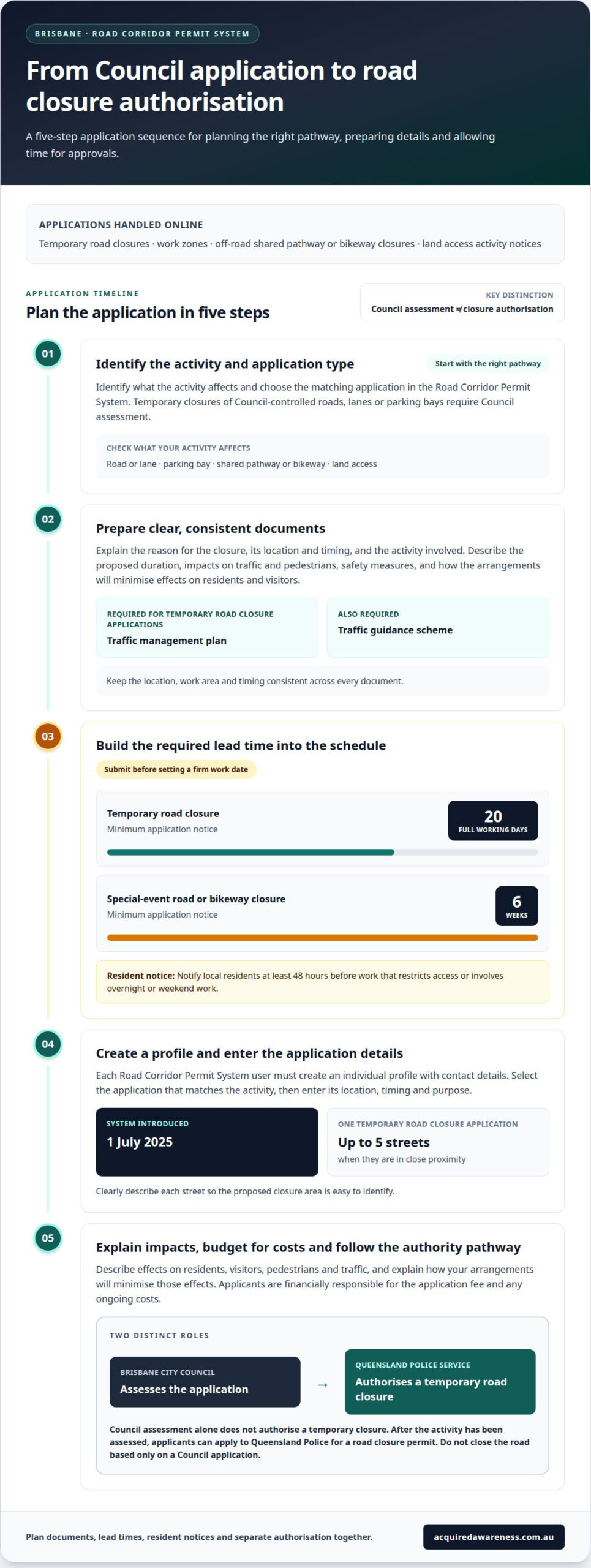
- Build the application schedule around the closure type: temporary road closures need at least 20 full working days’ notice, while special-event road and bikeway closures need at least 6 weeks.
- Prepare clear details about the activity, location, duration, traffic and pedestrian impacts, and safety measures to support assessment.
- Include a traffic management plan and traffic guidance scheme where required, and plan resident communication around access restrictions and work timing.
- Separate temporary closure applications from permanent closure requests, which follow a different assessment pathway.
Applying through the Road Corridor Permit System
Brisbane applications for temporary road closures, work zones, off-road shared pathway or bikeway closures, and land access activity notices are made online through the Road Corridor Permit System. When getting a road closure permit in Brisbane, first identify the application type and approvals your activity needs.
-
Prepare application documents and traffic management plans
Set out the reason for the closure, its location and timing, and the activity involved. Explain how your arrangements will minimise effects on residents and visitors. Temporary road closure applications require a traffic management plan and traffic guidance scheme. Include the proposed duration, effects on traffic and pedestrians, and safety measures. Keep the documents consistent: the location, work area and timing should describe the same activity throughout the application.
-
Plan application timing
Submit a temporary road closure application at least 20 full working days before the proposed closure date. Special-event road and bikeway closure applications must be submitted at least 6 weeks before the planned works. Use the relevant lead time when scheduling document preparation and resident notices. Getting a road closure permit in Brisbane involves more than lodging a form, so allow time for assessment before setting a firm work date.
- Create an individual profile and select the application. Every Road Corridor Permit System user must create an individual profile with contact details. Brisbane City Council introduced the system on 1 July 2025. Choose the application that matches the activity, then enter its location, timing and purpose. One Temporary Road Closure application can include up to 5 streets in close proximity. Describe each street clearly so the proposed closure area is easy to identify.
- Explain the effects and costs. Describe how the closure may affect residents, visitors, pedestrians and traffic, and how your arrangements will minimise those effects. Applicants using the system are financially responsible for the application fee and any ongoing costs. Include these in your project budget rather than treating the application as the only expense associated with the closure.
- Allow for the separate road-closing authority. Council assessment does not authorise a temporary road closure. Only the Queensland Police Service can authorise a temporary Brisbane road closure. Once the activity has been assessed, applicants can apply to Queensland Police for a road closure permit. Do not close the road based only on a Council application. An unauthorised closure can create safety and access risks for the public.
Brisbane City Council permits for road and footpath use
Identify whether your activity affects a Council-controlled road, lane, parking bay or footpath. You need Brisbane City Council approval before work disrupts or interferes with its transport network.
- Start by identifying the asset and the activity. Council assesses temporary closures of Council-controlled roads, lanes and parking bays. Work that disrupts or interferes with the transport network needs approval before it takes place. Roadway excavation also requires excavation approval, alongside an application for a temporary lane or road closure.
-
Check road closure permit costs
Budget for the Council application charge before lodging a temporary lane or road closure request. Applicants are also financially responsible for ongoing costs. Treat the application charge as one part of the project budget, not the full cost of carrying out the activity.
-
Account for bonds and traffic management fees
Separate Council’s application charge from other project expenses. Applicants remain financially responsible for ongoing costs. Plan your budget around the activity and its traffic arrangements, and don’t treat the Council fee as a bond or payment for traffic management.
- For footpath use, identify the applicable zone and permit type. The listed fee for other footpath applications is A$369 in Zones A and B, and A$184 in Zone C. Brisbane footpath permits incur a minimum five-week charge. The weekly permit fee is A$5.45 per square metre in Zone B and A$3.20 per square metre in Zone C.
- Build assessment time into the footpath work schedule. Brisbane City Council processes certain eligible, complete footpath applications within 5 working days when relevant fees are paid. Incomplete applications, or those requiring further information, may take up to 20 days. Council advises allowing 20 days for an outcome on a footpath works approval or permit request.
- Check whether a short footway activity needs approval. Equipment or materials deposited for less than 48 hours don’t require approval when work is outside the CBD and isn’t on a state-controlled main road. This exception is specific to those conditions. For work that requires traffic management design, traffic management design support can help align the plan with the activity.
Choosing the right road closure permit
First identify who controls the road and what the activity will affect. Those details determine the relevant authority and approval pathway.
-
Identify the road permit authority
Check whether the proposed closure involves a Council-controlled road or a Queensland Government road. Brisbane City Council assesses temporary closures on its roads, lanes and parking bays. For a Queensland Government road, contact the Department of Transport and Main Roads as well. The answer differs by road authority: Council assessment applies to Council-controlled roads, while state-road closures require contact with the department.
-
Check closure approval requirements
Match the application to the activity and its effects on road users. Construction, events and filming can involve different locations, durations and traffic impacts, so describe the proposed work accurately. Temporary road closure applications must be submitted at least 20 full working days before the proposed closure date. Special-event road and bikeway closure applications need at least 6 weeks before planned works.
- Include the relevant construction approvals. If Brisbane construction work will occur outside 6.30am-6pm, obtain Environmental Protection Act 1994 approval before submitting a road closure application. Roadway excavation also requires approval for the excavation, as well as an application for a temporary lane or road closure. Keep the excavation approval and closure application as distinct requirements.
- Plan event and filming closures around actual impacts. For an event, identify whether you’re requesting a temporary road closure or a bikeway closure, and provide the location and timing. Full road or lane closures are allowed only during periods of low traffic to minimise disruption. For filming, describe the activity and the road space it affects. Don’t assume a filming request follows the event pathway.
- Allow for the separate road-closing authority. Brisbane City Council assessment does not itself authorise a temporary road closure. Only the Queensland Police Service has authority to temporarily close a Brisbane road. After the activity has been assessed, applicants can apply for a road closure permit from Queensland Police. For a Queensland Government road, also contact the Department of Transport and Main Roads on 07 3137 8363.
- Separate permanent closure requests. A permanent road closure is different from a temporary permit for construction, an event or filming. In Brisbane, begin a permanent closure request by contacting the Queensland Government, which directs applicants to Brisbane City Council for assessment. Use this pathway for a proposal to close a road permanently, not to manage a temporary activity.
Resident notification before closures
Plan resident communication alongside the closure schedule. In Brisbane, local residents must be notified at least 48 hours before work that restricts access or involves overnight or weekend work.
- Identify who may be affected. Map the closure area and consider homes, businesses, driveways and pedestrian access. A street closure, for example, may affect residents beyond the work frontage if it blocks their usual vehicle route. Include everyone whose access will change, not just people beside the work site. This makes your notification relevant to the disruption.
- Set the notice deadline from the work timing. Give affected local residents notice at least 48 hours before work that restricts access or involves overnight or weekend work. Treat that as the minimum lead time for those situations. Build notification into the schedule before crews arrive, rather than relying on a last-minute conversation after access changes.
- Explain the practical impact clearly. State the affected location, planned work period and access changes in plain language. If a driveway entrance will be restricted, describe the restriction and when it applies. Make overnight work clear as well. Accurate details help residents understand what to expect and distinguish the closure from unrelated nearby activity.
- Choose a suitable way to reach the affected community. Use a method that can reach residents and businesses affected by the specific closure. Direct notices to nearby properties may suit a short street segment, while a larger closure may affect more addresses. The key is to notify local residents within the required timeframe, not simply to issue a notice.
- Keep a record of the notification process. Note when notices were distributed, which area they covered and what closure information they gave. A simple record helps the project team manage questions and keep messages consistent. If work timing or access arrangements change, update the affected residents promptly. Avoid leaving an earlier notice in circulation when it no longer reflects the planned work.
- Coordinate resident messages with the site team. Make sure the people managing the closure know what residents were told about access and timing. If a notice describes a restricted driveway, for example, the onsite team should understand that arrangement before work begins. Consistent communication supports orderly access and helps prevent avoidable confusion during the closure.
For a proposed Brisbane road closure, applicants must provide the reason, details, location and timing, and explain how they’ll minimise effects on residents and visitors. These details also help align resident messages with the application and planned arrangements.
The listed fee for a Brisbane residential driveway requiring full assessment, including an onsite inspection, is $307.50. The listed fee for a self-assessable Brisbane residential driveway is $21.25. Keeping the applicable process and fee clear can help residents understand arrangements when driveway access is affected.
What documents and traffic management plans are required for a Brisbane road closure application?
Prepare documents that describe the activity, its footprint and its effects on road users. Brisbane temporary road closure applications require traffic management planning as well as clear details about the activity.
- Describe the proposed activity. State what the work or event involves, where it will happen and how long it will last. Brisbane City Council permit applications should explain the activity, duration and potential effects on traffic or pedestrians. For example, clarify whether the request is for a full road closure or work affecting only a lane. This gives Council a clear scope to assess.
- Prepare a traffic management plan. Brisbane temporary road closure applications require a traffic management plan. Explain how traffic will be managed around the proposed closure and how the arrangements relate to the activity. The plan should address the effects identified in the application, not describe a different work area or timeframe. Keep the arrangements consistent across all submitted documents.
- Include a traffic guidance scheme. Temporary road closure applications require a traffic guidance scheme alongside the traffic management plan. Connect the scheme’s site-specific traffic arrangements to the location and closure you’re requesting. Council may also require a traffic guidance scheme for a temporary road or lane closure, so include it in your application preparation.
- Explain traffic and pedestrian impacts. Identify how the activity may affect vehicles and people walking through the area. For example, note whether it occupies a road, changes available access or affects pedestrian movement. Link each impact to the relevant arrangements in the traffic management plan. This makes clear how your application addresses the activity’s effects.
- Provide supporting event insurance details. Brisbane special-event closure applications require public liability insurance of at least A$20 million. Account for this requirement when preparing an event application. It is specific to special-event closure applications, so don’t treat the figure as a general requirement for every temporary road closure. Keep the event documentation aligned with the closure activity and timing.
- Review the documents together before submission. Compare the activity details, duration, location, traffic management plan and traffic guidance scheme. Check that they all describe the same closure and intended arrangements. If the application concerns roadway excavation, remember that excavation approval is also required alongside the temporary lane or road closure application. Record the separate approvals clearly in your project documents.
- Arrange design support where the plan needs development. A clear traffic management plan and traffic guidance scheme depend on the activity and its location. For support preparing project-specific traffic management design, take the next step and discuss the work requirements.
Acquired Awareness Traffic Management
Acquired Awareness Traffic Management can support the practical traffic arrangements for a Brisbane road closure. Once you’ve identified the permit pathway and prepared the required documents, the team can provide traffic control or traffic management implementation for your project. These services connect the planned closure arrangements with activity on the road.
For example, your project may need traffic control while work affects road users, or traffic management implementation to put the planned arrangements into effect. The right support depends on the activity and the plan. Acquired Awareness Traffic Management also offers Traffic Management Implementation – New Entrant training for people entering the field.
Contact Acquired Awareness Traffic Management to discuss the traffic management support your Brisbane road closure project needs.
Move your closure plan into action
A sound plan for getting a road closure permit in Brisbane connects approvals with safe, practical delivery on site. Before work begins, align the traffic arrangements with the activity, the people affected and everyone’s responsibilities. This preparation helps move the project from paperwork to operation with clear decisions.
Acquired Awareness Traffic Management can support the next stage with Traffic Control. For people building their capability in the field, it also offers the Traffic Control Course – New Entrant and Traffic Control Course – Renewal. The right next step depends on whether your project needs operational support or training.
Share the nature of your work and the support you need. Contact Acquired Awareness Traffic Management to discuss the next step for your project. With a considered plan and the right support in place, you can move forward with care for workers, road users and the Brisbane community.
Frequently Asked Questions
How do I apply for a road closure permit in Brisbane?
Apply online through Brisbane City Council’s Road Corridor Permit System. Create an individual profile with your contact details, then select the application type matching your activity. Describe its reason, location, timing and likely impacts. One Temporary Road Closure application can cover up to 5 nearby streets. After the activity has been assessed, apply to Queensland Police for the permit authorising the temporary road closure.
Which Brisbane council or authority issues road closure permits?
Brisbane City Council assesses temporary closures affecting Council-controlled roads, lanes and parking bays. For a Queensland Government road, contact the Department of Transport and Main Roads as well. The Queensland Police Service has authority to temporarily close a road in Brisbane, so Council assessment and the road-closing permit are separate steps. Identify the road authority first, especially if the work area crosses roads under different control.
What are the rules for notifying residents, businesses, and emergency services about a Brisbane road closure?
Notify local residents at least 48 hours before work that restricts access or involves overnight or weekend work. For businesses and emergency services, plan direct communication where the closure could affect access or response routes. Explain the affected location, timing, access arrangements and any detour information. If the work schedule or access plan changes, update the people relying on the earlier notice before the revised arrangements begin.
How do I arrange traffic control, detours, and pedestrian access for a Brisbane road closure?
Set out traffic control and detour arrangements in the traffic management plan and traffic guidance scheme, matching both to the actual work area. Preserve pedestrian passage: Brisbane residential areas require at least 1.2 metres clear from the property alignment or kerb. In Brisbane CBD or business areas, keep at least 1.8 metres clear. Arrange traffic control to reflect the approved site arrangements and maintain clear pedestrian routes.
What penalties or risks apply for closing a Brisbane road without a permit?
An unauthorised closure can create safety and access risks for the public. The Queensland Police Service has authority to temporarily close a road in Brisbane.