Blog
Recent Articles
Professional Gold Coast Traffic Management: Ensuring Safety and Compliance in 2026
April 22, 2026
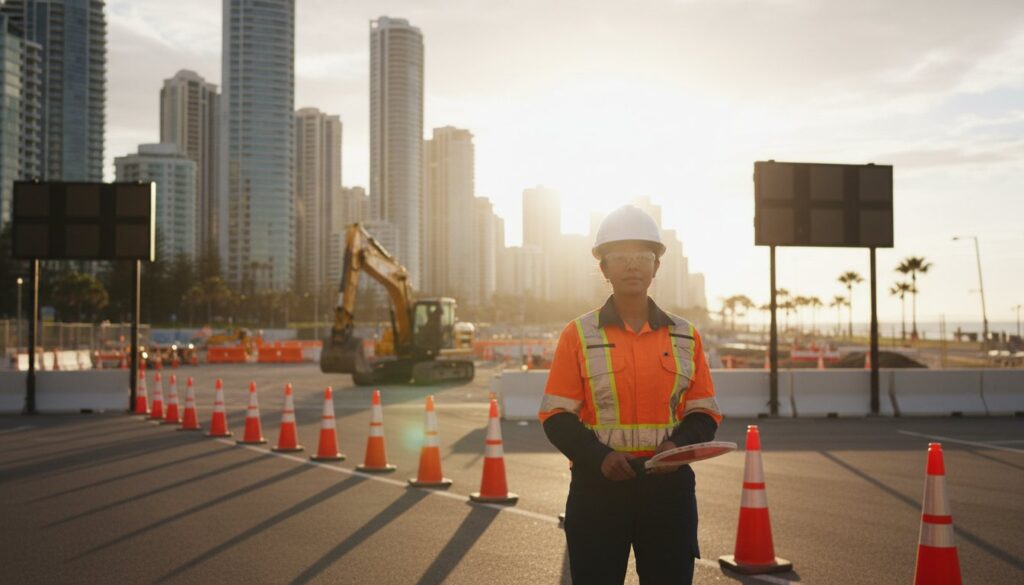
A single compliance oversight in a high-density zone like Surfers Paradise can result in immediate project shutdowns and significant financial penalties under 2026 Queensland safety legislation. You likely know that managing gold coast traffic is no longer just about placing signs; it’s a high-stakes balancing act between strict TMR requirements and the reality of heavy coastal congestion. It’s a complex environment where the margin for error is non-existent and the safety of the public rests entirely on your planning.
We’re here to ensure your project remains both safe and moving. This guide will help you master the technical intricacies of modern regulations and secure professional management solutions that protect your site, your staff, and your reputation. We’ll examine the latest 2026 safety mandates, provide a strategic roadmap for streamlining TMR and council permit approvals, and show you how to achieve zero safety incidents while maintaining minimal public disruption. You’ll gain the clarity needed to execute even the most complex infrastructure projects with total confidence and professional integrity.
Key Takeaways
- Navigate the evolving landscape of 2026 infrastructure projects and learn how to manage the unique balance between tourism surges and construction growth.
- Master the regulatory hierarchy between the City of Gold Coast and TMR to ensure your Traffic Management Plan (TMP) meets all local compliance standards.
- Discover why professional traffic management is a critical investment in risk mitigation that protects both your site and the public from costly safety breaches.
- Identify the essential equipment and VMS strategies required to maintain high visibility and driver communication within the complex flow of gold coast traffic.
- Leverage the expertise of a dual-identity service provider and Registered Training Organisation to guarantee your project is managed by elite, accredited professionals.
The Evolution of Gold Coast Traffic Challenges in 2026
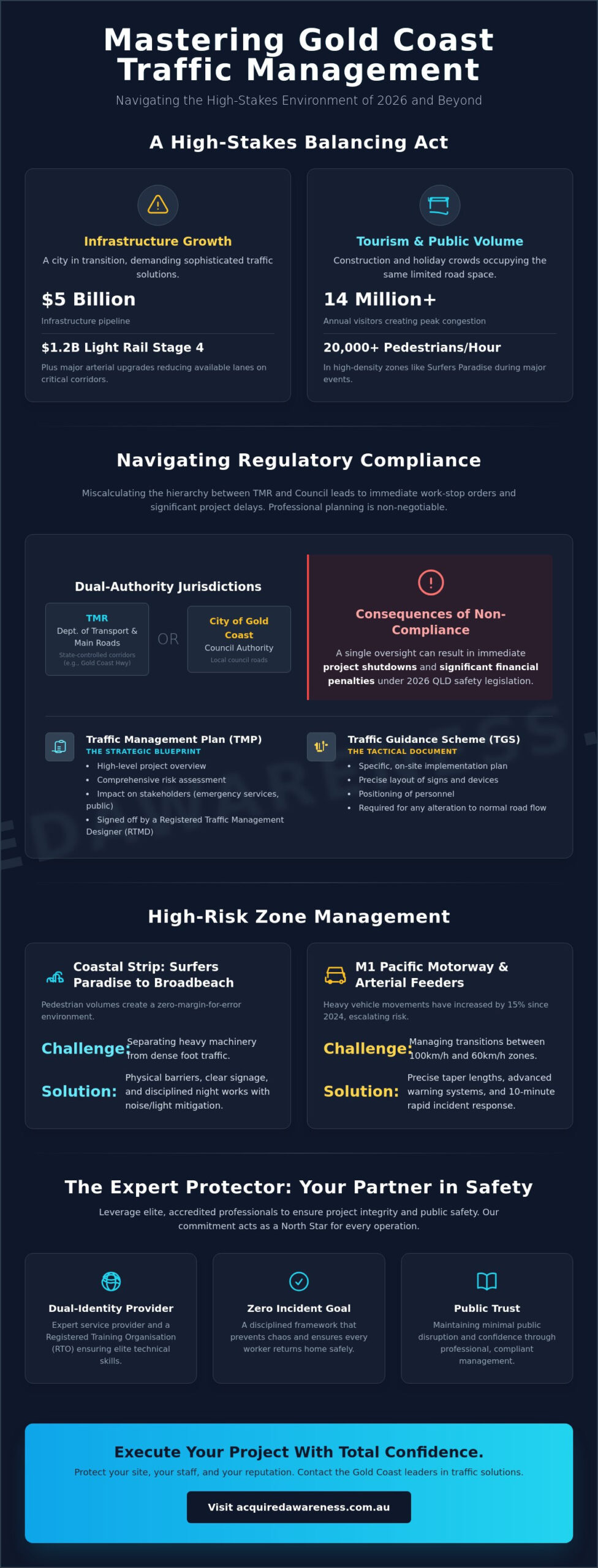
Managing gold coast traffic in 2026 requires a sophisticated understanding of a city in transition. The region has moved beyond its reputation as a simple holiday destination. It’s now a primary economic engine for South East Queensland, balancing a $5 billion infrastructure pipeline with a tourism sector that welcomed over 14 million visitors last year. This dual pressure creates a volatile environment where construction growth and peak holiday crowds occupy the same limited road space. Static, “set and forget” traffic plans are no longer viable in these high-density zones. A plan drafted on Monday can be rendered obsolete by Tuesday morning due to shifting weather patterns or unexpected changes in freight volume.
The 2026 infrastructure landscape is dominated by the $1.2 billion Light Rail Stage 4 and major arterial upgrades designed to restore road capacity. These projects often reduce available lanes on critical corridors, making professional traffic management essential for maintaining public trust. We view our role as the Expert Protector. Our mission is to ensure every worker returns home safely while minimizing the frustration of the commuting public. By adhering to the most rigorous Australian traffic control standards, we provide a disciplined framework that prevents chaos on our roads. This commitment to compliance and safety acts as a North Star for every operation we oversee.
High-Density Zones: Surfers Paradise to Broadbeach
The coastal strip between Surfers Paradise and Broadbeach represents one of the most complex environments for gold coast traffic control. With pedestrian volumes exceeding 20,000 people per hour during major events, the margin for error is zero. To manage these surges effectively, project leads can explore FootfallCam Pro2 People Counters to gain real-time insights into crowd movement. We prioritize the separation of heavy machinery from foot traffic through physical barriers and clear, authoritative signage. Night works are frequent in these precincts to avoid daytime gridlock. This requires strict mitigation of noise and light pollution to respect residential and tourist accommodation. We use directional lighting and silenced equipment to ensure project milestones are met without compromising the local community’s well-being.
The M1 Pacific Motorway and Arterial Feeders
Operations adjacent to the M1 Pacific Motorway demand a high-speed approach to safety. With heavy vehicle movements increasing by 15% since 2024, the risk profile on these arterial feeders has escalated. Managing the transition between 100km/h state-controlled roads and 60km/h local streets requires precise taper lengths and advanced warning systems. We deploy rapid response teams for motorway-impacted projects to clear incidents within a 10-minute window, preventing the “accordion effect” that leads to regional congestion. Our status as a Registered Training Organization (RTO) ensures our teams possess the elite technical skills required to manage these high-stakes environments with total composure.
Navigating Gold Coast Permits and Regulatory Compliance
Managing gold coast traffic requires a precise understanding of dual-authority jurisdictions. Project sites fall under the control of either the City of Gold Coast for local council roads or the Department of Transport and Main Roads (TMR) for state-controlled corridors like the Gold Coast Highway. Miscalculating this hierarchy leads to immediate work-stop orders and significant project delays. Compliance is governed by the Queensland Guide to Traffic Management, which sets the standard for how risks are identified and mitigated on every site. Professional planning ensures that your project meets these legislative requirements before the first cone is placed on the bitumen.
Traffic Management Plans (TMP) vs. Traffic Guidance Schemes (TGS)
A Traffic Management Plan (TMP) serves as the high-level strategic blueprint for your project. It details the project scope, risk assessment, and the broader impact on stakeholders, including emergency services and public transport. In contrast, a Traffic Guidance Scheme (TGS) is a tactical document. It provides the specific layout of signs, devices, and personnel for a particular work site. Under QLD safety mandates, any project that alters the normal flow of road users requires a Registered Traffic Management Designer (RTMD) to sign off on these documents. This level of technical oversight prevents costly fines, which can reach thousands of dollars for non-compliant setups, and ensures the safety of the workforce and the public.
Securing Council and TMR Road Use Permits
Operational success in 2026 depends on respecting lead times and submission accuracy. Standard permit applications for gold coast traffic management typically require 10 to 15 business days for processing. For complex works involving major arterial closures, authorities often mandate a 30-day review period. To secure a successful road occupancy application, you must provide a comprehensive documentation suite:
- Approved Traffic Guidance Schemes (TGS)
- Certificate of Currency for Public Liability Insurance (minimum A$20 million)
- Evidence of stakeholder notification and consultation
- Detailed work methodologies and schedules
Acquired Awareness manages this entire permitting lifecycle, acting as a disciplined liaison between your project and the regulatory bodies. We take full ownership of the approval process to ensure your site remains active and compliant. Our team provides the professional traffic planning required to navigate these complex administrative hurdles without compromising your project timeline. By treating compliance as a non-negotiable foundation, we protect your reputation and your budget from the risks of unauthorized road use.
Professional Traffic Control: Protecting Your Site and the Public
Choosing a traffic management partner based solely on the lowest hourly rate is a high-risk strategy. Budget traffic control often results in hidden costs that far outweigh any initial savings. A single safety breach or a poorly managed site can lead to regulatory fines exceeding A$100,000, project delays, or catastrophic reputational damage. Accessing reputable Traffic Control and Labour Hire Services is an investment in certainty. We adopt an Expert Protector mindset, taking full ownership of the environment to ensure every worker returns home safely. Our commitment to zero-harm environments across South East Queensland is the foundation of our operations. We don’t just provide staff; we deliver a disciplined safety culture that prioritizes the well-being of your team and the local community.
Accredited Personnel: The Backbone of Safety
There’s a significant gap between a worker who holds a basic ticket and a career traffic controller. By 2026, compliance standards demand a deeper level of site-specific expertise and situational awareness. Our status as a Registered Training Organisation (RTO) allows us to maintain a higher calibre of field staff. We provide continuous education that goes beyond the minimum requirements, ensuring our controllers are prepared for the complexities of modern gold coast traffic scenarios. This educational authority means our team understands the technical requirements of City of Gold Coast traffic management protocols. Our staff act as disciplined leaders on-site, managing the flow of vehicles and pedestrians with professional authority and calm precision.
Risk Mitigation and Incident Management
Effective gold coast traffic control requires proactive hazard identification rather than reactive fixes. Road environments are dynamic, and risks can shift in seconds. We implement rigorous standard operating procedures to manage everything from site breaches to aggressive driver behaviour. Our controllers are trained to de-escalate tension while maintaining the integrity of the work zone. Clear communication is essential to this process. We ensure a seamless flow of information between our controllers, your site managers, and the public. This collaborative approach minimizes confusion and maximizes safety. We also maintain a comprehensive audit trail for every project. Our documentation and reporting processes provide the clear evidence of compliance required for high-level infrastructure projects. This methodical approach ensures that even the most chaotic construction scenarios remain under total control.
- Zero-Harm Focus: Every decision is filtered through our “Safety First” mantra.
- Compliance Security: We meet 100% of the documentation requirements for 2026 standards.
- Professional Communication: Real-time coordination between all site stakeholders.
- Reliable Protection: Seasoned mentors who take responsibility for public safety.
It’s not enough to simply stop traffic. You need a partner who understands the legal and physical risks of the Queensland road network. We provide the steady, unflappable presence required to keep your project moving without compromise.
Essential Traffic Management Equipment for Gold Coast Projects
Managing gold coast traffic requires more than just high-visibility vests and hand-held bats. The coastal environment presents unique challenges, including salt-air corrosion and high-intensity UV exposure. These factors can quickly degrade substandard equipment, leading to safety hazards and non-compliance with Queensland’s Department of Transport and Main Roads (TMR) standards. We select hardware specifically engineered to withstand these conditions, ensuring that every cone, sign, and barrier remains visible and functional throughout the project lifecycle.
Relying on third-party rentals often introduces variables that compromise site safety. Acquired Awareness maintains an extensive inventory of company-owned equipment. This internal control allows us to guarantee that every piece of gear has undergone rigorous maintenance checks before deployment. It eliminates the delays associated with external suppliers and ensures that our response to emergency call-outs is immediate and reliable. Our commitment to equipment integrity means we don’t leave site safety to chance.
VMS Board Hire and Digital Communication
Digital communication is the most effective way to manage driver expectations and reduce frustration on busy Gold Coast arterials. Our Variable Message Signs (VMS) provide real-time updates to motorists about lane closures, speed changes, or detours. These units are equipped with remote programming capabilities. This allows our team to update messaging instantly from a central hub without needing a technician on-site. For large-scale projects requiring robust networking and connectivity, you can explore Professional Installation and Technical Integration Services to ensure your digital infrastructure remains reliable. This agility is vital for responding to sudden incidents or changing weather patterns. To support long-term sustainability on 2026 infrastructure projects, our VMS boards are solar-powered, providing 24/7 operation with zero emissions.
Physical Barriers and Delineation
Physical protection is the foundation of site safety. We utilize a range of TMR-approved barriers and delineators to create clear boundaries between work zones and moving vehicles. For high-speed areas, water-filled barriers provide essential energy absorption and positive separation. In tighter urban spaces, we deploy high-visibility cones and bollards that meet AS 1742.3 specifications. Night-work operations on the Gold Coast require additional specialized equipment. We deploy LED lighting towers and retroreflective signage to ensure 100% visibility during low-light hours. This methodical approach to equipment selection ensures that every worker and road user remains protected. Our inventory is audited monthly to ensure every item meets the highest performance benchmarks.
Ensure your project stays compliant and safe with our industry-leading hardware and expertise. Contact Acquired Awareness today to discuss your specific traffic management requirements.
Why Acquired Awareness is the Gold Coast Leader in Traffic Solutions
Acquired Awareness (AATM) has spent over 20 years refining its approach to gold coast traffic management. We’ve managed high-stakes environments ranging from the 2018 Commonwealth Games to complex, multi-year upgrades on the M1. This history isn’t just a list of dates. It’s a record of reliability in SEQ’s most challenging infrastructure landscapes. We combine the scale of a high-level corporate service provider with the agility and heart of a local partner.
Our operation is built on a unique dual identity. We are both an elite service provider and a Registered Training Organisation (RTO). This structure allows us to bridge the gap between theoretical compliance and practical, on-road execution. When logistical nightmares arise, our teams respond with a “can-do” attitude backed by calm authority. We don’t just show up to a site; we take full ownership of the environment to ensure every worker and motorist returns home safely.
The RTO Advantage for Our Clients
Our internal training arm, the Acquired Awareness Training Centre (AATC), acts as a rigorous filter for talent. This ensures that every team member we deploy to your site has been educated to our exact standards of excellence. We maintain direct oversight of staff competency, which removes the risks associated with third-party labor hire.
- Safety-Conscious Culture: Our staff are immersed in a “Safety First” mantra from their very first day of training.
- Custom Training: We develop site-specific training solutions to meet the unique technical requirements of complex projects.
- Direct Oversight: Because we are the educators, we can guarantee that our field teams are up to date with the latest 2026 TMR requirements and safety protocols.
This educational foundation means our clients receive a higher tier of risk mitigation. When conditions change on the road, our controllers possess the technical depth to make informed, safe decisions instantly. We don’t guess; we lead.
Get Started with Your Gold Coast Traffic Plan
Developing a robust gold coast traffic plan requires more than just signs and cones. It requires a methodical consultation process. We begin with a comprehensive site assessment to identify potential hazards and local bottlenecks. From there, our planning department manages the entire permit acquisition process, liaising with local councils and state authorities so you don’t have to.
You can request a detailed quote that encompasses traffic control personnel, professional planning services, and high-quality equipment hire. We provide transparent, fixed expectations to ensure your project stays on schedule and within budget. For project leads managing broader SEQ developments, see our Traffic Control Brisbane: The Complete Guide for Project Managers. We are ready to serve as your expert protector on the road, ensuring total compliance and public safety at every turn.
Securing the Future of Gold Coast Infrastructure
Success on the road in 2026 demands more than just signs and cones. It requires a disciplined approach to safety and a deep understanding of evolving regulatory standards. Managing gold coast traffic effectively means balancing high-speed transit needs with the protection of local work zones. You’ve seen how critical comprehensive TMR and Council permit management is for avoiding costly delays. Without the right equipment and accredited personnel, site risks escalate quickly. It’s about protecting every worker and commuter who moves through your project area.
Acquired Awareness brings over 20 years of SEQ infrastructure experience to every job site. As an RTO #40905 accredited training provider, we don’t just supply staff; we set the industry standard for excellence. Our team handles the technical complexities of compliance so you can focus on delivery. We’re committed to maintaining the highest safety benchmarks across Queensland. Let’s work together to ensure your next project remains safe, compliant, and on schedule.
Request a Professional Traffic Management Quote for Your Gold Coast Project
We look forward to helping you build a safer Gold Coast.
Frequently Asked Questions
Do I need a permit for a small skip bin or short-term road occupation on the Gold Coast?
Yes, any occupation of the road reserve requires a formal permit from the City of Gold Coast. This rule applies to skip bins placed on nature strips or road shoulders for any duration. Applications fall under the ‘Working in the Road Reserve’ permit framework. Fines for non-compliance can exceed A$3,000 for businesses under local laws. We handle these applications to ensure your project stays compliant from day one.
What is the lead time for a Traffic Management Plan (TMP) approval in 2026?
Standard TMPs typically require 10 business days for review and approval by the City of Gold Coast or the Department of Transport and Main Roads. Complex projects involving arterial gold coast traffic routes or high-speed roads may require up to 20 business days. We recommend submitting applications 4 weeks prior to your intended start date. This allows enough time for potential revisions or council feedback without delaying your project.
Can I use my own staff to hold a stop-slow bat if they have a white card?
No, a White Card is insufficient for directing traffic on public roads. Staff must hold a current Traffic Controller accreditation issued by TMR Queensland. Operating without the correct qualification violates the Transport Operations (Road Use Management) Act 1995. This can lead to immediate site shutdowns and heavy penalties for the PCBU. We provide fully qualified staff who’ve completed rigorous industry training to keep your site safe.
What are the specific requirements for night-time traffic control on the Gold Coast?
Night-time operations require enhanced visibility equipment including Level 2 or 3 high-visibility garments and illuminated traffic batons. All signage must use Class 1X retroreflective material to ensure clarity under artificial lighting. We also deploy trailer-mounted Arrow Boards and VMS units to provide early warning to motorists on high-volume gold coast traffic corridors. These measures are essential for protecting both our workers and the driving public during low-light hours.
How does Acquired Awareness ensure the quality of its traffic controllers?
We maintain quality through our status as a Registered Training Organisation, RTO 40764. Every controller undergoes rigorous internal assessment beyond the minimum TMR requirements. We conduct 100 random site audits monthly to verify that safety protocols and uniform standards are strictly met. This ensures our team remains the most disciplined in the industry. We don’t just hire staff; we train experts who take ownership of their environment.
What equipment is mandatory for a standard lane closure on a Gold Coast arterial road?
Mandatory equipment includes a minimum of 20 traffic cones spaced at 4-metre intervals for the taper. You must also deploy “Roadwork Ahead” and “Lane Status” signs at specific distances defined by the Manual of Uniform Traffic Control Devices. For arterial roads, a truck-mounted attenuator is often required to provide a physical crash barrier for workers. Our vehicles come fully equipped with these safety essentials to meet every regulatory standard.
Do you provide traffic management for private events and festivals?
How much does professional traffic management cost for a typical construction project?
Costs vary based on the number of controllers, vehicle requirements, and permit fees. While we don’t provide flat rates, industry data from 2024 indicates that a basic two-person crew with a fully equipped vehicle starts at approximately A$120 to A$180 per hour. Complex setups involving VMS boards or truck-mounted attenuators will incur additional daily hire charges. We’ll provide a detailed quote once we’ve reviewed your specific site requirements and compliance needs.