Blog
Recent Articles
Traffic Control in Queensland: The 2026 Comprehensive Guide
July 22, 2026
What if the safety of your entire worksite depended on a system of precision rather than just a person holding a sign? In the high-stakes environment of traffic control queensland professionals understand that every placement, permit, and second of communication is a calculated move to protect lives. It is a role defined by professional responsibility and a commitment to public welfare. Whether you are managing a major infrastructure build ahead of the 2032 Olympics or starting your first day on the road, the standards of 2026 require total technical accuracy.
You likely know that keeping up with the latest TMR regulations and finding reliable, accredited controllers in Brisbane can be a significant challenge. It is frustrating when project delays occur because of compliance gaps or a lack of clear planning. This comprehensive guide will help you master the essentials of traffic management in SEQ. We will show you how to hire professional crews and explain the process of obtaining your own accredited industry tickets. We will break down the May 2026 MUTCD updates, clarify the differences between various traffic roles, and provide a clear path to ensuring your worksite remains both safe and legally compliant.
Key Takeaways
- Understand why professional traffic management is a systematic safety requirement rather than a manual task on SEQ roads.
- Identify the critical components of hiring accredited traffic control queensland services to ensure your project remains compliant with TMR regulations.
- Learn the precise pathway to obtaining your industry tickets through RTO-accredited training and supervised on-site experience.
- Explore how modern equipment and digital technology are being integrated to enhance worksite visibility and public safety.
- Master the strategies for mitigating legal and financial risks by implementing professional traffic guidance schemes and expert planning.
Understanding Traffic Control: More Than Just a Stop-Slow Bat
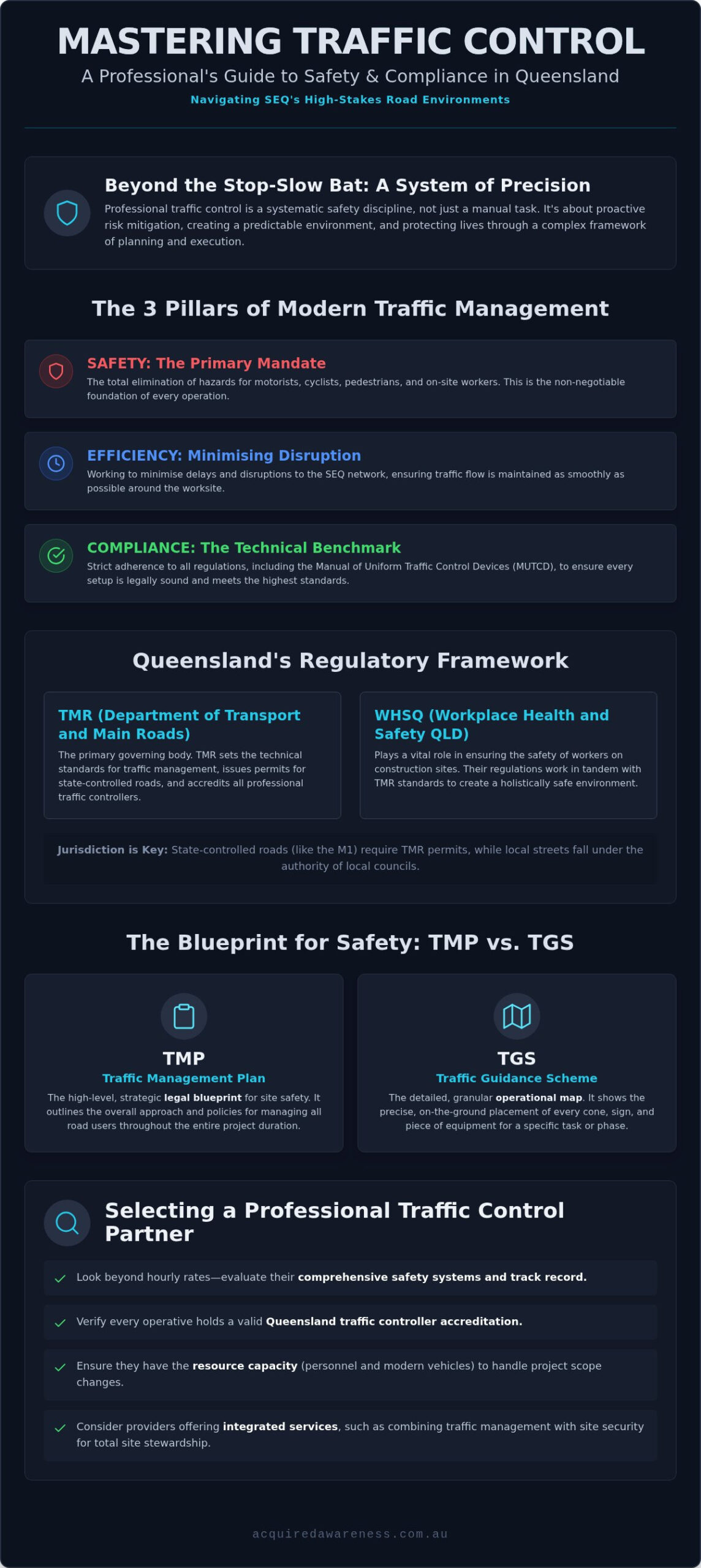
Professional traffic control is a systematic discipline designed to protect lives. It involves the precise management of road users, including motorists, cyclists, and pedestrians, to ensure they move safely around active worksites. While the public often sees a single individual with a stop-slow bat, this is merely the visible execution of a complex safety framework. Modern traffic control queensland standards require a proactive approach where risk is identified and mitigated before a single cone is placed on the asphalt. It’s about creating a predictable environment in an inherently unpredictable space.
This discipline is the backbone of civil construction and public events. Without disciplined management, high-speed roadworks or large-scale Brisbane festivals would become chaotic and hazardous environments. We distinguish between operational execution and strategic management. Operational control is the on-site implementation. Strategic management involves the creation of Traffic Guidance Schemes (TGS) and Traffic Management Plans (TMP). Foundational Road traffic control principles dictate that these plans must be data-driven and legally compliant to protect the project’s reputation and its people.
South East Queensland (SEQ) presents unique challenges. The region’s rapid growth and the upcoming 2032 infrastructure commitments mean our road networks are under constant pressure. For organizations like McMahons Civil and Contracting PTY LTD delivering critical civil and rail infrastructure, projects require deep local knowledge of TMR standards. A generic approach won’t work on the M1 or the Bruce Highway; you need a partner who understands the specific flow of Brisbane’s arterial corridors and the high stakes of regional connectivity.
Maintaining these high standards of connectivity is vital for the state’s broader travel industry, where professional services like Zoom FNQ rely on safe, efficient road networks to provide luxury private transfers in regions like Far North Queensland.
The Core Objectives of Modern Traffic Management
Our mission is centered on three non-negotiable pillars. Safety is the primary mandate. We aim for the total elimination of hazards for everyone on the road. Efficiency follows closely. We work to minimise disruptions to the SEQ network, ensuring that commuters aren’t unnecessarily delayed. For those who experience vehicle trouble in the Logan area, you can find out more about professional roadside assistance that helps keep traffic moving. Finally, compliance is our benchmark. Every setup must adhere strictly to the Manual of Uniform Traffic Control Devices (MUTCD), which was updated as recently as May 2026 to reflect new road user laws.
Who Regulates Traffic Control in Queensland?
The Department of Transport and Main Roads (TMR) is the primary governing body. They set the technical standards and accredit the personnel who manage our roads. However, Workplace Health and Safety Queensland (WHSQ) also plays a vital role in ensuring construction sites remain safe for workers. Navigating the hierarchy of approvals is a technical task. State-controlled roads require TMR permits; local streets fall under the jurisdiction of Brisbane City Council or regional authorities. Success in traffic control queensland depends on understanding which authority holds the keys to your specific worksite.
Procuring Traffic Control Services for SEQ Projects
Selecting a partner for traffic control queensland is a critical decision that impacts your project’s legal standing and its physical safety. It is not merely about sourcing labor; it is about securing a comprehensive safety system. A professional provider manages the entire lifecycle of road safety, from initial site audits to final equipment removal. You should evaluate more than just the hourly rate. Look for a provider with a robust safety record and the resource capacity to handle sudden changes in project scope. This includes having a fleet of modern vehicles and enough accredited personnel to cover multiple shifts without fatigue. Verify their Queensland traffic controller accreditation to ensure every operative on your site is legally qualified and insured.
For high-value construction sites in Brisbane, integrated services are becoming the standard. Combining traffic management with site security ensures that while the public is safe on the road, your equipment and materials remain protected behind the perimeter. This dual approach demonstrates a commitment to meticulousness and total site stewardship. Engaging with a team that understands these nuances is the best way to minimise project delays through expert coordination.
The Planning Phase: TMPs and TGSs
A Traffic Management Plan (TMP) is a legal blueprint for site safety that outlines how all road users will be managed throughout the duration of the project. While the TMP provides the high-level strategic framework, the Traffic Guidance Scheme (TGS) is the granular map showing exactly where every cone and sign must be placed. You cannot have one without the other. If you are unsure which level of planning your project requires, you can learn more about traffic management services South East Queensland and how they integrate into your project timeline.
Permits and Council Liaison
Navigating the permit process is often the most time-consuming part of procurement. Whether you are dealing with Brisbane City Council or regional authorities in the Gold Coast or Sunshine Coast, road corridor permits are mandatory for any work affecting traffic control queensland networks. Professional providers take this burden off your shoulders. They manage community impact and handle mandatory stakeholder notifications. This proactive attitude ensures your project starts on schedule and maintains a positive relationship with the local community.
Career Pathways: Obtaining Your Traffic Control Ticket
A career in traffic control queensland is built on a foundation of disciplined training and a deep sense of professional responsibility. It isn’t just about holding a bat; it’s about becoming a guardian of the road network. The journey begins with the White Card (Construction Induction), which is a mandatory prerequisite for anyone entering a construction site in Australia. This ensures you understand the fundamental safety protocols required before you ever step onto a live road corridor. It’s the first step in a career dedicated to protecting the well-being of the public and your fellow workers. Maintaining your own physical health is a core part of this professional responsibility; to help manage your fitness and nutritional needs on the job, visit Just Move It for their wellness and calorie tools.
Once you hold your White Card, the next step is to enrol in a TMR-approved course with a Registered Training Organisation. Selecting an RTO, such as Acquired Awareness Traffic Management (RTO #40905), is vital because the training must meet the rigorous standards set by the Department of Transport and Main Roads. The process involves a blend of classroom-based theory and practical simulated training. You’ll learn to manage vehicle flow and respond to emergency scenarios with total composure. This technical depth ensures that you aren’t just following orders, but understanding the logic behind every safety decision.
The transition from theory to the real world happens during your vocational placement. You must accumulate 20 hours of supervised experience on live Queensland roads. This is where you apply your knowledge under the mentorship of seasoned professionals. After successfully completing your hours and assessment, you can formally apply for your industry licence through the TMR portal. As of July 2026, the fee for a new three-year accreditation is A$234.60. This license is your credential as a professional committed to traffic control queensland standards.
Essential Training for New Entrants
The traffic control course is designed to be comprehensive and methodical. You’ll cover the May 2026 MUTCD updates and learn how to manage diverse road users, including new regulations for personal mobility devices. The 20-hour vocational placement is a non-negotiable requirement. It’s the period where you prove your ability to maintain worksite stability and protect the welfare of your team and the public under real-world pressure.
Advanced Certifications: TMI and Design
For those looking to advance, the industry offers clear progression. Traffic Management Implementation (TMI) is for personnel responsible for setting up and pulling down sites based on a Traffic Guidance Scheme. If your goal is to lead the planning phase, Traffic Management Design (TMD) accreditation is required. This allows you to design the complex schemes that keep SEQ moving safely. You can view our full range of traffic control courses to see which path fits your professional goals.
Essential Traffic Control Equipment and Technology
Rigorous maintenance is a non-negotiable safety factor. Equipment exposed to the harsh Queensland sun and heavy road spray can quickly lose its reflective properties. We conduct regular audits to ensure every item in our inventory provides maximum visibility during both day and night operations. For project managers, the choice between short-term and long-term hire often comes down to budget and duration. Short-term hire is ideal for rapid-response maintenance or community events. Long-term hire provides the cost-stability required for major infrastructure builds, such as the ongoing upgrades to the M1 or the Bruce Highway. If you are planning a project, you can contact us for professional equipment hire to ensure your site meets every regulatory mandate.
High-Visibility Equipment and Signage
A compliant SEQ worksite requires a standard kit of MUTCD-compliant signage, bollards, and pedestrian barriers. These tools create a predictable path for road users, reducing the risk of confusion. In high-speed zones, the role of arrow boards and vehicle-mounted attenuators (TMAs) becomes even more critical. TMAs act as a life-saving shield, designed to absorb the impact of a vehicle collision and protect the workers stationed ahead. You can explore our full range of traffic control equipment hire options to find the specific hardware required for your project’s risk profile.
Smart Technology: VMS Boards and Portable Signals
The industry is shifting toward electronic solutions for better visibility and real-time communication. Variable Message Signs (VMS) allow us to provide instant updates to motorists regarding lane closures or changed traffic conditions. VMS boards reduce driver frustration and improve site safety by providing clear, early warnings about road conditions. Additionally, portable traffic lights are essential for managing remote road closures or long-term regional projects where manual control is not feasible. These smart technologies integrate into a broader traffic control queensland strategy, ensuring that even the most complex road networks remain under total control.
Why Professional Management is Non-Negotiable
Attempting to manage road safety without expert oversight is a significant risk that no project manager should take. DIY traffic control often leads to compromised safety and severe legal consequences. In the rigorous environment of traffic control queensland, the financial penalties for non-compliance are substantial; however, the reputational damage from a workplace incident is often irreparable. Professional management provides the composure needed to handle high-pressure environments. It ensures every regulatory box is checked before the first vehicle enters the worksite. Choosing a partner for traffic control queensland means selecting a team that prioritizes meticulousness over shortcuts.
We believe that safety is a professional responsibility, not a manual labor task. When you outsource to a specialist, you aren’t just hiring people to hold signs. You are investing in a comprehensive safety system that includes planning, implementation, and constant monitoring. This proactive attitude keeps your project on track and protects the well-being of the public. It allows your team to focus on their core objectives while we maintain total control over the road corridor. It’s about ensuring worksite stability through every phase of the project, and for those who wish to expand their expertise into broader strategic oversight, you can discover Yellowhouse for accredited training in globally recognised project and programme management frameworks.
Mitigating Risk and Liability
Professional Traffic Management Plans (TMPs) act as your primary defense during a workplace incident or a government audit. These documents prove that every possible hazard was identified and mitigated according to current standards. Avoiding project shutdowns and hefty fines is a simple matter of cost-benefit analysis. It’s also essential to ensure all personnel on-site hold a valid white card QLD. This ensures a baseline of safety literacy across your entire workforce, reducing the likelihood of human error in high-stakes zones.
Choosing Acquired Awareness Traffic Management in South East Queensland
Acquired Awareness Traffic Management operates as the guardian of your project’s safety and reputation. Our dual identity as both a top-tier service provider and an RTO-accredited educational authority gives us a unique perspective. We don’t just follow the rules; we teach them. This ensures the crews managing your site are trained to the highest possible standard. Our regional heritage in Brisbane, the Gold Coast, and the Sunshine Coast means we understand the specific geographic challenges of SEQ. We take full ownership of the environments we manage. If you are ready to secure your worksite, you can Contact Acquired Awareness Traffic Management for a Traffic Management Quote to get started with a compliant, professional solution.
Securing the Future of SEQ Road Safety
Mastering the evolving landscape of traffic control queensland requires more than just reactive measures; it demands a forward-thinking approach to risk management. Throughout this guide, we have detailed how high-spec equipment and accredited training form a protective barrier for both your workforce and the public. As Brisbane continues its rapid expansion, the need for methodical, data-driven planning becomes the standard for every successful civil project. Professionalism in this field is defined by a commitment to technical accuracy and an unflappable attitude in high-stakes environments.
Acquired Awareness Traffic Management stands as a reliable regional partner, offering end-to-end solutions from expert TMP and TGS design services to comprehensive SEQ coverage across the Gold Coast and Sunshine Coast. As a Registered Training Organisation (RTO #40905), we ensure that every operative is equipped with the technical depth required to manage complex environments with total composure. We take full ownership of the safety systems we implement, providing the stability your project requires to stay on schedule and in total compliance.
Partner with Acquired Awareness Traffic Management for Professional Traffic Solutions
Your commitment to these professional standards builds a safer Queensland for everyone tomorrow. We are ready to help you navigate these requirements with seasoned expertise and genuine care for the well-being of the community.
Frequently Asked Questions
How do I become a traffic controller in Brisbane in 2026?
To become a traffic controller in Brisbane, you must first obtain a White Card and then complete a TMR-approved training course with a Registered Training Organisation. Following the theory component, you are required to finish 20 hours of supervised vocational placement on live roads. Once these steps are complete, you can submit your formal application for accreditation through the Department of Transport and Main Roads portal.
What is the difference between a traffic controller and a traffic manager?
A traffic controller is an operational role focused on the on-site management of vehicle and pedestrian movements. They are the personnel physically implementing the safety protocols on the road. In contrast, a traffic manager or designer focuses on the strategic planning phase. These professionals develop the Traffic Management Plans (TMP) and Traffic Guidance Schemes (TGS) that dictate how a site must be configured to remain compliant with Queensland safety standards.
How much does a traffic control course cost in Queensland?
The total investment for traffic control queensland training includes both the RTO course fee and the mandatory TMR accreditation fee. While training providers set their own rates for the classroom and practical components, the Department of Transport and Main Roads charges a fixed fee of A$234.60 for a new three-year accreditation as of July 2026. This fee is subject to annual indexation every July.
Do I need a White Card before I start traffic control training?
Yes, a White Card is a fundamental prerequisite that must be obtained before you can begin your practical traffic control training. This national construction induction qualification ensures you have a baseline understanding of worksite hazards. It is a legal requirement for anyone working within a construction zone or road corridor in Queensland to hold this card at all times.
How long is a QLD traffic control ticket valid for?
A Queensland traffic control ticket is valid for three years from the date of issue. To maintain your accreditation, you must complete a renewal course before the expiry date listed on your card. Failing to renew on time means you cannot legally work on a road corridor until your accreditation is officially reinstated by TMR. This ensures all personnel remain updated on the latest safety regulations and MUTCD standards.
Can I hire traffic control equipment without hiring a crew?
Professional equipment hire is available as a standalone service for projects that already have an accredited crew on-site. You can source MUTCD-compliant signage, bollards, and electronic VMS boards to support your existing team. Ensuring your hardware meets current Australian Standards is essential for maintaining total worksite control and legal compliance during any road-based activity.
What are the legal requirements for a Traffic Management Plan in SEQ?
A Traffic Management Plan in SEQ must adhere to the Queensland Manual of Uniform Traffic Control Devices (MUTCD) and the Queensland Guide to Temporary Traffic Management (QGTTM). It is a legal requirement that these plans are designed by an individual holding a current Traffic Management Design (TMD) accreditation. The plan must account for all road users, including the latest 2026 traffic control queensland regulations regarding personal mobility devices.
Is traffic control a good career path in Queensland?
Traffic control is a stable and rewarding career path with high demand driven by major infrastructure projects and the 2032 Brisbane Olympic Games. In 2026, annual salaries for controllers in Brisbane typically range from A$70,000 to A$90,000 when including overtime and penalty rates. The role offers a clear progression into implementation and design for those who demonstrate a high level of professional responsibility and technical competence.