
Blog
Recent Articles
Traffic Control Plan Design in QLD: The 2026 Compliance Guide
August 10, 2026
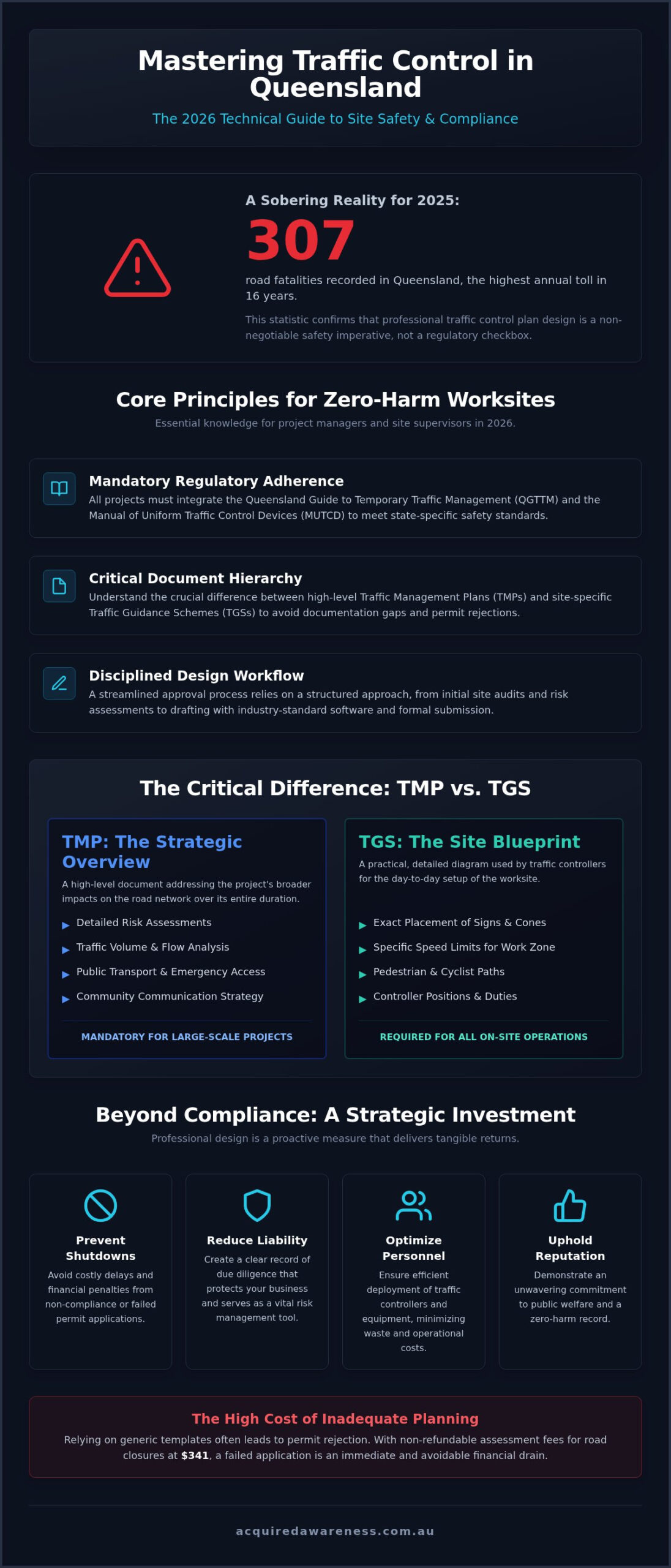
In 2025, Queensland recorded 307 road fatalities, the highest annual toll in 16 years. This sobering reality confirms that traffic control plan design qld is far more than a regulatory box to tick; it’s a vital safety blueprint for every project. We understand the daily pressure of managing a high-stakes worksite. You’re balancing tight construction deadlines against the deep responsibility of keeping your crew and the local community safe.
It’s easy to feel frustrated by complex TMR permit processes or the looming risk of a project shutdown due to a compliance oversight. You want a site that operates with total composure and absolute safety. This 2026 guide provides the technical expertise you need to master current standards like the QGTTM and MUTCD. We’ll show you how to secure necessary permits without delays, optimize traffic flow around your worksite, and maintain a zero-harm record that protects your reputation and your people.
Key Takeaways
- Understand the mandatory integration of the Queensland Guide to Temporary Traffic Management (QGTTM) to ensure your 2026 projects meet current state-specific safety standards.
- Learn the critical hierarchy between strategic Traffic Management Plans (TMPs) and site-specific Traffic Guidance Schemes (TGSs) to avoid documentation gaps.
- Streamline your approval process by following a disciplined design workflow, from initial site audits to drafting with industry-standard software.
- Discover how professional traffic control plan design qld acts as a strategic investment that reduces operational costs by optimizing personnel and preventing project shutdowns.
- Recognize the value of partnering with an RTO-backed specialist to guarantee technical accuracy and uphold your responsibility to public welfare.
What is Traffic Control Plan Design in QLD?
Professional traffic control plan design qld represents the technical engineering of road space to manage the flow of vehicles and pedestrians during temporary disruptions. It’s far more than a simple drawing of signs and cones. Instead, it’s a comprehensive strategy that accounts for speed limits, road geometry, and traffic volume. Understanding What is Traffic Control begins with recognizing it as a discipline of safety engineering. In the 2026 Queensland landscape, the Traffic Management Designer (TMD) acts as the strategic architect of the road corridor. They must possess the high-level technical skills required to interpret complex site data and translate it into a compliant, executable plan.
The legal necessity for this meticulous design is clear. All road works in Queensland must comply with the Manual of Uniform Traffic Control Devices (MUTCD) and the Queensland Guide to Temporary Traffic Management (QGTTM). As of mid-2026, Queensland continues to use specific departures from national standards, such as maintaining the 2019 edition of AGTTM Part 8. Following these rules is mandatory. Relying on generic, “off-the-shelf” templates is a common mistake that leads to permit rejections. Local authorities, such as the Brisbane City Council, require site-specific details that templates simply cannot provide. With non-refundable assessment fees for road closures currently at $341, a failed application is an avoidable financial drain.
Why Design is the Foundation of Site Safety
Meticulous planning serves as the primary defense against worksite accidents. By identifying potential hazards before the first sign is placed, a designer can implement higher-order controls to eliminate risks. This proactive approach protects your personnel and the public from the high stakes of roadside environments. A well-constructed plan also functions as a vital risk management tool. It reduces corporate liability and provides a clear record of due diligence for insurance purposes. When every movement on-site is governed by a professional design, the environment remains stable and under control—a concept of technical precision that you can explore further when you visit AAC LTD | All About Control.
Key Stakeholders in the QLD Design Process
Successful design requires disciplined collaboration between several key entities. The Department of Transport and Main Roads (TMR) oversees the standards for state-controlled roads and manages the digital “Permits for Access to Road and Corridor” portal. Local Government Authorities (LGAs) manage their own specific road networks and permit requirements. Within your project, the TMD must work closely with site managers and traffic controllers. This ensures the theoretical design aligns perfectly with the physical constraints of the site. As an RTO-backed provider, Acquired Awareness Traffic Management prioritizes this technical accuracy to ensure every stakeholder’s requirements are met without compromise.
The Critical Difference Between TMPs and TGSs
The distinction between a Traffic Management Plan (TMP) and a Traffic Guidance Scheme (TGS) is fundamental to a compliant traffic control plan design qld. While these terms are sometimes used interchangeably by non-specialists, they represent two distinct layers of safety documentation. A TMP provides the overarching strategic framework, while the TGS serves as the tactical, site-specific instruction. For most complex projects in South East Queensland, both documents are necessary to satisfy the requirements of the Queensland Guide to Temporary Traffic Management (QGTTM).
Acquired Awareness Traffic Management integrates these components into a unified safety solution. We ensure that the strategic intent of the project matches the daily operational reality on the road. Maintaining compliance with traffic control plan design qld standards requires keeping these documents updated as site conditions change. If you’re unsure which documentation your specific site requires, our team can provide expert traffic management design services to clarify your obligations and ensure total site control.
Traffic Management Plans (TMP): The Strategic Overview
A TMP is a high-level document that addresses the broader impacts of a project on the road network. It doesn’t just show where a cone goes; it explains how traffic volumes will be managed over the project’s duration. Key elements include detailed risk assessments, public transport considerations, and communication strategies for local residents and businesses. To stay organised throughout this intensive planning phase, you can discover Mega Office Supplies for all your office essentials and stationery. For large-scale infrastructure projects in SEQ, a TMP is mandatory. It demonstrates to authorities like TMR that you’ve considered the cumulative impact of your work on the regional transport system and have a robust plan to mitigate disruptions.
Traffic Guidance Schemes (TGS): The Site Blueprint
The TGS is the practical diagram that traffic controllers use on the ground. It specifies the exact placement of every sign, the length of tapers, and the location of physical barriers. In 2026, the industry has fully transitioned from the older “Traffic Control Plan” (TCP) terminology to “TGS” to align with national Austroads standards. Site-specific adjustments are vital because one size never fits all in Brisbane’s diverse road network. A TGS must account for physical constraints such as driveways, narrow medians, or existing roadside furniture—especially when staging heavy plant in the road reserve. For civil and construction projects managing concrete pours that require dedicated machinery, you can visit Equipcon for specialised concrete pumping equipment and support. It also integrates the safety requirements for personal mobility devices under the July 2026 legislative updates. A disciplined TGS ensures that the theory of the TMP is safely translated into action.
Regulatory Standards: MUTCD and the QLD Guide
Queensland’s regulatory framework for traffic control plan design qld is a blend of national harmonisation and state-specific precision. As of August 2026, the primary directive is the Queensland Guide to Temporary Traffic Management (QGTTM). This document integrates the Austroads Guide to Temporary Traffic Management (AGTTM) while maintaining critical departures that address local conditions. For instance, while Austroads published updates in May 2026, Queensland retains specific harmonised versions, including Edition 1.1 (2021) for most parts and Edition 1.0 (2019) for Part 8. This meticulous adherence to version control ensures that every plan remains legally defensible and operationally safe.
Operating within this framework requires a seasoned understanding of how Queensland variations impact site layout. These differences aren’t just bureaucratic; they’re designed to address the specific fatality rates and road conditions found across South East Queensland and regional areas. A plan that works in New South Wales may fail to meet the rigorous safety mandates of the Queensland Department of Transport and Main Roads (TMR). Our role as a disciplined leader in the field is to bridge the gap between these technical requirements and your project’s practical needs.
Compliance with the QLD MUTCD
The Queensland Manual of Uniform Traffic Control Devices (MUTCD) dictates the physical implementation of every sign and barrier. It provides the technical specifications for visibility standards and placement, ensuring that road users have sufficient time to react to changes. Taper lengths and buffer zones are strictly calculated based on the road’s permanent speed limit rather than arbitrary estimates. The MUTCD serves as the primary legal authority for all traffic control devices and road works within Queensland. Failing to meet these signage requirements doesn’t just risk a fine; it compromises the safety of everyone on the road.
TMR Accreditation Requirements for Designers
A compliant plan can only be authored by a designer holding a current Traffic Management Design (TMD) qualification. This accreditation ensures the designer understands the complex interplay between the AGTTM and the QGTTM. The Acquired Awareness Training Centre plays a dual role here, operating as both a service provider and an educational authority. Because we are a Registered Training Organisation (RTO #40905), our design team operates with the technical depth of instructors.
You should always verify that your traffic management partner holds current credentials before commencing work. For the 2026-27 financial year, individual traffic controller accreditation fees are set at $230.45 for a three-year term, reflecting TMR’s focus on formalised training. This commitment to ongoing education is what ensures your traffic control plan design qld remains compliant with the latest legislative shifts and safety mandates.
The Step-by-Step Design and Approval Process
Securing a compliant traffic control plan design qld requires a methodical approach that moves from physical discovery to official authorisation. This sequence is designed to ensure that no hazard is overlooked and every regulatory requirement is satisfied before work begins. A disciplined workflow prevents the chaotic operational scenarios that often arise from rushed or generic planning. By following a structured path, you ensure your project remains safe, compliant, and on schedule.
From Site Audit to Final Draft
A physical site visit is a non-negotiable requirement for accurate design. You cannot identify critical constraints like narrow medians, obscured line-of-sight, or hidden driveways from a satellite image alone. During the audit, designers account for local features such as school zones, bus stops, and specific peak hour flows that dictate when lanes can be safely closed. This stage also determines the necessary equipment requirements. For example, the design must specify the precise placement of VMS boards to provide motorists with clear, advance warning of disruptions. Once the data is collected, the designer drafts the Traffic Guidance Scheme (TGS) using industry-standard software to create a precise site blueprint. This stage is critical for the success of your traffic control plan design qld as it bridges the gap between theory and the actual road environment.
Navigating Council and TMR Permits
Once the design is finalised, it must be submitted to the relevant authority for a Road Corridor Permit (RCP). For works on local roads, the Brisbane City Council currently requires a non-refundable assessment fee of $341. Lead times for these approvals can vary, but you should typically allow at least 10 to 15 business days for a standard application in 2026. Common pitfalls that lead to permit rejection include insufficient risk assessments or failing to provide a public liability insurance certificate of at least $20 million. If you don’t note the road authority as an interested party, your application will likely be delayed or rejected.
Managing this process internally can be a significant administrative burden. Professional permit management offers a ‘set and forget’ advantage, ensuring that all technical documentation meets the specific expectations of TMR or local councils. After receiving final approval, the plan is handed over to accredited traffic controllers for implementation. If you require an expert team to navigate these complexities on your behalf, our staff provides end-to-end traffic management design solutions that guarantee technical accuracy and timely approvals.
Why Professional Design is a Strategic Project Investment
Professional traffic control plan design qld is more than a compliance necessity; it’s a strategic investment in your project’s bottom line. While some view traffic management as a simple overhead, disciplined planning serves as a powerful tool for cost control. Poorly conceived plans often lead to hidden expenses that far outweigh the initial design fee. These include heavy fines for non-compliance, immediate project shutdowns by regulatory bodies, and the cascading costs of construction delays. By prioritising technical precision from the outset, you protect your budget and your timeline from these avoidable risks.
Mitigating Liability and Project Delays
The financial impact of a single safety incident on a construction site is devastating. Beyond the human cost, which is our primary concern, an incident triggers rigorous legal investigations and potential litigation. Professional plans are designed to withstand the scrutiny of regulatory audits and inspections. They provide a clear, documented record of due diligence that proves you’ve met your professional responsibilities. Continuous workflow is maintained through smart traffic phasing, which prevents the bottlenecks that often lead to frustrated motorists and site personnel. When your traffic flow is steady, your project stays on track.
Comprehensive site safety also extends to the health of your team, particularly when utilizing temporary water sources; to ensure your site meets health standards, you can discover AWARE Water Testing for expert laboratory analysis of drinking and bore water.
Acquired Awareness: Your SEQ Design Partner
Acquired Awareness (AATM) brings a legacy of safety and precision to every project across South East Queensland. We leverage our dual identity as a top-tier service provider and a Registered Training Organisation (RTO #40905) to deliver designs that are both technically elite and practically executable. Our team doesn’t just follow the rules; we understand the “why” behind every regulation. This allows us to create custom solutions for everything from short-term roadworks to major regional events.
Our proactive attitude and steadfast commitment to public welfare make us a reliable partner for any high-stakes environment. We take full ownership of the environments we manage, allowing you to focus on your core construction objectives. Contact our team for a TMP design consultation to ensure your next project is backed by the highest standards of traffic control plan design qld. Let us help you maintain total control over your operational landscape.
Secure Your Project’s Success through Disciplined Design
Mastering the complexities of Queensland’s regulatory landscape is essential for any project manager who prioritizes safety and operational stability. We’ve explored how a meticulous approach to traffic control plan design qld distinguishes between strategic management and site-specific implementation. By strictly adhering to the 2026 standards of the MUTCD and QGTTM, you don’t just tick a compliance box; you actively protect your personnel and the public. Professional design acts as a strategic investment that prevents costly shutdowns and ensures your site operates with total composure.
Acquired Awareness stands as a reliable, regional partner with deep SEQ local knowledge and a 100% compliance record. As an RTO #40905 accredited organization, we bring instructor-level technical depth and a proactive attitude to every environment we manage. Our team takes full ownership of the safety blueprints we create, allowing you to focus on your core mission. Don’t leave your site’s safety to chance or generic templates. Request a Professional Traffic Design Consultation today to ensure your next project remains on schedule. We’re ready to help you maintain total control over your operational landscape.
Frequently Asked Questions
What is the difference between a TCP and a TGS in Queensland?
A Traffic Guidance Scheme (TGS) is the site-specific diagram that has replaced the older “Traffic Control Plan” (TCP) terminology in Queensland. This shift aligns state standards with national Austroads guides. While a TCP was often a static drawing, a modern TGS provides precise, actionable instructions for the placement of every sign and device on-site. It ensures that the strategic goals of the broader management plan are executed accurately on the road.
How long does it take to get a traffic management permit in Brisbane?
Obtaining a traffic management permit from Brisbane City Council typically takes 10 to 15 business days for standard applications. For more complex projects involving major road closures or state-controlled roads, you should allow for longer assessment periods. This timeline reflects the council’s non-refundable assessment process, which currently carries a fee of $341. Early submission of your traffic control plan design qld is essential to avoid project start-date delays.
Who is authorized to design a traffic management plan in QLD?
Only a person holding a current Traffic Management Design (TMD) qualification is authorized to author and sign off on these plans. These designers must maintain their accreditation through regular renewals and training. Choosing an RTO-backed provider like Acquired Awareness ensures your designer has the technical depth required by TMR. This professional oversight is a legal mandate that protects you from the risks associated with unauthorized or amateur planning.
Do I need a traffic management plan for a small skip bin on the road?
You absolutely require a permit and a site-specific TGS for placing a skip bin on a public road corridor. Any obstruction to the normal flow of traffic or pedestrians is considered a disruption that must be professionally managed. Failing to secure a permit for a skip bin can result in immediate fines from local government authorities. A compliant plan ensures the bin is visible to motorists and does not create a hazard for the public. For projects coordinating site waste disposal, experienced hire services like Madi’s Skips demonstrate how professional delivery and positioning are integral to keeping public corridors safe and unobstructed.
What are the penalties for operating without a compliant traffic plan in QLD?
Operating with a non-compliant or missing plan can lead to immediate site shutdowns and substantial financial penalties. Beyond fines, the greatest risk is the massive increase in corporate liability if a safety incident occurs. Authorities like TMR and local councils perform regular audits to verify that traffic control plan design qld requirements are being met. Non-compliance suggests a lack of due diligence, which can damage your professional reputation and insurance standing.
Can I use a generic traffic management plan template for my project?
Generic templates are rarely acceptable because they cannot account for the unique physical constraints and traffic patterns of your specific site. Queensland authorities require site-specific details, such as the location of driveways, bus stops, and local school zones. Using a template often leads to permit rejection and avoidable administrative costs. A custom design ensures that your site remains under total control and meets the precise standards of the QGTTM.
How often does a traffic guidance scheme need to be reviewed?
A traffic guidance scheme must be reviewed whenever site conditions change or the project moves into a new phase. Even if the site appears static, regular reviews ensure that signs remain visible and that the plan still effectively manages local traffic volumes. Best practice dictates a daily site check by a qualified implementer. If the road environment or legislative requirements shift, the TGS must be updated by an accredited designer to maintain compliance.
What information must be included in a QLD traffic management plan?
A compliant plan must include detailed site diagrams, calculated taper lengths, sign placement schedules, and a comprehensive risk assessment. It must also address the needs of vulnerable road users, such as pedestrians and cyclists. Following the July 2026 legislative updates, plans must now specifically account for personal mobility devices and e-bikes. Including these details demonstrates a disciplined commitment to public welfare and ensures your documentation meets the rigorous standards of the MUTCD.