Blog
Recent Articles
What is TMI? A Guide to Traffic Management Implementation in Brisbane
May 5, 2026
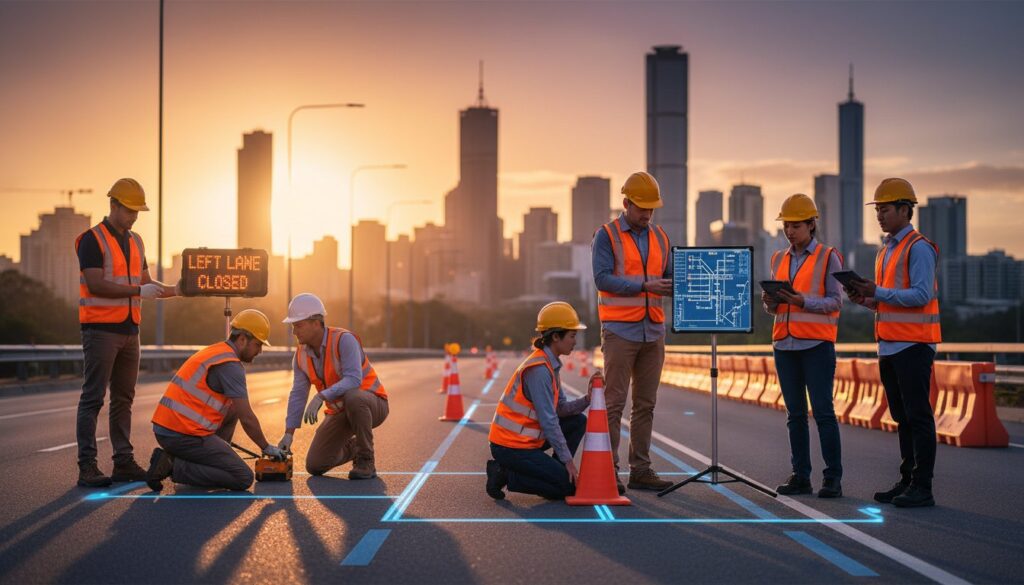
In the high-stakes world of Queensland infrastructure, TMI isn’t a warning about oversharing; it’s a vital safety mandate that keeps 34,000 kilometres of state-controlled roads moving. If you’ve spent any time on a Brisbane worksite, you’ve likely asked yourself: what is tmi and how does it differ from basic traffic control? While the acronym might be common slang, in our industry, it stands for Traffic Management Implementation. It’s the critical link between a technical plan and a safe, live environment. This role is essential for managing the freight demand that’s expected to double over the next 20 years.
You probably recognize that keeping road users safe while Queensland’s population grows by 50 percent is a serious responsibility. It’s natural to feel overwhelmed by shifting TMR requirements or the move toward national Austroads harmonization. This guide promises to clear that confusion by explaining the RIIWHS302E competency and the path to becoming a qualified implementer. We’ll preview the specific prerequisites for the three-year accreditation and help you find a reputable Brisbane RTO to secure your certification.
Key Takeaways
- Understand what is tmi in a professional context and why it is the vital link between planning and site safety.
- Learn to interpret complex Traffic Guidance Schemes (TGS) and Traffic Management Plans (TMP) to ensure full compliance on every job.
- Distinguish between implementation and design roles to determine the best path for your career progression in the traffic industry.
- Gain clarity on the specific TMR standards and MUTCD Part 3 requirements that apply to all Brisbane infrastructure projects.
- Discover the steps to obtain your RIIWHS302E competency through a registered training organization with deep local expertise.
What is TMI? From Social Slang to Essential Road Safety
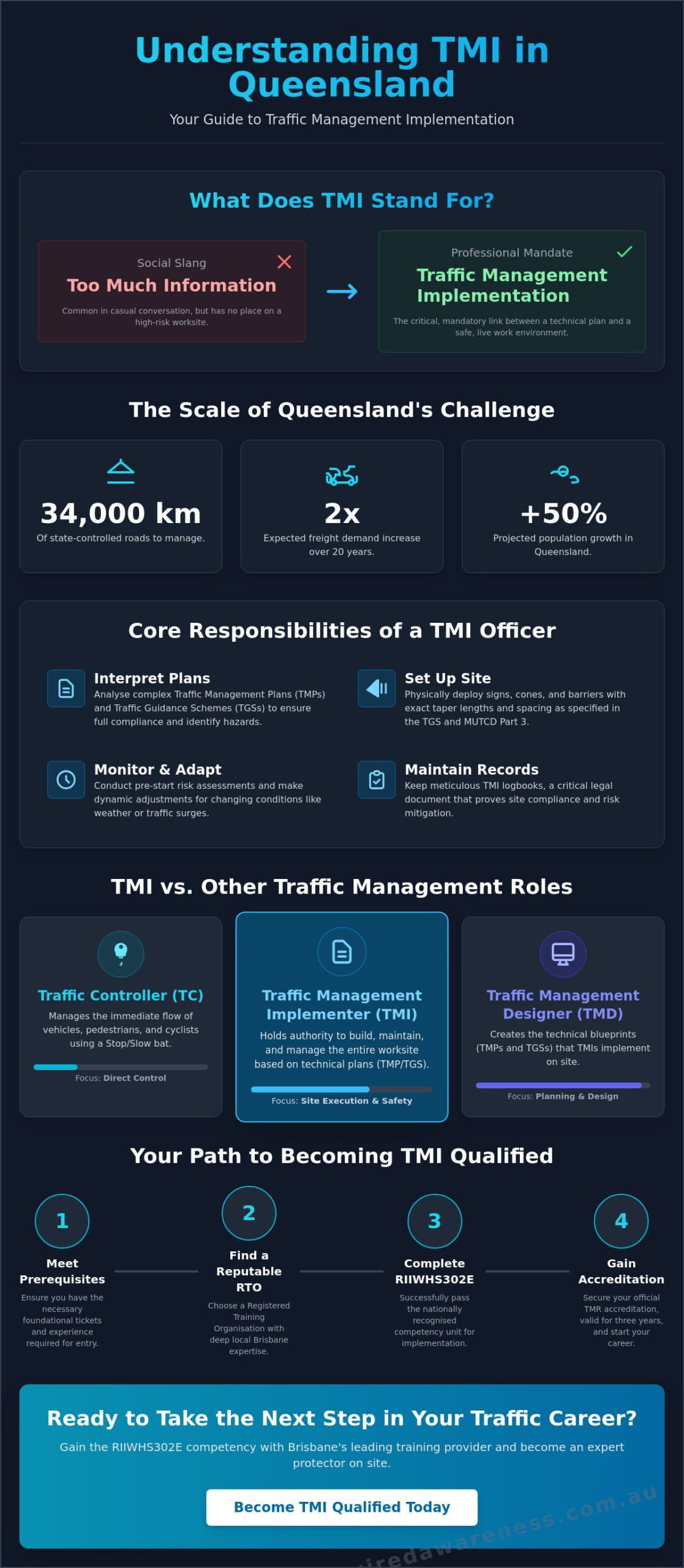
Search for the term “TMI” on any social media platform and you’ll find thousands of posts about “Too Much Information.” While that slang is common in casual conversation, it has no place on a high-risk worksite. In the Queensland infrastructure sector, asking what is tmi leads to a much more critical answer. It stands for Traffic Management Implementation. This is a mandatory safety qualification required for anyone responsible for the physical setup and ongoing maintenance of traffic control devices on Queensland roads. It’s the technical backbone of road worker protection.
At Acquired Awareness, we view TMI as more than just another industry acronym. It represents a commitment to the public and our staff. We act as the Expert Protector on site. This means we take full ownership of the environment, ensuring that every cone, sign, and barrier is placed with absolute precision. Understanding What is Traffic Management at a foundational level helps professionals appreciate why these rules exist. We aren’t just moving cars. We’re managing lives. A single misplaced sign can lead to a catastrophic incident, which is why the TMI qualification is non-negotiable for anyone leading a crew on the ground.
The Pivot: Why Context Matters in Traffic Control
New entrants often find the “alphabet soup” of the Brisbane construction industry confusing. Between TCs, TMIs, and TMDs, the jargon can feel like a barrier to entry. However, the term “Implementation” is the most important part of the acronym. It represents the physical transition from a theoretical plan to a live, functioning site. Without proper implementation, even the most sophisticated traffic plan fails to protect the people behind the barriers. It’s the difference between a safe workspace and a chaotic hazard.
Implementation is the active process of turning a paper plan into a real-world safety zone. It involves a high level of responsibility and technical knowledge. A TMI qualified person must understand how to read complex diagrams and translate them into the physical world. TMI is the specific process of setting up, maintaining, and pulling down traffic guidance schemes according to the Queensland Manual of Uniform Traffic Control Devices (MUTCD) Part 3. We don’t leave safety to chance. We follow the standards to ensure every person on the road gets home safely at the end of the day.
The Core Responsibilities of Traffic Management Implementation (TMI)
Many people entering the industry ask what is tmi beyond the basic entry-level duties of a traffic controller. While a Traffic Controller (TC) manages the immediate flow of vehicles using a Stop/Slow bat, the TMI officer holds the authority to build and manage the site itself. This role requires a deep understanding of the Queensland Guide to Traffic Management (QGTM). You aren’t just standing on a corner; you’re actively interpreting technical diagrams to protect lives. It’s a leadership position that demands discipline and technical proficiency.
A TMI professional takes responsibility for several high-stakes tasks on a daily basis:
- Analysing Traffic Management Plans (TMP) to identify site-specific hazards before work begins.
- Setting up Traffic Guidance Schemes (TGS) with exact taper lengths and sign spacing.
- Deploying physical infrastructure like high-visibility barriers, bollards, and advanced warning signs.
- Conducting pre-start risk assessments to account for Brisbane’s unique road conditions and peak hour surges.
Translating Plans into Safe Worksites
The TMI officer acts as the essential bridge between the traffic designer and the road crew. Designers create the blueprints, but the TMI professional turns those lines on a page into a physical reality. This requires mathematical precision. If a sign is five metres out of place, it might not give a driver enough time to react. We monitor the site flow constantly. If a sudden Brisbane storm hits or traffic volume spikes unexpectedly, the TMI must make dynamic adjustments to keep the site compliant and safe.
Safety First: The Legal Responsibility of a TMI
Holding a TMI qualification carries a significant duty of care. You’re legally responsible for the safety of the construction crew, the motoring public, and your fellow traffic controllers. This responsibility extends to meticulous record-keeping. The TMI logbook serves as a critical legal document that proves the site was compliant at all times. A TMI’s primary goal is the mitigation of risk through disciplined execution of safety plans.
Precision in these tasks is what separates a professional operation from a dangerous one. If you’re ready to step into this leadership role, our Traffic Management Implementation courses provide the technical foundation you need to manage high-risk zones with confidence. We don’t just teach the rules; we mentor you on how to apply them when the stakes are highest.
TMI vs. TMA vs. TMD: Choosing the Right Traffic Career Path
The traffic management industry uses a lot of acronyms that can confuse even the most experienced site workers. When people ask what is tmi, they’re often trying to distinguish it from other specialized roles like TMA or TMD. Each of these qualifications represents a different level of responsibility and a unique environment on the worksite. Understanding these distinctions is the first step toward building a sustainable career in Queensland’s growing infrastructure sector. We believe in providing clear, authoritative guidance to help you find the right path for your skills and goals.
The industry is generally divided into three core functions that must work in unison to ensure safety. TMI (Implementation) professionals are the “doers” who physically set up the site and manage the live environment. TMA (Truck Mounted Attenuator) operators are specialist drivers who use heavy vehicles equipped with crash-absorbing cushions to protect the rear of a worksite. Finally, TMD (Traffic Management Design) experts are the office-based professionals who develop the complex plans that everyone else follows. All these roles must adhere to the TMR Standards for TMI in Brisbane to maintain a compliant and safe road network.
Career Progression in South East Queensland
Most successful professionals in our industry follow a logical, sequential path. You’ll usually start by completing a Traffic Control Course Brisbane to learn the fundamentals of directing traffic. Moving into a TMI role is the natural next step toward leadership. As a TMI supervisor, you take on greater responsibility for the entire crew’s safety. This jump in accountability usually comes with a corresponding increase in salary and job stability. It marks your transition from a team member to a disciplined leader who takes ownership of the worksite environment.
Which Qualification Do You Need?
Choosing the right qualification depends on your preferred work environment and long-term career vision. If you enjoy being active on-site and managing physical infrastructure, the TMI qualification is your best asset. For those who prefer a technical, office-based role, TMD is the ultimate goal. However, for maximum employability in South East Queensland, we recommend holding both your TC and TMI tickets. This dual capability makes you an invaluable asset to any project. It shows you have the versatility to handle any situation that arises on a high-risk site. Your next move should align with where you see yourself in the next three to five years.
Queensland Compliance: TMR Standards for TMI in Brisbane
The Queensland Department of Transport and Main Roads (TMR) serves as the ultimate authority for road safety and infrastructure management across the state. When professionals ask what is tmi in a regulatory sense, they’re referring to the strict adherence to the Manual of Uniform Traffic Control Devices (MUTCD) Part 3. This document, alongside the Queensland Guide to Traffic Management (QGTM), dictates exactly how every sign and barrier must be placed. Because TMR is responsible for 34,000 kilometres of the state’s road network, maintaining these standards is a massive undertaking that requires disciplined, qualified personnel.
Compliance isn’t a one-time achievement. Your TMI accreditation is valid for exactly three years from the date of issue. This ensures that every worker on a Brisbane site remains current with the latest safety protocols and legislative changes. As Queensland moves toward harmonizing with the Austroads’ Guide to Traffic Management 2020, staying updated through a licensed RTO is the only way to ensure your skills meet the current legal requirements. We take pride in our role as an educator, ensuring our students don’t just pass a test but truly understand their professional responsibility.
Navigating TMR Requirements for Worksites
TMR requirements vary significantly depending on the environment. High-speed motorways require much longer tapers and advanced warning distances compared to quiet suburban Brisbane streets. Any worker operating on a state-controlled road must hold TMR-approved training to be legally compliant. Failing to meet these standards leads to more than just fines. Compliance audits are frequent, and a non-compliant site can be shut down immediately, causing massive delays to critical infrastructure projects. Our focus is on total risk mitigation to prevent these outcomes before they happen.
Local Knowledge: Brisbane’s Unique Traffic Challenges
Working in South East Queensland presents specific challenges that generic training can’t cover. Major projects like the Cross River Rail require intricate traffic management shifts that evolve daily. Local Brisbane weather also plays a significant role. Sudden afternoon storms can turn a standard worksite into a high-risk zone in minutes. A TMI professional must know how to adjust their setup for reduced visibility and wet road surfaces instantly. This local expertise is the AATM advantage. We know Brisbane’s roads because we live and work on them every day. If your accreditation is approaching its expiry, you can book your TMI renewal course to maintain your standing as a qualified safety leader.
How to Become TMI Qualified with Acquired Awareness Traffic Management
Achieving your accreditation begins with a clear understanding of what is tmi and why the training process is so rigorous. Acquired Awareness Traffic Management operates as a Registered Training Organisation (RTO #40905) licensed by the Queensland Department of Transport and Main Roads. Choosing a certified RTO is non-negotiable. It ensures your qualification is recognized on every state-controlled road in Queensland. Our TMI New Entrant course provides the technical foundation needed to transition from a basic traffic controller to a site leader. We take this responsibility seriously because we know that the safety of the Brisbane community depends on the quality of our graduates.
The training for national competency unit RIIWHS302E involves a structured, two-part process. You’ll complete a minimum of eight hours of theory where we cover the technicalities of the Queensland Guide to Traffic Management. This is followed by a practical component requiring a minimum of three on-the-job setups. This hands-on approach allows you to practice placing signs, cones, and barriers in a controlled environment before you face the complexities of a live worksite. We don’t just explain the rules; we demonstrate how to apply them with precision and discipline.
The Acquired Awareness Traffic Management Training Experience
Our instructors are industry veterans who have managed major roadworks across South East Queensland for decades. They bring real-world scenarios into the classroom, moving beyond the textbook to prepare you for actual site challenges. You’ll have access to modern equipment and a curriculum that reflects the latest TMR-approved standards. Our commitment to integrity and excellence ensures that every student leaves our facility with the confidence to act as an Expert Protector on any road project. We pride ourselves on being a reliable partner in your professional development.
Enrolment and Career Support
We’ve simplified the enrolment process to support both individual career seekers and large corporate teams. Whether you choose to train at our Brendale or Yatala locations, you’ll receive the same high level of professional mentorship. Our relationship with students doesn’t end when the certificate is issued. We offer post-course support to help you find work in the growing South East Queensland traffic industry. Our reputation for producing disciplined, safety-conscious professionals makes our graduates highly sought after by local employers. Ready to lead on-site? Book your TMI course with Acquired Awareness Traffic Management today.
Secure Your Future in Queensland’s Infrastructure
You now have a definitive answer to what is tmi and why it serves as the technical backbone of road safety in South East Queensland. Transitioning from an entry-level traffic controller to a qualified TMI supervisor requires a serious shift in responsibility and a deep commitment to rigorous TMR standards. We’ve seen how implementation bridges the critical gap between a designer’s plan and a live, high-risk environment. This role is about more than just placing signs; it’s about the disciplined mitigation of risk for every worker and road user on our network.
As an accredited training provider (RTO #40905), Acquired Awareness Traffic Management is ready to help you take that next professional step with confidence. Our dual training locations in Brendale and Yatala provide easy access to the latest curriculum and modern safety equipment. We’ve maintained an industry-leading safety record across SEQ for years, and we’re proud to mentor the next generation of expert protectors. Your journey toward site leadership starts with the right education and a safety-first mindset.
Start your TMI career with Brisbane’s safety experts at Acquired Awareness Traffic Management today. We’re here to ensure you get the training you need to excel.
Frequently Asked Questions
Is TMI the same as a Traffic Control ticket?
No, they are distinct qualifications with different responsibilities. A Traffic Control ticket allows you to direct traffic using a Stop/Slow bat, while the TMI qualification authorizes you to physically set up and maintain the worksite. If you’re asking what is tmi in comparison to TC, think of it as the difference between following a plan and being the one responsible for building the safety zone.
How long does a TMI course take to complete in Brisbane?
A TMI course for new entrants requires a minimum of eight hours of theory followed by a practical assessment component. This practical part must include at least three on-the-job setups to demonstrate your competency in a live environment. We schedule these sessions throughout the month at our Brendale and Yatala facilities to help students meet TMR requirements without delay.
Can I work as a TMI officer without a White Card?
No, you can’t work as a TMI officer or even enrol in the training without a valid QLD White Card. The White Card is a mandatory prerequisite proving you’ve completed general construction induction training. Safety is our North Star, and ensuring every worker has foundational safety knowledge is the first step toward managing a secure site.
What is the difference between TMI and TMD in QLD?
TMI focuses on the physical implementation of existing plans, while TMD is a higher-level qualification for designing those plans. Implementers are the “doers” who interpret Traffic Guidance Schemes on the ground to protect the crew. Designers are the office-based experts who develop the technical blueprints according to the Queensland Guide to Traffic Management.
How much does a TMI qualified worker earn in South East Queensland?
TMI qualified workers generally earn a higher hourly rate than entry-level traffic controllers because of their increased legal responsibility. While specific rates vary based on the employer and the complexity of the project, the transition to a TMI role is a recognized step toward leadership. This qualification makes you a more valuable asset for major Brisbane infrastructure projects.
What happens if my TMI ticket expires?
If your ticket expires, you lose your legal authorization to work on state-controlled roads in Queensland. Your accreditation is valid for exactly three years from the date of issue. You’ll need to complete a renewal course before that expiry date to maintain your standing and avoid the need to retake the entire new entrant course.
Do I need my own vehicle to work in Traffic Management Implementation?
Most traffic management companies in Brisbane require you to have reliable transport and a valid driver’s license. Worksite locations change daily, and you’re often required to reach sites at times when public transport isn’t available. Having your own vehicle is a practical necessity for maintaining the flexibility this industry demands, and protecting your transport with professional security insights from safeandsoundmobile.co.uk can help safeguard your ability to get to every shift.
Can I do my TMI training online in Queensland?
No, you can’t complete TMI training entirely online because TMR standards require a physical practical assessment. While some theory may be delivered in a classroom setting, you must perform a minimum of three physical on-the-job setups to be deemed competent. This ensures you can safely manage real-world traffic scenarios under the guidance of our expert mentors.