Blog
Recent Articles
Traffic Control Course Gold Coast: Your 2026 Guide to Getting Certified
May 4, 2026
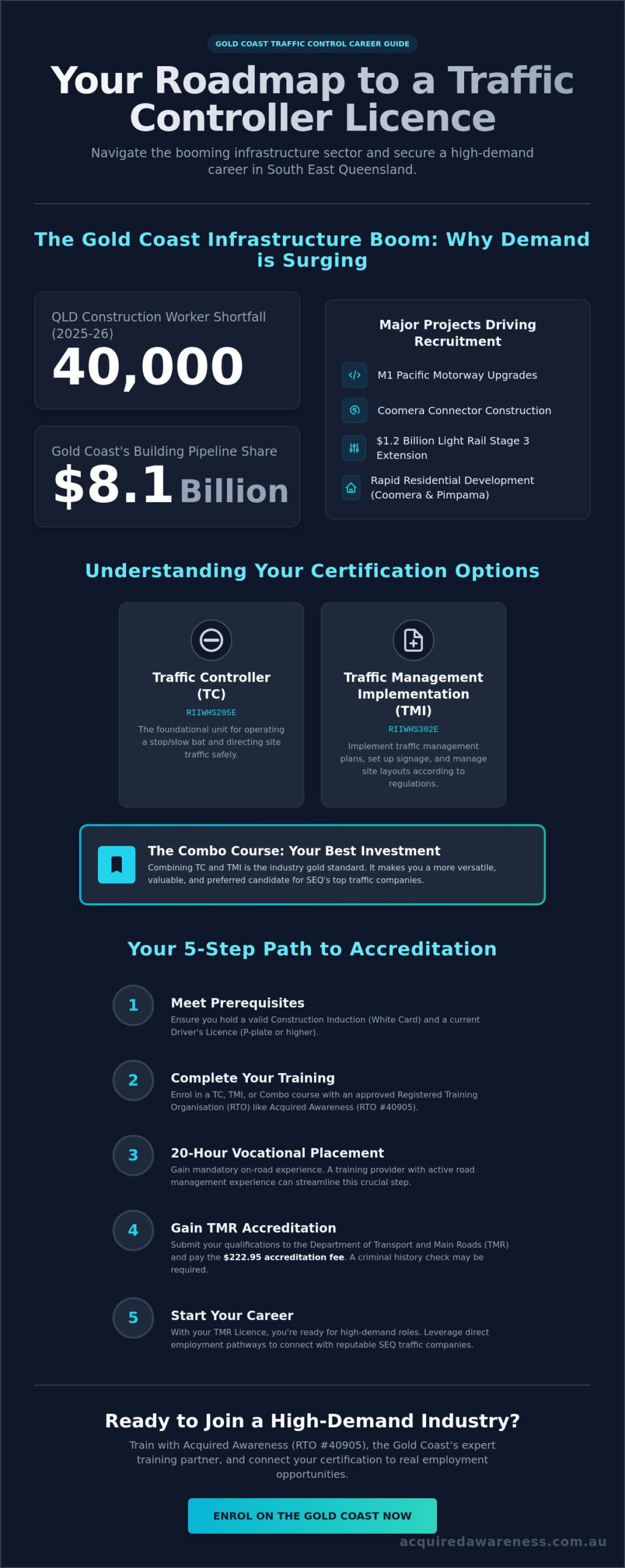
Queensland is currently facing a shortfall of approximately 40,000 construction workers for the 2025-26 period. With the Gold Coast accounting for an $8.1 billion share of the state’s building pipeline, there’s a massive demand for safety professionals on our roads. You likely know that the industry is booming, but finding the right traffic control course gold coast often feels complicated due to confusing course codes and the mandatory 20-hour vocational placement requirement.
This guide simplifies the entire process so you can secure your QLD Traffic Controller Retail License with confidence. We’ll break down the $222.95 TMR accreditation fee, explain the difference between TC and TMI certifications, and show you how to prepare for high-speed environments like the M1. You’ll discover exactly what’s needed to meet RIIWHS205E standards and how to land a role with a reputable South East Queensland traffic company. From understanding the $1.2 billion Light Rail Stage 3 project to navigating your criminal history check, we provide the clear, safety-focused roadmap you need to start your career.
Key Takeaways
- Identify the major infrastructure projects, such as the M1 upgrades and Coomera Connector, that are driving the current demand for skilled traffic staff.
- Navigate the specific differences between Traffic Control (TC) and Traffic Management Implementation (TMI) to ensure you select the right traffic control course gold coast for your career goals.
- Review the mandatory prerequisites, including a valid White Card and Driver’s Licence, that are essential for successful TMR accreditation.
- Discover how choosing a training provider with active road management experience can streamline your path to completing the required 20-hour vocational placement.
- Gain insights into the direct employment pathways available through Acquired Awareness, connecting your certification to high-demand roles across South East Queensland.
The Gold Coast Infrastructure Boom: Why Traffic Control is 2026’s Top Career Move
The Gold Coast skyline is currently defined by more than just high-rises; it is shaped by a massive surge in transport and civil works. With an $8.1 billion share of Queensland’s building pipeline, the region is undergoing a total transformation. Major projects like the M1 Pacific Motorway upgrades and the ongoing construction of the Coomera Connector have turned South East Queensland into a high-activity zone. This “Big Build” has created a critical need for safety professionals. Queensland faces a projected shortfall of 40,000 construction workers through 2026. Enrolling in a traffic control course gold coast is no longer just about getting a job; it’s about entering a sector where your skills are in permanent demand.
We view traffic management as a professional discipline focused on “Expert Protection.” It’s a role that requires discipline, calm authority, and a commitment to public safety. Effective Road traffic control ensures that even the most complex construction sites remain safe for both workers and the motoring public. For those seeking a career change, the industry offers a unique blend of lifestyle benefits. You’ll find flexible shift patterns and competitive hourly rates that reflect the high level of responsibility you carry on-site. It’s a dependable path for those who take pride in maintaining order in high-risk environments.
High-Demand Zones: From Southport to Coolangatta
Activity is concentrated in several key hubs across the coast. The northern Gold Coast corridor, specifically around Coomera and Pimpama, is seeing rapid residential development that requires constant road management. In the central districts, the $1.2 billion Light Rail Stage 3 extension continues to drive recruitment. Beyond construction, the Gold Coast’s tourism and event industry relies on accredited controllers to manage crowds and vehicles during major international festivals. Whether it’s a highway upgrade or a community event, the need for professional oversight is constant from the northern suburbs down to Coolangatta.
Earning Potential for Gold Coast Controllers
Entry-level positions in South East Queensland offer strong financial foundations. New entrants typically start on industry-standard award rates, but the real earning potential lies in the variety of the work. Major infrastructure projects often require 24/7 operations. Choosing night shifts or weekend rosters on highway projects can significantly boost your take-home pay through penalty rates. We’ve found that students who train with an industry leader like AATC are often better prepared for these high-stakes environments. When you demonstrate competence and a “safety first” mindset, you become a priority for the most reputable traffic companies in the region.
Understanding the QLD Traffic Control Course: TC, TMI, and Combo Options
Selecting the right traffic control course gold coast is the first step toward a career where safety and compliance are paramount. In Queensland, the Department of Transport and Main Roads (TMR) manages the Traffic Controller Accreditation Scheme. This regulatory framework ensures that every individual on the road meets rigorous safety standards. To gain your license, you must train with a Registered Training Organisation (RTO) like Acquired Awareness (RTO #40905). We don’t just teach the basics; we provide the technical depth required to manage live traffic environments with total control.
While you can choose to study these units individually, the “Combo” course is the industry gold standard. It combines the Traffic Controller (TC) and Traffic Management Implementation (TMI) units into a streamlined learning path. Holding both qualifications makes you significantly more versatile on-site. It allows you to transition from holding the bat to setting up complex signage arrays as the project requires. Most reputable SEQ employers prefer candidates with both tickets. It simplifies roster management and increases site efficiency, making you a more valuable asset to any team. Our traffic control course gold coast curriculum is specifically designed to exceed these minimum industry standards.
RIIWHS205E: Control Traffic with a Stop/Slow Bat
The RIIWHS205E unit is the foundation of the industry. It focuses on the practical application of the stop/slow bat to manage vehicle flow. You’ll learn essential communication protocols, including the use of two-way radios to coordinate with team members across the site. Safety is the primary mandate here. We emphasize risk mitigation, especially when working on high-speed Gold Coast roads. Before you can enroll, you must hold a valid White Card. This ensures you have the baseline safety knowledge required for any construction environment in Australia.
TMI: Setting Up the Site
So, what is TMI? This qualification moves beyond the bat to the physical implementation of Traffic Management Plans (TMPs). It involves the precise placement of signs, bollards, and other safety devices to guide motorists through a worksite. It’s an essential skill for anyone looking to progress into team leader or supervisor roles. TMI and TC work together to create a “Safety First” environment. One manages the human element of traffic flow, while the other manages the infrastructure. If you’re serious about a long-term career, exploring our training programs is the most direct way to secure your future in the field.
Choosing the Right Gold Coast Training Provider: Beyond the Price Tag
When searching for a traffic control course gold coast, it’s tempting to choose the provider with the lowest advertised price. However, a cheap course often becomes expensive if the Registered Training Organisation (RTO) fails to provide placement support. In Queensland, new controllers must complete 20 hours of mandatory vocational placement on a live worksite. Many budget providers leave students to find these hours themselves. This can lead to significant delays in accreditation and lost income. We believe training should be a seamless bridge to employment, not a hurdle to clear.
The “AATC Advantage” stems from our dual identity. Acquired Awareness is both a top-tier RTO and a major traffic management service provider (AATM). Our instructors aren’t just teachers; they are active industry professionals who manage safety on high-risk projects daily. This ensures you receive training that’s current, compliant, and grounded in real-world logic. When comparing providers, use this checklist to ensure you receive quality instruction:
- Accreditation: Confirm the RTO is recognized by TMR and holds a valid registration (RTO #40905).
- Placement Support: Ask specifically if they provide the mandatory 20 hours of on-site experience.
- Equipment: Ensure they use modern signage, radios, and safety gear during simulations.
- Trainer Currency: Verify that instructors have recent experience on major South East Queensland roads.
The Importance of Industry-Linked Training
Learning from active traffic managers is superior to classroom-only theory. Our instructors bring actual Gold Coast scenarios into our Yatala training centre. They discuss the specific challenges of managing high-speed traffic on the M1 or navigating the tight constraints of the Light Rail construction zones. This “Expert Protector” mindset prepares you for the mental demands of the job. You don’t just learn how to hold a bat; you learn how to read the road and mitigate risks before they become incidents. We take pride in producing graduates who are ready for the field on day one.
Location and Accessibility for Gold Coast Students
Accessibility is a key factor for busy professionals. Our training facilities are strategically located in Yatala and Brendale to serve the entire South East Queensland corridor. The Yatala centre is particularly convenient for those seeking a traffic control course with easy access from the M1 Pacific Motorway. We understand that many students are balancing current jobs with their career transition. To accommodate this, we offer flexible scheduling, including weekend options, to ensure you can get certified without disrupting your existing commitments. It’s a professional, organized approach to career development.
Your Step-by-Step Guide to Getting a Traffic Control Ticket on the Gold Coast
Securing your accreditation is a structured process that demands attention to detail and a commitment to safety. You don’t just “get a ticket”; you earn the right to manage public safety on our roads. Completing a traffic control course gold coast provides the technical foundation, but you must follow a specific sequence of steps to satisfy the Department of Transport and Main Roads (TMR) requirements. This pathway ensures that every controller on a site like the M1 upgrade is competent, reliable, and ready for the high-risk nature of the work.
- Step 1: Meet the Prerequisites. You must hold a valid General Construction Induction Card (White Card) and a current open or provisional driver’s licence. These are mandatory entry requirements.
- Step 2: Classroom Training. Complete a 1-day theory session and practical simulation at a registered facility. This covers the core units RIIWHS205E and RIIWHS302E.
- Step 3: Vocational Placement. You’re required to complete 20 hours of mandatory practical experience on a live worksite under the supervision of a qualified controller.
- Step 4: Competency Assessment. Once your hours are logged, your trainer will assess your evidence to ensure you meet industry standards.
- Step 5: TMR Application. Submit your final paperwork and fees to TMR to receive your official Industry Authority Card, often called a “Blue Card.”
Mastering the 20-Hour Vocational Placement
The 20-hour placement is often where students feel the most pressure. It’s your first real opportunity to apply classroom theory to the unpredictable environment of a live road. During this time, you’ll work alongside experienced professionals, learning how to manage vehicle flow and communicate effectively under pressure. We don’t leave our students to struggle with this requirement. Through our industry partnerships, we help bridge the gap between training and experience, ensuring you complete your hours efficiently. To succeed, show up early, maintain a “safety first” attitude, and treat every hour as an extended job interview. Many students find that a strong performance during placement leads directly to a permanent position. If you’re still exploring your options across the region, our guide to finding a traffic control course near me in Brisbane and SEQ covers the full range of TMR-compliant training locations available to you.
TMR Accreditation: The Final Hurdle
After completing your traffic control course gold coast and placement, you must finalize your accreditation with the state government. As of February 2026, the fee for a new 3-year traffic controller accreditation is $222.95. You may also need to pay a $50.95 fee for a criminal history check, which became standard for new applications in July 2025. Accuracy is vital during this stage. Any errors in your paperwork can delay your ability to start work. Once your application is approved, your traffic control ticket is valid for three years. If you’re ready to take the first step toward a high-demand career, you can book your training session today with our expert team.
Start Your Career with Acquired Awareness: The Gold Coast’s Expert Training Partner
Choosing Acquired Awareness means training with a team that takes full ownership of the environments they manage. We aren’t just a classroom-based RTO; we are a seasoned leader in the field. Our dual identity as an elite service provider and a registered training organisation gives our students a distinct advantage. When you complete a traffic control course gold coast with us, you’re learning from the same experts who protect the public on Queensland’s most complex infrastructure projects. We maintain a deep sense of professional responsibility, ensuring every graduate is prepared for the high-risk nature of the job.
Our commitment to “Safety First” is more than a slogan; it’s our North Star. We take pride in our Australian roots and our role as a local, family-founded partner that genuinely cares about the well-being of our staff. This community-focused approach ensures that you aren’t just another number in a classroom. We provide a steady, unflappable environment where you can build the confidence needed to work on high-speed roads. By training at our Yatala or Brendale facilities, you’re aligning yourself with a business that leaves nothing to chance.
Beyond the Ticket: Career Progression at AATM
We view your initial accreditation as the beginning of a long-term professional journey. Many of our graduates transition directly into roles with our traffic management service arm, AATM. This direct pathway provides immediate stability and the opportunity to work on major SEQ projects. As you gain experience, we support your progression into team leader or supervisor positions. We encourage our staff to pursue a traffic management course to expand their technical capabilities and take on higher levels of responsibility. This focus on internal growth is why so many professionals choose to stay within our ranks for years.
Ready to Lead the Way? Enrol Today
Our training centres in Yatala and Brendale host regular intakes to meet the growing demand for accredited controllers. We offer a methodical and rhythmic learning experience that mirrors the structured nature of traffic control itself. To secure your spot, you can view our upcoming dates and book through our online portal. We provide all the necessary tools and guidance to help you navigate the compliance requirements and start your career with integrity. Join the ranks of the Expert Protectors and help us ensure the safety of Queensland’s road users. Book your traffic control course gold coast today and take control of your professional future.
Secure Your Place in Queensland’s Infrastructure Future
The Gold Coast is entering a period of unprecedented growth. With the $8.1 billion construction pipeline and major M1 upgrades, the demand for accredited controllers has never been higher. You now have the roadmap to navigate the TMR accreditation process and the 20-hour vocational placement requirement. Choosing a traffic control course gold coast with an industry leader ensures you aren’t just getting a ticket; you’re gaining the protection and expertise of a seasoned mentor. We leave nothing to chance when it comes to your training and safety, much like the rigorous instructional standards found at Twobar Scuba for those mastering technical skills in other high-stakes environments.
We take pride in our role as both a registered training organisation (RTO #40905) and an elite service provider. This dual identity allows us to offer direct industry placement support that budget providers simply can’t match. We’re committed to delivering excellence and ensuring you’re ready for the road on day one. Book Your Gold Coast Traffic Control Course with AATC Today and join a team that prioritizes safety above all else. Your new career in South East Queensland is ready when you are.
Frequently Asked Questions
How long does a traffic control course on the Gold Coast take to complete?
The classroom component of a traffic control course gold coast takes one full day to complete. This session covers the mandatory theory and practical simulations required by TMR. After the classroom day, you must complete 20 hours of vocational placement on a live worksite. The total time depends on how quickly you schedule your placement hours; however, most students finish the entire process within two to three weeks.
What is the total cost of getting a traffic control ticket in QLD including TMR fees?
The total investment includes the training course and mandatory government fees. A new traffic controller course typically costs between $450 and $499. Additionally, the Queensland Government requires a $222.95 fee for the 3-year accreditation as of February 6, 2026. If you require a criminal history check, an additional $50.95 fee applies. Factoring in these verified costs ensures you’re prepared for the full accreditation process without financial surprises.
Do I need a manual driver’s licence to become a traffic controller on the Gold Coast?
You don’t need a manual driver’s licence to work as a traffic controller in Queensland. However, you must hold a current open or provisional licence to be eligible for accreditation. While an automatic licence is sufficient for the Industry Authority Card, having a manual licence can be an advantage. Some employers prefer manual drivers for TMI roles where you may need to operate various site vehicles or utility trucks.
Can I do my 20 hours of vocational placement with Acquired Awareness?
Yes, we actively assist our students in completing their 20-hour mandatory vocational placement. Because we operate as both an RTO and a major traffic management service provider, we have the infrastructure to facilitate these hours. We don’t believe in leaving students to find their own placements. This support is a core part of our commitment to helping you start your career as quickly and safely as possible.
Is the traffic control course hard to pass for beginners?
The course is designed for entry-level participants, but it requires a high level of focus and responsibility. You’ll need to demonstrate competence in using the stop-slow bat and communicating via two-way radio. Our instructors act as mentors to guide you through the technical units. While the material is accessible, we maintain strict safety standards to ensure every graduate can manage high-risk environments with total confidence and integrity.
How often do I need to renew my QLD traffic control accreditation?
Your Queensland Traffic Controller Industry Authority Card is valid for exactly three years from the date of issue. To maintain your accreditation, you must complete a renewal course and pay the 3-year renewal fee of $222.95. This rate is current as of February 6, 2026. It’s essential to track your expiry date to avoid working with an invalid ticket; doing so would be a major compliance breach and safety risk.
What is the difference between a Blue Card and a Yellow Card in traffic management?
In industry terms, a Blue Card refers to the Traffic Controller (TC) accreditation for using a stop-slow bat. A Yellow Card typically refers to the Traffic Management Implementation (TMI) qualification. While the TC role manages vehicle flow, the TMI role involves setting up signs and devices according to a traffic management plan. Holding both qualifications through a traffic control course near me in Brisbane and SEQ significantly increases your employability across South East Queensland corridors.
Are there traffic control jobs available on the Gold Coast immediately after the course?
Demand for accredited controllers is exceptionally high in 2026. Queensland currently faces a shortfall of approximately 40,000 construction workers, and the Gold Coast holds an $8.1 billion share of the building pipeline. Major projects like the M1 upgrades and Light Rail Stage 3 create immediate openings for qualified staff. Once you have your TMR accreditation, you’ll find numerous opportunities with reputable traffic companies throughout the South East Queensland region.