Blog
Recent Articles
Traffic Management Course Brisbane: Your 2026 Guide to QLD Certification
May 2, 2026
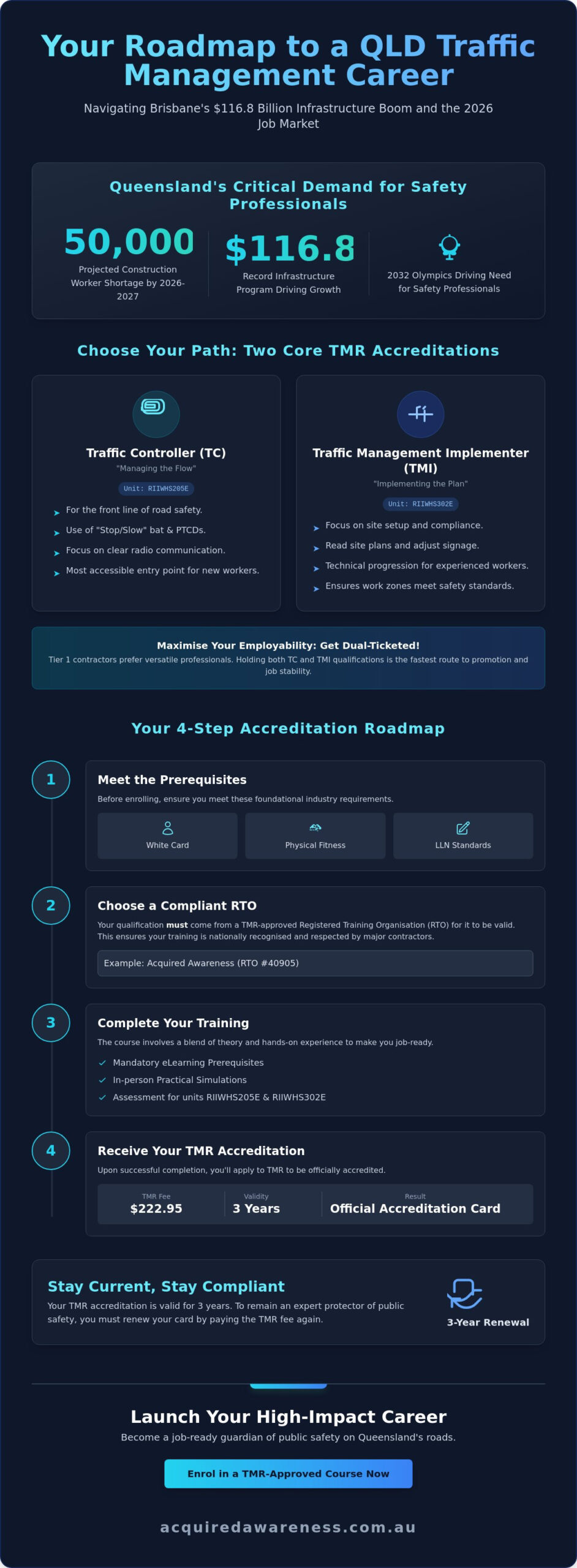
Queensland is currently facing a construction worker shortage expected to peak at over 50,000 people between 2026 and 2027. With a record $116.8 billion infrastructure program driving Brisbane’s growth, the demand for disciplined safety professionals has never been higher. It’s common to feel overwhelmed by industry acronyms or worry about whether a training provider is legitimate. You deserve a clear path to accreditation without the fear of paying for the wrong ticket. This guide ensures you select the right traffic management course to launch a stable, high-impact career.
We’ll provide a methodical breakdown of the $222.95 TMR accreditation fee, the mandatory eLearning prerequisites, and the specific RIIWHS205E and RIIWHS302E units required for compliance. You’ll gain a complete understanding of how to meet Queensland’s rigorous safety standards and prepare for major projects like the Cross River Rail, which is set to open in 2026. By the end of this article, you’ll have a certain roadmap to becoming a job-ready guardian of public safety on our local roads.
Key Takeaways
- Understand the current QLD regulatory landscape and why TMR compliance is the foundation of every professional traffic management course.
- Differentiate between Traffic Controller (TC) and Traffic Management Implementer (TMI) roles to choose the qualification that matches your career aspirations.
- Explore how practical simulations at our Brendale and Yatala facilities prepare you for the high-risk environments of Brisbane’s active road networks.
- Gain insights into how the 2032 Olympic infrastructure boom is driving a critical need for safety-conscious professionals across South East Queensland.
- Learn how training with an active industry leader provides a direct pathway from the classroom to a stable career on Tier 1 construction projects.
Understanding the 2026 Traffic Management Course Landscape in Brisbane
A traffic management course isn’t just a classroom requirement; it’s the legal gateway to working on any public road project in Queensland. The Department of Transport and Main Roads (TMR) serves as the regulatory backbone for our industry, setting the safety standards that keep workers and the public alive. In 2026, the landscape is defined by the full implementation of the Austroads Temporary Traffic Management (TTM) harmonisation. This initiative ensures that Brisbane’s roadwork practices align with national safety protocols while respecting the specific legislative requirements unique to Queensland’s infrastructure.
Professional training is non-negotiable because the stakes on a live site are absolute. Whether you’re managing a lane closure on the Bruce Highway or a pedestrian detour in the CBD, you’re responsible for human lives. High-quality training integrates global best practices in road traffic control to ensure every student understands risk mitigation and conflict management. We don’t just provide a “ticket.” We build the technical competence required to handle the unpredictable nature of Brisbane’s traffic flow with calm authority.
The Role of the Registered Training Organisation (RTO)
To work legally in QLD, you must obtain your qualification from a Registered Training Organisation (RTO) like Acquired Awareness (RTO #40905). There’s a vital distinction between a simple certificate of attendance and a nationally recognised unit of competency. RTOs are held to rigorous auditing standards, ensuring the training you receive is current, compliant, and respected by Tier 1 contractors. Choosing a reputable RTO ensures your accreditation is valid across Brisbane and the wider state, providing the professional stability you need in a high-risk sector. This emphasis on certified education is a global standard; for instance, professionals in the Malaysian region often turn to KLGreens for HRD Corp approved training that meets rigorous industry benchmarks.
Mandatory Requirements for Entry-Level Workers
Before you can enrol in a traffic management course, you must hold a valid General Construction Induction Card, or “White Card.” This is the foundational safety requirement for the industry. Beyond paperwork, the physical demands of the job are real. You’ll need a baseline level of fitness to stand for extended periods in the South East Queensland heat. Additionally, you must meet Language, Literacy, and Numeracy (LLN) standards. Clear communication is a safety mandate; you’ll need to read site plans, write incident reports, and communicate via UHF radio with total clarity. These prerequisites ensure that every trainee is prepared for the responsibility of the role.
Choosing Your Path: Traffic Control vs. Traffic Management Implementation
Deciding on your first traffic management course depends on where you see yourself on the worksite. The industry splits responsibilities into two primary streams: active control and site implementation. While both fall under Queensland’s Traffic Controller Accreditation Scheme, the daily tasks differ significantly. New entrants often find the Traffic Control (TC) path is the most accessible entry point, whereas the Traffic Management Implementation (TMI) path offers a technical progression for those with site experience.
Maximum employability in the 2026 Brisbane market requires versatility. Tier 1 contractors often look for “dual-ticketed” individuals who can transition between directing traffic and adjusting site signage. Enrolling in a comprehensive traffic management course that covers both disciplines is often the fastest route to a promotion. It’s important to remember that these qualifications aren’t permanent. Both TC and TMI accreditations expire after three years. For traffic controllers, the renewal involves a $222.95 fee payable to TMR for a new 3-year accreditation card. This cycle ensures you remain an expert protector of your team and the public by staying current with safety mandates.
The Traffic Control (TC) Course: Managing the Flow
This stream focuses on the RIIWHS205E unit, preparing you for the front line of road safety. You’ll learn the disciplined use of the “Stop/Slow” bat and the technical operation of Portable Traffic Control Devices (PTCDs). Clear communication is the priority here. You’ll practice precise two-way radio protocols to coordinate movements on high-volume arterials. For those starting from scratch, the Traffic Control Course Brisbane: Master the Skills for a Safety-First Career in 2026 provides the baseline skills needed to stand confidently on a live site. Professionals working across South East Queensland, including those seeking a traffic control course Gold Coast certification, will find that mastering these RIIWHS205E fundamentals is the essential first step regardless of location.
The Traffic Management Implementation (TMI) Course: Setting the Stage
TMI training, which covers the RIIWHS302E unit, shifts the focus to the physical environment. You’ll learn how to interpret a Traffic Guidance Scheme (TGS) and translate it into a safe, compliant work zone. This includes the strategic placement of multi-message signs, traffic cones, and safety barriers. Before starting this course, you must complete the “Working in Proximity to Traffic” (WIPT) eLearning through TMR’s Accelerate portal. This involves Part 1 (Awareness) and Part 2 (Works Protection Methods), each costing $39.60. It’s a role that demands a high level of integrity and attention to detail. If you want to understand the mechanics of site setup, our resource on What is TMI? A Guide to Traffic Management Implementation in Brisbane explains the technical requirements in depth. If you’re unsure which path fits your current experience, our team can help you select the right training package for your needs.
The Training Experience: What to Expect at Acquired Awareness
Training at Acquired Awareness Traffic Management is designed to bridge the gap between regulatory requirements and real-world execution. We operate dedicated facilities in Brendale and Yatala. These locations serve as controlled environments where you can master the technicalities of a traffic management course without the immediate pressure of live traffic. Our curriculum balances intensive classroom theory with rigorous on-road simulations. We believe that competence is built through repetition and expert mentorship. It’s not enough to know the rules; you must know how to apply them when conditions change rapidly.
We instill the “Expert Protector” mindset from the first hour of every session. You aren’t just a worker on a site; you are a guardian of public safety. Our trainers bring decades of combined experience from major South East Queensland infrastructure projects. They’ve managed complex sites on the Cross River Rail and various M1 upgrades. This frontline knowledge ensures you learn the nuances of the job that a textbook simply can’t provide. We take pride in our Australian roots and our role in building the state’s future. Our goal is to produce graduates who are disciplined, dependable, and ready to lead.
Practical Assessment: Proving Your Competency
Proving your competency requires more than passing a written test. You’ll undergo a practical assessment on a live or simulated site to demonstrate your ability to manage complex traffic flows. We place a heavy emphasis on critical scenarios, such as maintaining emergency vehicle priority during peak hour congestion. Learning these protocols is a core part of How to Get Your Traffic Control Ticket in Brisbane: The 2026 Step-by-Step Guide. We ensure you leave the traffic management course ready to react with composure when the unexpected happens on the road.
Compliance and Documentation
Safety on a Brisbane worksite is only as strong as the documentation supporting it. A significant portion of our training focuses on administrative integrity. You’ll learn to complete site diaries, risk assessments, and Traffic Guidance Scheme (TGS) logs with total accuracy. In 2026, TMR compliance is stricter than ever to ensure public safety and mitigate legal risks. Acquired Awareness Traffic Management ensures all paperwork meets the latest national standards, protecting both you and your employer from avoidable fines or safety breaches. We leave nothing to chance when it comes to compliance.
Why Brisbane Projects Demand Professional Traffic Management
Brisbane’s skyline is currently a testament to the $116.8 billion infrastructure program in motion across Queensland. As we move through 2026, the preparations for the Brisbane 2032 Olympic and Paralympic Games have shifted from early planning to intensive, high-stakes construction. This surge creates a critical demand for graduates of a high-quality traffic management course. Tier 1 contractors in South East Queensland don’t just look for a basic ticket; they seek professionals who understand the legal and safety complexities of a modern, high-risk worksite. They require individuals who can maintain site integrity under the pressure of tight deadlines and public scrutiny.
A common misconception is that traffic control involves “just standing around” with a bat. In reality, the role is defined by constant vigilance and rapid decision-making. You are the primary shield between high-speed traffic and the workers behind the barriers. Professional training teaches you to read the road, anticipate erratic driver behavior, and manage the 7.50% construction cost escalation by ensuring sites remain efficient and incident-free. High-quality training correlates directly with career longevity. When you demonstrate a disciplined approach to site protection, you become an indispensable asset to any project team. Workers searching for a traffic control course near me will find that accessible, TMR-compliant training across Brisbane and South East Queensland is the most direct route to becoming that indispensable asset.
Major SEQ Projects and Career Opportunities
The opening of the Cross River Rail in 2026 and the ongoing M1 Pacific Motorway upgrades are primary examples of projects requiring elite safety teams. These environments are increasingly adopting “smart” traffic management technology, including AI-driven monitoring and big data analytics to manage flow. Our courses prepare you for this technological shift, ensuring you’re as comfortable with digital monitoring tools as you are with physical signage. Brisbane’s unique geography, characterized by narrow suburban corridors and major river crossings, demands specialized local knowledge. We provide the context needed to manage these specific local challenges safely.
Safety First: The Acquired Awareness Mantra
At Acquired Awareness, “Safety First” is the North Star for everything we do. We weave this mantra into every module, emphasizing your responsibility to protect the public, your colleagues, and yourself. This culture of protection is what sets our graduates apart in the eyes of major employers. Integrity on the job leads to better outcomes for everyone involved in Queensland’s infrastructure. To begin your journey with a provider that prioritizes your professional standards, review our Traffic Control Course Brisbane: Your 2026 Guide to Getting Started.
Choosing a training provider that is also an active service provider gives you a distinct advantage in the 2026 job market. If you are ready to step into a role that demands discipline and offers genuine career stability, view our upcoming course dates and secure your place in Brisbane’s growing infrastructure sector.
From the Training Room to the Road: Launching Your Career
Applying for Work in Brisbane
In 2026, a professional traffic control resume must be concise and compliance-focused. You should clearly list your RTO-issued Statement of Attainment, your White Card, and your driver’s license status. Reliability is the most valued trait in this sector. Because of the 50,000-worker shortage facing Queensland, companies are looking for dependable individuals with their own transport and a “can-do” attitude. New entrants must also complete 20 hours of practical experience on a live site to finalize their TC qualification. We often look to our own graduates first when expanding our teams, as we know they have been trained to our elite safety standards. If you’re ready to start, you can apply for a position directly through our recruitment portal once your training is complete.
Next Steps: Booking Your Course
Securing your place in an upcoming traffic management course is a straightforward process. We hold regular sessions at our Brendale and Yatala facilities to accommodate the growing needs of the South East Queensland region. You can view our live training calendar online to find a date that fits your schedule. Whether you are a new entrant looking for your first ticket or an experienced professional needing a three-year refresher, our enrollment process is designed to be efficient and transparent. Join the ranks of Brisbane’s expert protectors and take ownership of your professional future. We are ready to help you ensure the safety of our roads and the success of our state’s infrastructure projects. Book your training today and start your journey with a partner that genuinely cares about your career.
Secure Your Future in Queensland’s Infrastructure Sector
Brisbane is undergoing a massive transformation, with a $116.8 billion infrastructure program driving demand for skilled safety professionals through 2026 and beyond. Choosing the right traffic management course is the most critical step you’ll take toward a stable career in this high-growth industry. You now understand the difference between TC and TMI roles, the necessity of TMR compliance, and how to navigate the 2026 Austroads harmonisation.
Training with Acquired Awareness (RTO #40905) means learning from an active service provider that manages major South East Queensland projects daily. Our facilities in Brendale and Yatala offer the practical environment you need to build confidence before stepping onto a live site. We take pride in our Australian roots and our mission to protect the public. Book Your Traffic Management Course in Brisbane Today to join our team of expert protectors. We’re ready to help you launch a rewarding career where your commitment to safety makes a real difference to our community.
Frequently Asked Questions
How long does a traffic management course take in Brisbane?
A standard traffic management course typically takes one full day of intensive classroom and practical training for each specific qualification. For the Traffic Controller (TC) ticket, you’ll also need to complete 20 hours of supervised practical experience on a live site after the initial training. Most students finish the theory and simulated assessment within eight hours, allowing them to begin their practical hours immediately.
What is the difference between a Traffic Controller and a Traffic Management Implementer?
Traffic Controllers manage the active flow of vehicles using “Stop, Slow” bats and portable traffic control devices to protect workers. Traffic Management Implementers focus on the physical setup of the work zone, including placing signs and barriers according to a Traffic Guidance Scheme. While a TC ensures immediate safety on the road, a TMI ensures the entire site is compliant with TMR standards before work begins.
Do I need a White Card before I start a traffic management course?
Yes, you must hold a valid General Construction Induction Card, or White Card, before enrolling in any traffic management course. This is a mandatory prerequisite for anyone entering a construction or roadwork site in Queensland. You’ll need to present this card during your enrollment to verify you have the foundational safety knowledge required for the industry.
How much can I expect to earn as a traffic controller in Brisbane in 2026?
Earnings for traffic professionals in 2026 are highly competitive because of the $116.8 billion infrastructure program and a projected shortage of 50,000 workers. While rates vary between employers, the high demand for certified staff often leads to opportunities for overtime and penalty rates on major projects. Tier 1 contractors typically offer higher pay scales for those who hold both TC and TMI qualifications.
Is my Queensland traffic control ticket valid in other Australian states?
Your Queensland accreditation is primarily for use within the state under TMR regulations. However, the 2026 Austroads harmonisation initiative has significantly improved the portability of these skills across state lines. While you might need to register with the local transport authority or complete a short bridging unit in another state, the core units of competency are nationally recognised.
How often do I need to renew my traffic management certifications?
You must renew your traffic management certifications every three years to remain compliant with Queensland regulatory requirements. This process involves completing a refresher course to update your skills on the latest safety protocols and MUTCD legislation. Staying current ensures you’re aware of new technologies and “smart” traffic systems being deployed across Brisbane’s infrastructure projects.
Can I do the traffic management course online?
No, you cannot complete a full traffic management course entirely online because of the mandatory practical assessment requirements. While the “Working in Proximity to Traffic” (WIPT) prerequisites are delivered via TMR’s online portal, the core training must happen in person. We provide hands-on instruction at our Brendale and Yatala facilities to ensure you can safely manage live traffic scenarios.
What equipment do I need to bring to my training at Acquired Awareness Traffic Management?
You must bring your own steel capped safety boots and a high visibility vest or shirt to every training session. We also require you to bring your current driver’s license and your White Card for identification and prerequisite verification. Acquired Awareness Traffic Management provides all the technical equipment, such as “Stop, Slow” bats and UHF radios, needed for your practical simulations during the course.