Blog
Recent Articles
Traffic Control Course Brisbane: Master the Skills for a Safety-First Career in 2026
April 29, 2026
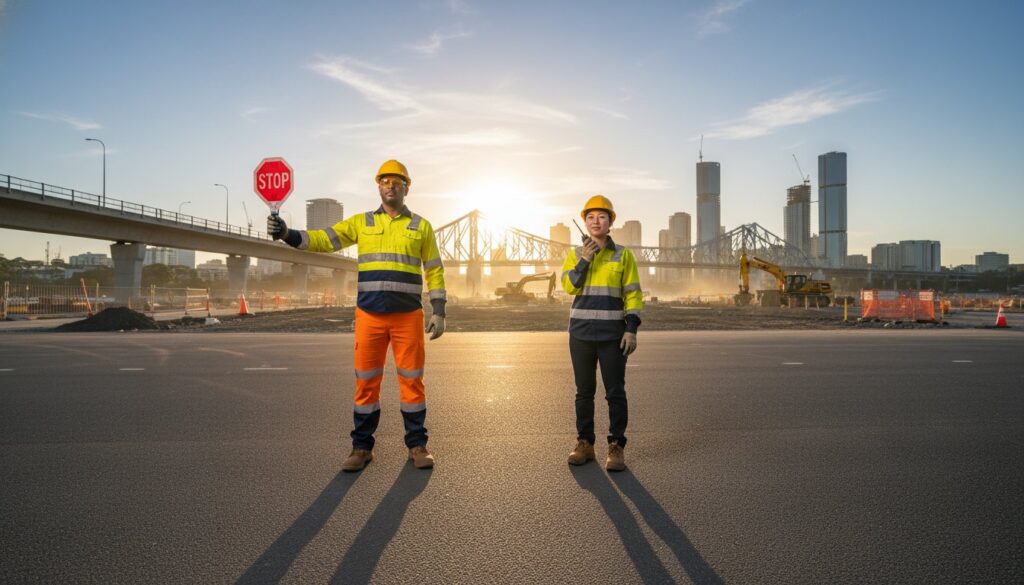
With over A$20 billion in infrastructure projects currently shaping the South East Queensland landscape, your entry into the workforce shouldn’t be stalled by paperwork or confusion. Securing a spot in a reputable traffic control course brisbane is the most direct path to a stable, safety-first career in 2026. You likely believe that entering the traffic management industry should be a clear, guided process. However, many applicants find themselves overwhelmed by conflicting information regarding RII course codes or the logistics of completing the mandatory 20-hour vocational placement.
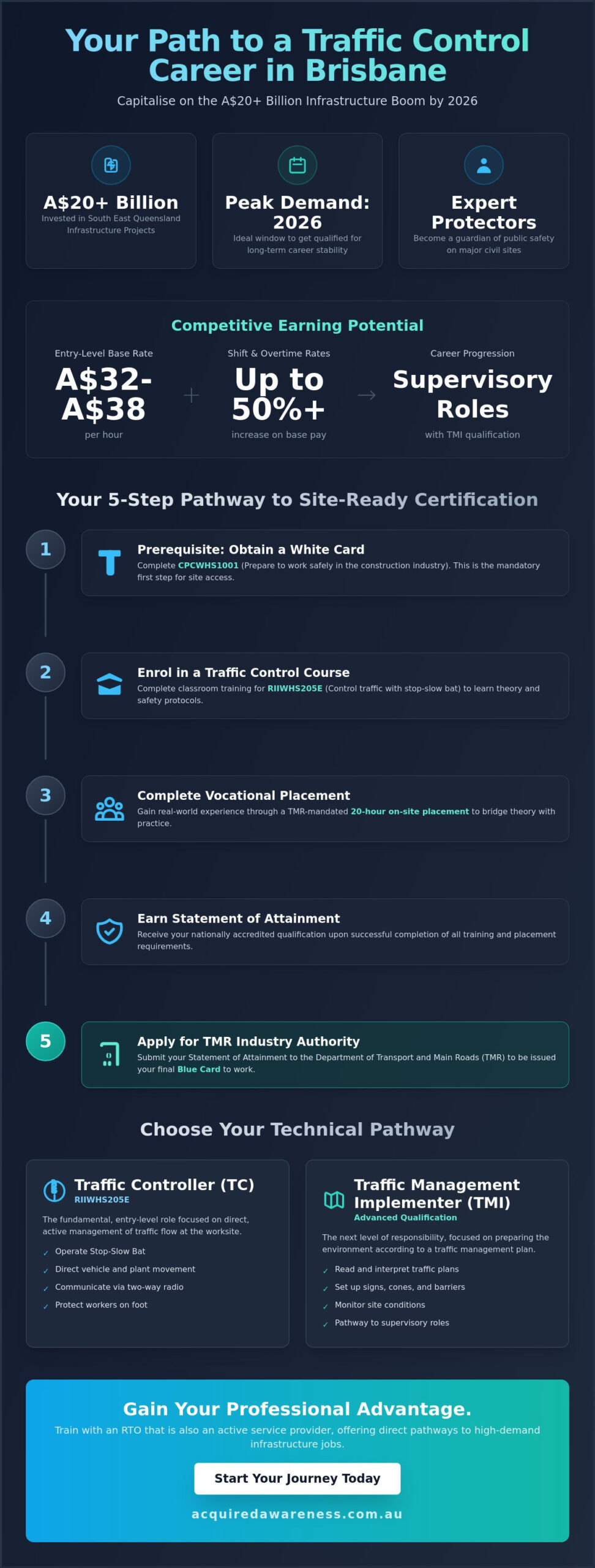
We’re here to ensure you move forward with confidence and professional authority. This guide provides the exact steps required to earn your nationally accredited statement of attainment and successfully apply for your TMR Industry Authority Blue Card. We’ll break down the specific differences between TC and TMI functions, explain how we facilitate your on-site placement, and connect you with the high-demand infrastructure roles currently driving Brisbane’s growth. It’s time to stop worrying about the red tape and start your journey as a guardian of public safety.
Key Takeaways
- Prepare for Brisbane’s 2026 infrastructure surge by understanding the vital “Expert Protector” role traffic controllers play in securing major civil construction sites.
- Discover the technical differences between Traffic Control (TC) and Traffic Management Implementation (TMI) to determine which RII qualification aligns with your career goals.
- Learn the mandatory compliance steps and why a White Card (CPCWHS1001) is the essential prerequisite for enrolling in a traffic control course brisbane.
- Demystify the TMR-mandated 20-hour vocational placement to ensure you successfully bridge the gap between classroom theory and real-world site safety.
- Gain a significant professional advantage by training with an RTO that operates as an active service provider, offering direct pathways to high-demand infrastructure jobs.
Infrastructure Boom: Why 2026 is the Best Time for a Traffic Control Course in Brisbane
Brisbane is currently undergoing a massive physical transformation. By 2026, the city will reach a peak in civil construction activity, creating a sustained demand for qualified safety personnel. This makes it the ideal window to complete a traffic control course brisbane. Every major South East Queensland (SEQ) site requires an “Expert Protector” to manage the interface between heavy machinery and the public. We view traffic controllers as the primary guardians of site integrity. Your presence ensures that projects remain efficient. Most importantly, it ensures that every worker and commuter returns home safely at the end of the day.
The role of a traffic controller is built on a foundation of professional responsibility. It is not merely about holding a stop-slow bat; it involves the active mitigation of risk in high-pressure environments. As the state prepares for a decade of growth, the industry needs disciplined individuals who take ownership of their surroundings. This career path offers long-term stability within a pipeline of projects that shows no signs of slowing down. Our commitment to excellence means we value professionals who treat safety as a non-negotiable mandate.
Major 2026 Projects Driving Demand in Brisbane
The A$5.4 billion Cross River Rail project and the Brisbane Metro expansion continue to be primary drivers for local hiring through 2026. These projects operate around the clock, requiring multiple shifts of safety-conscious professionals who understand global best practices in road traffic control. Beyond the CBD, growth corridors in Brendale and Yatala are seeing a 12% increase in industrial development. These sites prioritize RTO-trained workers who can demonstrate technical competence and a total focus on the mission at hand. The scale of these worksites means that reliable traffic management is the backbone of project success. If you’re also considering opportunities across the broader South East Queensland region, our traffic control course Gold Coast 2026 certification guide outlines the $8.1 billion building pipeline and the specific requirements for working on high-speed environments like the M1.
The Earning Potential of a Brisbane Traffic Controller
- Long-term Security: The SEQ infrastructure pipeline is currently scheduled through the 2032 period.
- Immediate Impact: Qualified controllers are often deployed to sites within days of completing their RTO training.
- Safety First: Every project prioritizes compliance and the protection of the public.
The Technical Breakdown: Choosing Between Traffic Control (TC) and Implementation (TMI)
Understanding the distinction between operational roles is the first step toward a long-term career in civil construction. A traffic control course brisbane offers two distinct pathways that define your daily duties on a worksite. While both are rooted in our “Safety First” mantra, they serve different operational functions. The industry operates with a clear chain of command. Traffic Controllers (TCs) manage the immediate flow of vehicles, while Traffic Management Implementers (TMIs) prepare the physical environment. Understanding this hierarchy ensures every team member knows their specific role in protecting the public and our infrastructure.
RIIWHS205E: Control Traffic with a Stop-Slow Bat
This unit is the fundamental entry-level ticket for the industry. It focuses on the direct management of vehicle flow and the protection of workers on foot. Your primary responsibility is the Stop-Slow bat. You’ll learn to communicate via two-way radio and manage driver behavior to prevent incidents. The training includes a classroom component and a practical simulation. You must demonstrate you can handle real-world pressure in a controlled environment before you’re permitted on a live road. It’s the frontline of safety.
RIIWHS302E: Implement Traffic Management Plans
This advanced qualification empowers you to lead a crew on-site. Instead of just managing the bat, you’re responsible for the physical setup. This includes the strategic placement of signs, cones, and bollards according to a Traffic Guidance Scheme (TGS). It’s a leadership-focused role that requires a deep understanding of compliance and site layouts. Those who can implement plans are often the first on-site at 6:00 AM to establish the safety zone. You can learn more about these responsibilities in our comprehensive guide to traffic management implementation in Brisbane.
By 2026, Queensland’s infrastructure pipeline is projected to require a 15% increase in certified personnel compared to 2023 levels. Most Brisbane employers now prefer candidates who hold both certifications. This versatility is highly valued because it allows a worker to stay on-site for the full duration of a project. You can set up the site in the morning and transition to active control during peak traffic hours. Holding both tickets makes you a more dependable asset and ensures you aren’t limited to a single task. If you want a complete breakdown of the RIIWHS205E and RIIWHS302E units, the TMR accreditation fees, and the mandatory eLearning prerequisites, our traffic management course Brisbane 2026 QLD certification guide covers every step in detail.
- Versatility: You can perform any role required on the day.
- Consistency: Employers prioritize “dual-ticketed” staff for long-term contracts.
- Leadership: Implementation training is the prerequisite for moving into supervisor roles.
If you’re ready to build a stable career, our industry-leading training programs provide the technical depth and practical skills needed to excel in these high-stakes environments.
Compliance Checklist: Mandatory Requirements for Brisbane Traffic Controllers
Entering the traffic management industry in Queensland is a serious commitment. It involves more than just holding a sign; it requires a commitment to public safety and strict adherence to regulatory standards. Before enrolling in a traffic control course brisbane, candidates must verify they meet several non-negotiable criteria. These standards ensure that every individual on a worksite possesses the mental and physical capacity to manage high-pressure environments.
The basic prerequisites for training include:
- Attaining a minimum age of 18 years.
- Holding a current or recent open or provisional Queensland driver’s licence.
- Demonstrating English literacy and numeracy levels sufficient to read site plans and communicate via two-way radios.
- Maintaining the physical fitness required to stand for extended periods, often up to 12 hours, while handling equipment in various weather conditions.
Maintaining high energy levels through proper nutrition is vital for such demanding shifts. For those who find themselves working in international hubs like the UAE, specialized services like Shift 2 Fresh provide a reliable way to access fresh fruits and vegetables from the Philippines and South Asia, helping busy professionals stay healthy and focused.
The Essential White Card: Your Entry to Construction
The CPCWHS1001 unit, commonly known as the White Card, is your mandatory ticket to any construction environment. You can’t step onto a Brisbane worksite without this valid accreditation. It provides the foundational knowledge of workplace health and safety required to identify hazards and prevent injuries. Acquired Awareness functions as both a Registered Training Organisation (RTO) and a service provider. We integrate White Card training for new entrants to streamline their career path. Having a Queensland White Card is a strict prerequisite before you can be issued your traffic control ticket.
Applying for Your TMR Industry Authority (Blue Card)
Completing your traffic control course brisbane is only the first step toward employment. Once you finish your training, you must apply for a Traffic Controller Industry Authority through the Department of Transport and Main Roads (TMR). This process is rigorous. TMR conducts a comprehensive criminal history check and a traffic history review. These checks ensure applicants are suitable for roles that involve significant public responsibility and safety mitigation.
The application process typically follows these steps:
- Submit your TMR application form (F3907) at a TMR customer service centre.
- Provide your Statement of Attainment from an approved trainer like Acquired Awareness.
- Pay the required government licensing fee.
- Wait for the background checks to clear.
While processing times vary, you should allow at least 14 to 28 days for TMR to issue your authority. You cannot legally work on a live road until your Industry Authority card arrives or you receive an official interim letter. This structured approach ensures every controller on our roads meets the highest standards of integrity and competence. We don’t leave safety to chance. This discipline is what keeps our infrastructure projects moving and our community safe.
The 20-Hour Vocational Placement: Bridging the Gap from Training to Site
The Department of Transport and Main Roads (TMR) mandates a 20-hour vocational placement for every student seeking a traffic control license. This requirement isn’t just a box to tick; it’s a critical safety mandate designed to ensure you’re ready for the high-pressure environment of Queensland’s roads. While the classroom portion of your traffic control course brisbane provides the essential knowledge, the placement builds the intuition required to save lives. You’ll move beyond the safety of a training room and step onto active Brisbane infrastructure projects.
Acquired Awareness bridges this gap by coordinating placements through our own operational divisions. We don’t leave you to find your own way on a dangerous site. Because we operate as both a registered training organization and a leading service provider, we place you with experienced crews who prioritize safety and compliance. This hands-on period is where you learn to read the road, anticipate unpredictable driver behavior, and manage the complex rhythm of a live site. It’s about building muscle memory under the watchful eye of industry veterans.
What Happens During Your Vocational Placement?
During these 20 hours, you’re an active participant under strict supervision. You’ll operate the stop-slow bat in real-time traffic, managing vehicle flow with precision and calm authority. Effective radio communication is another core skill you’ll refine during this phase. You’ll learn to deliver clear, concise instructions to your team members, ensuring everyone stays informed and protected. Hazard identification becomes a constant process rather than a theoretical checklist. Your supervisor monitors your performance closely and signs off on your logbook once you’ve demonstrated consistent adherence to safety protocols. It’s the moment you stop feeling like a student and start acting like a professional protector of the public.
Securing Your Final Assessment
Once your 20 hours are logged and signed off, you’ll undergo a final competency check. This is the definitive step before you’re issued your ticket. You must arrive on-site with full P.P.E., including high-visibility clothing, steel-cap boots, and a hard hat. Professional conduct is just as important as technical skill during this evaluation. We look for individuals who are punctual, alert, and disciplined. If you’re ready to start this process, follow our 2026 step-by-step guide to getting your traffic control ticket. This resource outlines exactly how to move from your initial traffic control course brisbane to your first day on the job with confidence.
Ready to begin your career with an industry leader who prioritizes your safety? View our upcoming course dates and secure your spot today.
Why Train with Acquired Awareness: The RTO and Service Provider Advantage
Choosing where to complete your traffic control course brisbane is a decision that defines your professional standards and career trajectory. Acquired Awareness (RTO #40905) stands apart because we aren’t just a training school. We are an active, high-level traffic management service provider. This dual identity creates a constant feedback loop where real-world site challenges inform our classroom instruction every day. We don’t just teach the theory of traffic management; we live it on major infrastructure projects across Queensland.
Our “Expert Protector” philosophy guides every lesson. We believe a traffic controller is a guardian of public safety, not just a person holding a stop-slow bat. We’ve invested in state-of-the-art training facilities in Brendale and Yatala to ensure students learn in environments that mirror actual worksites. This commitment to excellence ensures our graduates are prepared for the high-risk realities of the road, focusing on risk mitigation and strict compliance from the moment they step onto the bitumen. Workers seeking opportunities across the wider SEQ region can also explore our Gold Coast traffic control course certification guide, which details how to qualify for roles on the $1.2 billion Light Rail Stage 3 and other major coastal infrastructure projects.
From the Training Room to the Worksite
We maintain a “hire from within” strategy that prioritizes our top-performing students. When you train with us, you’re essentially auditioning for a role with one of the state’s most respected service providers. This pathway provides a level of job security and immediate opportunity that standalone RTOs simply can’t offer. Our graduates don’t just leave with a certificate; they leave with a professional network and a direct line to employment.
Ongoing support is a hallmark of the AATC experience. We provide mentorship to graduates as they navigate their first shifts on complex civil projects. Our deep-rooted reputation with Brisbane’s leading construction and civil contractors means they trust the quality of our trainees. We’ve spent years proving our commitment to safety, and we pass that credibility on to every student who completes our curriculum. You’ll benefit from:
- Direct recruitment opportunities for high-achieving graduates.
- Practical mentorship from industry veterans who’ve managed major Queensland highway upgrades.
- Training on the latest industry-standard equipment and safety technology.
Book Your Course at Brendale or Yatala Today
Securing your spot for 2026 is simple. Our online booking tool provides real-time availability for both our Brendale and Yatala locations, allowing you to plan your career transition with precision. We offer comprehensive initial training as well as mandatory renewal courses for experienced controllers looking to maintain their industry standing. We don’t leave your career to chance. We provide the structure, the expertise, and the equipment you need to succeed in a demanding field.
Take the first step toward a stable, safety-focused career in the infrastructure sector. Enroll in our Brisbane Traffic Control Course today and join a team that values integrity and professional protection above all else.
Secure Your Future in Queensland’s 2026 Infrastructure Boom
Brisbane’s infrastructure pipeline for 2026 demands a workforce that prioritizes safety and technical excellence. Completing a traffic control course brisbane with a provider that understands the local landscape is the first step toward a stable career. You’ve seen how the distinction between Traffic Control and Traffic Management Implementation shapes your daily responsibilities. Meeting mandatory compliance standards and finishing your 20-hour vocational placement ensures you’re site-ready from day one. Our industry needs disciplined professionals who take ownership of public safety and maintain a safety-first mindset at all times.
Acquired Awareness (RTO #40905) provides nationally accredited training at our purpose-built centres in Brendale and Yatala. As a leading SEQ service provider, we don’t just teach the rules; we offer immediate job opportunities to help you transition directly into the field. Our commitment to integrity means we provide the technical depth and practical skills you need to manage high-risk environments with confidence. Take control of your professional path and join a team that values your contribution to Queensland’s growth.
Book Your Brisbane Traffic Control Course with Acquired Awareness
We look forward to seeing you at our Brendale or Yatala facility soon to help you start your new career.
Frequently Asked Questions
How long does a traffic control course in Brisbane take to complete?
A standard traffic control course brisbane takes one full day of face to face training to complete the initial theory and practical components. After finishing this classroom session, you must complete 20 hours of supervised vocational placement on live roads. This ensures you’ve gained real world experience under the guidance of a qualified professional before your final assessment is signed off by your trainer.
Can I get a traffic control ticket without a driver’s licence in QLD?
You can’t obtain a traffic control ticket in Queensland without a valid driver’s licence. The Department of Transport and Main Roads (TMR) mandates that all applicants hold a current Australian open or provisional licence. This requirement ensures every controller understands road rules and vehicle behavior. It’s a vital component of risk mitigation and maintaining a safe work zone for the public.
How much does a traffic control course cost in Brisbane for 2026?
While course fees vary between providers, the mandatory TMR application fee for a three year Traffic Controller Industry Authority is A$218.40 as of July 2024. Training costs usually cover your learner’s logbook and classroom materials. It’s best to check our current schedule for the most up to date pricing for your 2026 enrollment to ensure full compliance with updated infrastructure safety regulations.
What is the difference between a TC ticket and a TMI ticket?
A TC ticket qualifies you to operate a stop/slow bat and manage vehicle flow directly. In contrast, a TMI ticket focuses on Traffic Management Implementation, which involves setting up and removing signs, cones, and bollards according to a site plan. Most professionals in Brisbane choose to hold both qualifications to increase their employability and operational flexibility on site while ensuring total compliance with safety standards.
Do I need a White Card before I start my traffic control training?
Yes, you must hold a valid White Card before you can begin your practical traffic control course brisbane training. This unit is the foundational safety requirement for the Australian construction industry. We verify this credential at the start of your course to ensure you’re legally permitted to enter a worksite. It reflects our commitment to maintaining the highest standards of site integrity and worker protection.
How do I find my 20 hours of vocational placement in Brisbane?
Most students secure their 20 hours of vocational placement by contacting local traffic management companies or through their RTO’s industry partnerships. You’ll need to complete these hours on a live road site while being supervised by a controller who has held their license for at least 12 months. This phase is critical for turning classroom theory into disciplined, safety first habits that protect the community.
Is my Queensland traffic control ticket valid in other Australian states?
Your Queensland traffic control ticket is generally recognized in other states, but you may need to apply for mutual recognition. Each state has its own regulatory body, such as SafeWork NSW or VicRoads, which governs local road rules. Always check the specific requirements of the state you’re moving to, as you might need to complete a short bridging course or pay a transfer fee to remain compliant.
What equipment and P.P.E. do I need to start my traffic control course?
You need specific Personal Protective Equipment (PPE) to participate in the practical components of your training. This includes steel-capped safety boots, a high-visibility vest or shirt meeting Australian Standard AS/NZS 1906.4, and long trousers. Sun protection, such as a wide-brimmed hat and safety glasses, is also mandatory. These items ensure you’re protected while working in the harsh Queensland environment and meeting all safety mandates.