Blog
Recent Articles
How to Get Your Traffic Control Ticket in Brisbane: The 2026 Step-by-Step Guide
April 24, 2026
Securing your traffic control ticket in Brisbane shouldn’t feel like deciphering a code of technical jargon and hidden costs. With Queensland’s infrastructure pipeline valued at over A$80 billion as of 2024, the demand for qualified professionals is at an all-time high. You want a clear path to the job site. You don’t want a headache over whether you need a TC or TMI qualification. We understand that starting a career involves questions about which RTO to trust and how to ensure your training meets Department of Transport and Main Roads (TMR) standards. Safety is our North Star. It starts with the right education.
It’s frustrating when conflicting information keeps you from earning a paycheck and contributing to our state’s growth. You deserve a straightforward process that prioritizes your safety and compliance from day one. This guide provides a complete roadmap to obtaining your QLD traffic control ticket, covering everything from mandatory prerequisites to booking your first shift in Brisbane. We’ll break down the 2026 requirements, explain the difference between roles, and show you how to identify a reputable training partner. By the end of this article, you’ll have a clear, actionable plan to join the ranks of Queensland’s expert protectors.
Key Takeaways
- Identify the mandatory prerequisites, including age verification and the General Construction Induction (White Card), required to enter the industry.
- Navigate the step-by-step process of obtaining your traffic control ticket through a TMR-approved training provider.
- Understand the critical progression from theoretical classroom assessments to essential practical placements in the field.
- Learn the formal procedure for submitting your application to the Department of Transport and Main Roads to receive your official licensing card.
- Discover the professional advantages of training with an active industry leader situated in North or South Brisbane.
What is a Traffic Control Ticket in Queensland?
In Queensland, what many call a traffic control ticket is officially known as the Traffic Controller Industry Authority card. This is a mandatory photo identity card issued by the Department of Transport and Main Roads (TMR). It serves as proof that you’ve met the rigorous road traffic control standards in Australia and possess the skills to manage public safety. Without this authority, you cannot legally direct traffic or operate a “Stop/Slow” bat on any state-controlled or local government road. We view this qualification as a badge of professional responsibility. It’s not just a permit; it’s a commitment to protecting lives in high-risk environments.
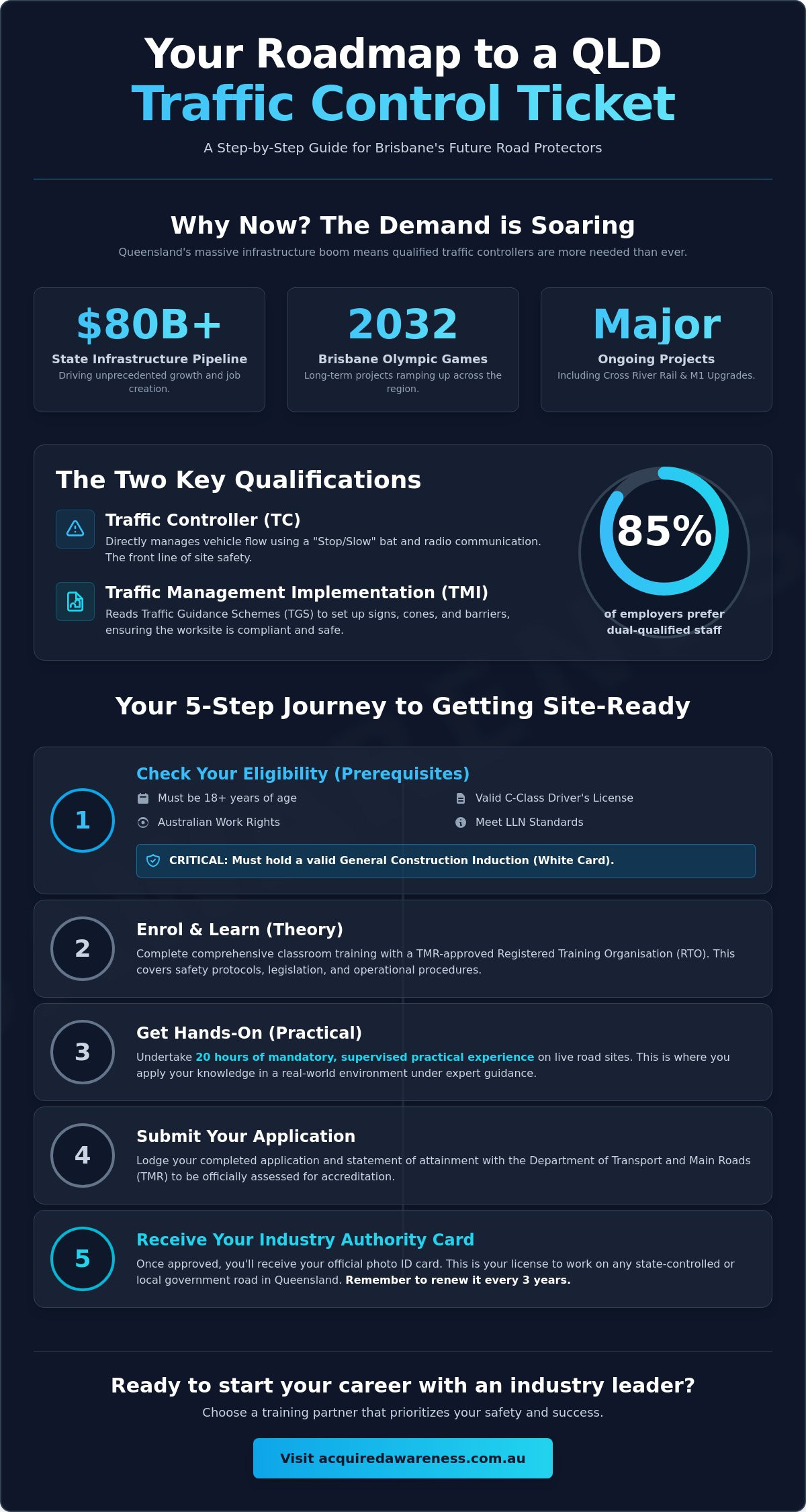
The path to obtaining your traffic control ticket depends on your experience level. New entrants must complete a comprehensive training course through a Registered Training Organisation (RTO). This initial process includes theoretical learning and a mandatory 20 hours of supervised practical experience on live road sites. For experienced workers, Right Pathway can provide support in navigating the Recognition of Prior Learning (RPL) process to formalise existing skills. For those already in the industry, your authority must be renewed every three years. This renewal process ensures your knowledge remains current with the latest safety mitigation protocols and legislative changes. Maintaining compliance is essential for any professional who values excellence and integrity on the job.
Traffic Controller (TC) vs. Traffic Management Implementation (TMI)
It’s vital to understand the distinction between these two primary qualifications. A Traffic Controller (TC) focuses on direct traffic interaction. They use the “Stop/Slow” bat and radio communication to guide vehicles safely through work zones. Traffic Management Implementation (TMI) is a separate but complementary skill set. TMI holders are responsible for reading Traffic Guidance Schemes (TGS) and physically setting up the signs, cones, and barriers that define a site. In the current Brisbane market, approximately 85% of employers prefer candidates who hold both qualifications. Being dual-ticketed makes you a more versatile and dependable asset to any crew. If you’re weighing up your options, our detailed traffic control course guide for Brisbane in 2026 breaks down the difference between TC and TMI certifications so you can choose the right path from the start.
Industry Demand in South East Queensland
The demand for skilled traffic professionals in Brisbane is at a historic high. Massive infrastructure commitments, such as the A$5.4 billion Cross River Rail and the ongoing A$1 billion upgrades to the Pacific Motorway, have created a constant need for safety-conscious staff. As we move toward the 2032 Olympic Games, the volume of roadwork and construction is only expected to increase. This environment offers a clear career trajectory for those with a “can-do” attitude. Many professionals start as controllers and progress to site supervisors or traffic planners. If you’re based further south, the booming $8.1 billion Gold Coast building pipeline means there’s equally strong demand for certified professionals — our traffic control course Gold Coast guide for 2026 covers everything you need to know about getting certified in that region. For businesses in North Queensland also scaling up to meet these infrastructure needs, you can check out Active Voice and Data Services for specialist data and communication cabling. We take pride in mentoring the next generation of expert protectors who keep Queensland moving safely every day.
Prerequisites: What You Need Before You Enrol
To secure a traffic control ticket in Queensland, you must meet specific regulatory benchmarks. These aren’t just suggestions. They ensure every person on a Brisbane road project maintains the highest safety standards. Compliance begins before you even step into the classroom. You must be at least 18 years of age to apply. You’ll need to provide evidence of Australian work rights, such as an Australian birth certificate, a citizenship certificate, or a valid visa with work entitlements.
The Importance of the White Card
The General Construction Induction card, commonly known as a White Card, is your entry pass to any worksite. You cannot step onto a Brisbane construction zone without one. This qualification covers basic risk management and health and safety legislative requirements. If you have an interstate card, check its validity with Workplace Health and Safety Queensland. Most cards issued under the National Code of Practice are recognized, but older cards might require an update. You can obtain this through an accredited RTO like Acquired Awareness Training Centre (AATC) to ensure full compliance before starting your specialized training.
Personal Protective Equipment (PPE) Essentials
Working outdoors in the Brisbane climate requires specific gear to mitigate heat stress and physical injury. You must arrive with steel-capped safety boots that meet Australian Standard AS 2210. High-visibility clothing and a compliant hard hat are also standard requirements. While we often provide specific safety equipment during the training course, you should prepare your own kit for long-term employment. Brisbane’s UV levels frequently reach extreme ratings of 11 or higher during summer months. Long sleeves and broad-brimmed hat attachments are essential for skin protection while you earn your traffic control ticket. Being prepared shows you’re ready for the physical demands of the job.
The Training Process: From Classroom to Practical Placement
Obtaining your traffic control ticket requires a disciplined approach to both theory and field application. You must select a Registered Training Organisation (RTO) that holds current Department of Transport and Main Roads (TMR) approval. This ensures your certification meets the strict legislative standards required for Queensland infrastructure projects. The training is structured into three distinct phases to ensure every trainee is competent, confident, and ready for the demands of the site.
Your journey begins in the classroom with the theory component. During this stage, you complete in-class assessments that cover the legal frameworks and safety protocols governing Queensland roads. We focus on risk mitigation and the importance of clear communication. Once the theory is mastered, you move to practical simulated training. This takes place in a controlled environment. You’ll practice using the stop-slow bat and two-way radios without the immediate pressure of live vehicles. This step is vital for building muscle memory before entering the workforce. For a comprehensive overview of what to expect at each stage, our 2026 traffic control course guide for Brisbane walks you through the full process from enrolment to your first day on-site.
The final phase involves completing 20 hours of supervised ‘live’ traffic control. This is not just a suggestion; it’s a mandatory requirement for all new entrants in the state. It bridges the gap between simulated exercises and the unpredictable nature of Brisbane’s traffic flow. You’ll work under the guidance of experienced professionals to ensure you can manage real-world hazards effectively. If you want to understand exactly how a traffic control course in Brisbane prepares you for a safety-first career in 2026, including how on-site placement is facilitated and which high-demand roles are available, our detailed breakdown covers every step. This practical immersion is where your training truly comes to life.
Course Units and Competencies
The curriculum is built around two core units of competency. RIIWHS205E focuses on the technical aspects of controlling traffic with a stop-slow bat. You learn how to position yourself for maximum visibility and how to manage different vehicle types. RIIWHS201E teaches you to work safely and follow WHS policies. This unit is the foundation of our “Safety First” mantra. These competencies translate to real-world protection for both the construction crew and the motoring public. We don’t just teach you to hold a sign; we train you to manage a high-risk environment with total authority. If you’re looking to advance your credentials further, enrolling in a traffic management course in Brisbane covers the additional RIIWHS302E unit required for higher-level site responsibilities.
The 20-Hour Practical Logbook Requirement
Queensland requires 20 hours of supervised work because classroom learning cannot replicate the complexity of a live roadwork site. This logbook period is your opportunity to demonstrate consistency. Acquired Awareness actively assists students in finding placement opportunities to fulfill these hours. We believe in supporting our trainees from the classroom to the kerbside. A critical part of this process is the ‘Third Party Sign-off’. A qualified supervisor must observe your performance and verify your competence in your logbook. This verification acts as a final safety check before you are authorized to work independently with your traffic control ticket. If you’re considering advancing beyond the controller role, understanding the responsibilities of a TMI-qualified professional in Brisbane can help you plan your next career step.
Completing Your Application with Transport and Main Roads (TMR)
Earning your Statement of Attainment from an RTO is a significant milestone, but it doesn’t grant you immediate authority to manage live traffic. This document serves as proof of competency, not a license. To legally operate on Queensland roads, you must convert this training into an official TMR Industry Authority card. This physical card is your official traffic control ticket. It signifies to employers and site supervisors that you’ve met the rigorous safety and compliance standards mandated by the state government.
The application process requires a visit to a TMR customer service centre. You can’t complete this step entirely online because TMR must verify your identity and original documents in person. You’ll need to submit a completed Traffic Controller Accreditation Application (Form F3907). Along with this form, bring your original Statement of Attainment and three forms of identification. Usually, this includes a primary document like a birth certificate or passport, and secondary documents such as a driver’s license or Medicare card. TMR staff will take your photo for the card, ensuring the person on the job site matches the credentials on file.
TMR Application Fees and Processing Times
As of the 2026 fee schedule, the cost for a three-year traffic controller industry authority remains a necessary investment in your career. While the 2024/25 fee was set at A$211.35, you should check the current TMR gazetted rates for any indexation adjustments. Once you’ve paid the fee and lodged your paperwork, your physical card typically arrives by mail within 21 days. Don’t worry about the wait. TMR provides a ‘Statement of Completion’ or a lodged application receipt. This document allows you to start working immediately. It’s valid for 60 days, giving you ample time to join a crew while your permanent card is printed and posted.
Renewing Your Ticket Every Three Years
Your traffic control ticket isn’t a lifetime qualification. It expires every three years. Safety protocols evolve, and TMR ensures all controllers remain current with the latest Queensland Manual of Uniform Traffic Control Devices (MUTCD) standards. We recommend tracking your expiry date closely; if you let the ticket lapse, you can’t legally step onto a road site. If it expires, you might be required to retake the full initial course rather than a shorter refresher.
The renewal process involves a ‘Refresher’ course. This training focuses on industry updates, risk mitigation strategies, and recent changes to safety legislation. Working with an expired ticket carries heavy risks. You face personal fines exceeding A$2,000, and your employer could face even steeper corporate penalties. More importantly, an expired ticket suggests a lapse in safety currency, which compromises the protection of your team and the public. Stay proactive about your credentials to maintain your standing as a professional protector of our roads.
Why Train with Acquired Awareness in Brisbane?
Choosing where to earn your traffic control ticket determines the quality of your safety foundation. We don’t just teach the theory; we live the practice. Acquired Awareness operates as one of South East Queensland’s premier traffic management providers. This dual role ensures your education is current, compliant, and grounded in real-world scenarios. We provide a unique advantage that traditional classroom-only providers can’t match. We are active participants in the industry.
Every day, our teams manage complex traffic flow across major Queensland infrastructure projects. This operational experience flows directly into our training rooms. When you train with us, you’re learning from a company that understands the evolving safety standards of 2026. Our trainers aren’t just educators. They’re seasoned professionals who spend time on active sites. They bring practical stories, real-world problem-solving, and a deep sense of professional responsibility to every session. This ensures you leave the course with more than just a certificate. You leave with the confidence to manage high-risk environments safely.
State-of-the-Art Training Facilities
Our Brendale and Yatala centres serve as hubs for excellence in South East Queensland. As RTO #40905, we maintain a standard that makes us the preferred choice for major infrastructure partners. We’ve designed these spaces to simulate the pressure and precision required on the job. Our ‘Safety First’ mantra isn’t a slogan. It’s the core of our technical instruction. We focus on risk mitigation and compliance to ensure every trainee is prepared for the technical demands of the field. Our facilities reflect the actual environments you’ll face on Brisbane’s roads, from suburban streets to major highway upgrades. Professionals working across the broader South East Queensland corridor, including those seeking a traffic control course on the Gold Coast, benefit from our Yatala centre’s convenient location between Brisbane and the Gold Coast.
Employment Opportunities Post-Certification
We don’t just train the workforce; we build our own team. Acquired Awareness frequently recruits top-performing students directly from our courses. This creates a seamless transition from the classroom to a career. Working for a local Brisbane company offers stability and a sense of community pride. You aren’t just managing cars. You’re protecting your neighbors and fellow workers. Our commitment to your career doesn’t end when the course finishes. We provide the mentorship and professional support needed to excel in this disciplined field. If you’re ready to start a career built on integrity and excellence, take the first step now.
Take the Lead on Queensland’s Roads
Securing your traffic control ticket is a strategic investment in a career that builds and protects Queensland’s infrastructure. The process is straightforward when you follow the 2026 TMR requirements, starting with your White Card and moving through focused classroom and practical training. As a TMR Approved Training Provider and RTO #40905, Acquired Awareness provides the high-level compliance and technical expertise you need to succeed on-site. We operate from dual locations in North and South Brisbane, making professional training accessible across SEQ. We aren’t just an educator; we’re an active employer in the region that understands the safety standards required for high-risk environments. You’ll gain more than a qualification; you’ll develop the disciplined mindset of an expert protector. It’s time to take ownership of your professional path and contribute to the safety of our local community. We’re ready to help you start this journey with confidence and integrity.
Start your career today: Book your Traffic Control Course now
Frequently Asked Questions
How much does a traffic control ticket cost in Brisbane?
The total investment for a traffic control ticket includes both the training course fee and the government application cost. As of July 2024, the Department of Transport and Main Roads (TMR) charges a mandatory fee of A$218.85 for the three year accreditation. Training providers in Queensland typically charge between A$350 and A$600 for the initial combined course, depending on the level of site practicals included in the package.
How long does a traffic control course take to complete?
Obtaining your traffic control ticket requires a combination of classroom theory and on-site experience. You’ll spend 1 full day in a classroom setting at an RTO to learn safety protocols and compliance standards. Following this, TMR regulations mandate that you complete a minimum of 20 hours of supervised practical experience on a live road site before your final competency is signed off.
Do I need a driver’s licence to get a traffic control ticket in QLD?
Yes, you must hold a current or recent driver’s licence to be eligible for accreditation in Queensland. TMR safety mandates require all applicants to have held an Australian provisional or open licence within the last 2 years. This requirement ensures that every controller has a fundamental understanding of vehicle behavior and road rules before they take responsibility for the safety of the public and road workers. This foundational knowledge is similar to the high standards set by professional schools like Seattle Driving Academy, which focus on creating safe, responsible drivers from the very first lesson.
What is the difference between a Blue Card and a Yellow Card in traffic control?
The Blue Card and Yellow Card refer to two distinct levels of responsibility on a worksite. A Blue Card allows you to work as a Traffic Controller, where you’ll physically direct traffic using a slow/stop bat. A Yellow Card, now known as Traffic Management Implementation (TMI), qualifies you to set up, monitor, and dismantle traffic guidance schemes according to approved plans. Most Brisbane employers prefer candidates who hold both qualifications to ensure maximum site flexibility.
Can I work as a traffic controller in Brisbane with an interstate ticket?
You can’t work in Queensland immediately with an interstate ticket because each state operates under different regulatory frameworks. You must apply for mutual recognition through TMR to transfer your accreditation to a Queensland license. This process often involves a gap training session at a local RTO to ensure you understand the specific safety requirements of the Queensland Manual of Uniform Traffic Control Devices (MUTCD).
How much do traffic controllers earn in Brisbane in 2026?
Projected earnings for traffic controllers in 2026 reflect the growing demand for infrastructure protection across Queensland. Entry-level positions typically start at A$32 to A$38 per hour under current industry awards. Experienced controllers working on major infrastructure projects or night shifts often earn between A$45 and A$60 per hour when including industry allowances for travel and site conditions. These rates highlight the professional value placed on those who manage high-risk environments.
What happens if I fail the practical component of the course?
If you don’t meet the competency standards during your practical assessment, our instructors will provide a detailed feedback report. Safety is our absolute priority, so we’ll work with you to schedule additional supervised hours until you can manage a site with calm authority. You won’t be charged the full course fee again, but a small reassessment fee may apply to cover the cost of the trainer’s time and site compliance monitoring.
Is there a lot of math involved in the traffic control course?
The course involves basic functional mathematics used to ensure site safety and compliance. You’ll need to calculate buffer zones and taper lengths using provided formulas and tables from the MUTCD. These calculations are straightforward and don’t require advanced calculus. Our trainers provide clear templates to help you master these technical requirements, ensuring every sign and cone is placed with precision to protect road users.