Blog
Recent Articles
White Card Brisbane: The Complete 2026 Guide to Construction Safety Induction
April 28, 2026

You can’t step onto a Tier 1 construction site in Queensland on Monday morning without a valid induction, yet many workers still find themselves sidelined by shifting regulatory requirements. Securing your white card brisbane is the non-negotiable first step for anyone looking to enter the state’s A$160 billion infrastructure pipeline. We understand the frustration of sorting through conflicting information about online versus face-to-face training, especially when you’re eager to start work. It’s a common hurdle, but it doesn’t have to be a barrier to your progress.
At Acquired Awareness, we bridge the gap between mandatory compliance and practical, site-ready skills. We’ll ensure you master the latest 2026 safety standards and walk away with a nationally recognised certificate that employers trust. This guide outlines the streamlined booking process at our local facilities, the essential PPE you’ll need for your session, and how our expert-led training provides the confidence to manage high-risk environments safely and effectively. You’ll gain more than just a piece of plastic; you’ll gain the protection of professional knowledge.
Key Takeaways
- Understand the legal necessity of the CPCWHS1001 unit and how it ensures total compliance with Queensland’s WHS Regulation 2011.
- Identify the mandatory 100 points of ID and USI requirements needed to facilitate a seamless enrolment process for your safety training.
- Learn the most efficient way to secure your white card brisbane through expert-led, 4.5 to 6-hour courses at our Brendale and Yatala facilities.
- Master the rules of national portability and the “2-year rule” to ensure your safety credentials remain valid for work across all Australian states.
- Discover how this essential certification serves as a gateway to high-demand career opportunities in traffic management, civil construction, and logistics.
What is a White Card and Why is it Mandatory in Brisbane?
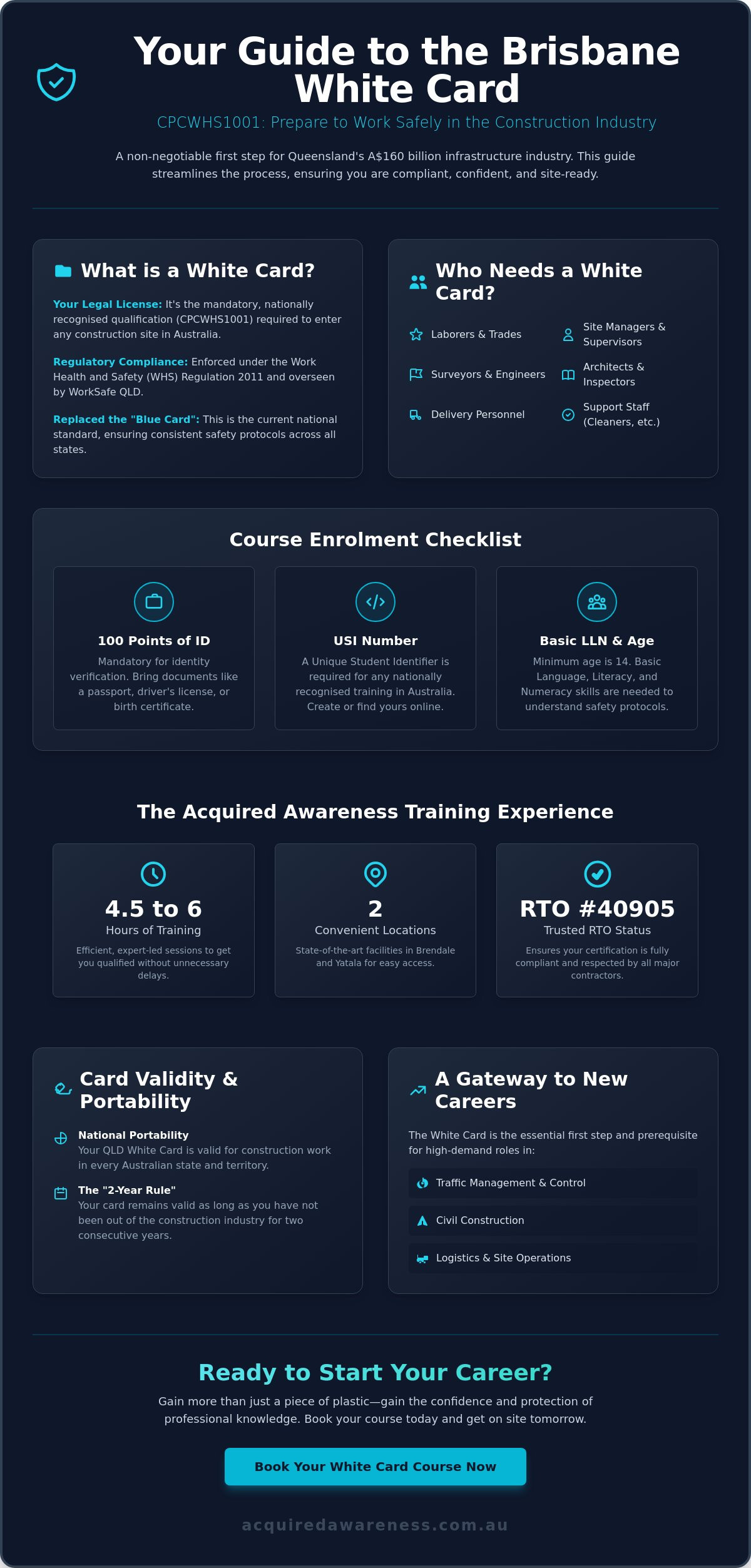
Entering a construction site in Queensland isn’t just about showing up with boots and a high-visibility vest. It starts with completing the CPCWHS1001 – Prepare to work safely in the construction industry unit. This nationally recognised qualification serves as the foundation for all site safety protocols. If you’re looking for a baseline definition of What is a White Card?, it’s essentially your legal license to set foot on any active project. Under the Work Health and Safety (WHS) Regulation 2011, this induction is a non-negotiable requirement. Brisbane contractors are exceptionally strict; you won’t get past the site gate without a physical card in your hand. This national system replaced the old Queensland “Blue Card” years ago, ensuring that safety standards remain consistent whether you’re working in the CBD or across state lines.
The Role of WorkSafe QLD in Construction Safety
Who Needs a White Card in South East Queensland?
The requirement for a white card brisbane wide extends much further than many people realize. It isn’t reserved solely for the laborers swinging hammers or the trades installing complex electrical systems. Site managers, architects, surveyors, and engineers all must hold current certification to perform their duties on-site. Even casual visitors or delivery drivers who need to enter active construction zones are often required to show their card to the site supervisor. This ensures everyone understands the common hazards and communication protocols used in the industry. For those looking to diversify their skills, this qualification is also the primary prerequisite for specialized traffic control courses in Brisbane. Safety is a collective responsibility that starts with the right education.
- Laborers and Trades: Essential for daily site access and task performance.
- Site Management: Required for supervisors, foremen, and project leads.
- Technical Roles: Necessary for surveyors, engineers, and building inspectors.
- Support Staff: Often required for cleaners, security, and delivery personnel.
The construction landscape is inherently unpredictable. By mandating a physical card and a standardized curriculum, Queensland authorities ensure that every person on a site has the same fundamental understanding of risk mitigation. It’s a disciplined approach that builds trust between contractors and the workforce. We take pride in delivering this training because it’s the first step in our mission as expert protectors of public and worker safety.
Course Requirements: What You Need to Bring to Your Brisbane Training
Safety doesn’t start on the job site. It starts in the classroom. Preparation is the first step in risk mitigation, and arriving at your training session without the necessary documentation can delay your entry into the construction industry. To secure your white card brisbane, you must meet specific regulatory benchmarks set by WorkSafe Queensland. These requirements ensure every participant is legally identifiable and capable of meeting the physical demands of high-risk work environments.
The minimum age for undertaking general construction induction training in Queensland is 14 years. Candidates must also demonstrate a basic level of Language, Literacy, and Numeracy (LLN). This means you need to be able to read safety signs, follow verbal instructions, and complete basic written forms. If you have concerns about these requirements, it’s best to contact our team at Acquired Awareness before your course date to discuss support options.
Every student must also provide a Unique Student Identifier (USI). This is a federal requirement for all vocational education in Australia. Since 2015, RTOs cannot issue a statement of attainment without a verified USI. You should create your USI via the official government portal at least 24 hours before your class to avoid administrative delays.
The 100 Points of ID Checklist
Compliance is non-negotiable. You must present 100 points of identification before the training begins. If you arrive without sufficient ID, you cannot participate in the assessment. This is a strict auditing requirement for all RTOs operating in Queensland. Your identification must be original; digital copies or photocopies are typically not accepted unless they’re via an official government app like the QLD Digital Licence.
- Primary Documents (70 points): Australian Birth Certificate or a valid Passport. You can only use one primary document.
- Secondary Documents: Queensland Driver’s Licence (40 points), Medicare Card (25 points), or a Student ID Card from a tertiary institution (25 points).
- International Students: You must provide your Passport and a valid Visa. This ensures compliance with Commonwealth regulations regarding overseas students.
PPE and Practical Assessment Expectations
A central component of the CPCWHS1001 unit is demonstrating the correct use of Personal Protective Equipment (PPE). You won’t just talk about safety; you’ll prove you can implement it. Face-to-face assessment is mandatory for these practical components because an instructor must physically verify your ability to fit and wear equipment correctly. This hands-on approach is why the white card brisbane qualification remains the gold standard for site safety.
During the assessment, you will learn to use four mandatory pieces of PPE:
- A hard hat for head protection.
- A high-visibility vest for site presence.
- Ear plugs or ear muffs for hearing conservation.
- Safety glasses for eye protection.
While Acquired Awareness provides all necessary PPE for the duration of the training, understanding its application and maintenance is a core assessment criteria. You must demonstrate that you can adjust a hard hat for a secure fit and insert ear protection properly to ensure maximum noise reduction. These skills are fundamental to survival on a modern construction site.
The Acquired Awareness Training Experience: Brendale and Yatala
Choosing a training provider is a decision that directly impacts your safety and the safety of those around you. At Acquired Awareness, we deliver the white card brisbane workers need through a rigorous, face-to-face curriculum designed for the modern construction environment. Our standard course duration spans 4.5 to 6 hours. This timeframe is a deliberate choice. It ensures every participant achieves total comprehension of risk management and legislative requirements without rushing through critical safety benchmarks.
We move beyond the textbook by integrating real-world scenarios from our extensive history in traffic management and civil infrastructure. Our instructors don’t just recite codes of practice; they share lessons learned from major South East Queensland projects. This practical approach transforms abstract concepts into life-saving habits. We understand that your time is valuable. Upon successful completion of the course, you receive your Statement of Attainment immediately. You leave our facility with the credentials required to step onto a job site the very next morning.
Why Face-to-Face Beats Online for QLD Workers
Current Queensland regulations are clear regarding the delivery of general construction induction training. WorkSafe QLD restricts online White Card training to residents living in specific remote postcodes. For the majority of workers in the Brisbane metropolitan area, face-to-face training is the only compliant path. If you’ve been tempted by the convenience of a white card online QLD providers advertise, it’s critical to understand which delivery methods are legally valid and which could leave your certification rejected on site. Compliance is just the beginning. The real value lies in the interaction. You can’t ask a pre-recorded video a specific question about a complex site hazard.
Our instructors bring decades of combined experience from SEQ infrastructure projects. They provide a level of mentorship that digital platforms can’t replicate. You’ll also find yourself in a room with other professionals, ranging from apprentices to seasoned tradespeople. These networking opportunities are vital. They allow you to share experiences and build connections within the local industry before you even reach the site gates. We foster an environment of professional responsibility where the “Safety First” mantra is lived, not just spoken.
Our Brendale and Yatala Training Hubs
We operate two strategic hubs to ensure accessibility for the entire South East Queensland workforce. Our Brendale facility serves North Brisbane, Moreton Bay, and the Sunshine Coast corridor. It’s a professional environment equipped with modern classrooms and industry-standard safety gear. We provide plenty of accessible parking to ensure your training day starts without unnecessary stress. This location is ideal for those living in the northern suburbs who need a local, reliable RTO.
Our Yatala facility acts as a strategic hub for Logan, Gold Coast, and South Brisbane workers. Situated in the heart of one of Queensland’s fastest-growing industrial zones, this center is built for high-volume, high-quality training. Both locations feature:
- Professional, climate-controlled classrooms designed for focused learning.
- Dedicated spaces for practical demonstrations of personal protective equipment (PPE).
- Easy access to major arterial roads including the M1 and Gympie Road.
- Instructors who maintain a disciplined, “can-do” attitude focused on your success.
We maintain these facilities to the highest standards because we take our role as an “Expert Protector” seriously. This same dedication to professional standards and safety can be seen in other specialized industries, such as the comprehensive property protection services offered by Mosquito Assassin Pest Control LLC. Every square foot of our training space is dedicated to ensuring you are well-prepared, highly organized, and incapable of being caught off guard on a live site.
Validity and Compliance: Using Your QLD White Card Nationally
Your white card brisbane is a nationally recognized credential. It confirms you have completed the CPCWHS1001 unit of competency, which is the baseline safety standard for the Australian construction industry. This certification isn’t restricted by state borders. If you move to New South Wales, Victoria, or Western Australia, your Queensland-issued card remains a valid proof of general induction training. It acts as a professional passport for the construction sector.
Compliance is a continuous commitment rather than a one-time event. Under the Work Health and Safety Regulation 2011, a White Card doesn’t have a fixed expiry date. However, the “two-year rule” is a critical compliance factor you must understand. If you’ve been out of the construction industry for more than two consecutive years, your card is no longer considered valid. In this scenario, you must retake the induction course to ensure your safety knowledge aligns with current 2026 standards and legislation. For a comprehensive breakdown of how these requirements apply across the sector, our building industry white card guide for 2026 covers everything you need to stay compliant on Queensland job sites.
In 2026, digital verification has become the industry standard. While physical plastic cards are still issued and widely used, many site supervisors now accept digital versions stored in secure government wallets. We recommend keeping your physical card in your vehicle as a backup. If your card is lost or damaged, you must contact the Registered Training Organisation (RTO) that originally issued it. They can verify your records and issue a replacement for a small administrative fee. If your original RTO is no longer operating, you should contact Workplace Health and Safety Queensland directly.
Reciprocity Across Australian States
The CPCWHS1001 unit ensures that every worker on an Australian site shares a fundamental understanding of risk mitigation. If you are moving to Brisbane with an interstate card, you don’t need to retrain unless your card is older than the current national unit requirements. While cards are portable, site-specific inductions are still required for every new project to address unique local hazards and emergency procedures. This ensures that national standards meet local realities on every job site.
Maintaining Your Certification
Your Statement of Attainment is your most valuable document. It is the permanent legal record of your training. We suggest keeping a high-resolution digital scan of this document in cloud storage. If you change your name or contact details, updating these with your RTO ensures your records remain accurate for future verification. Regular safety refreshers are recommended every three years, even if the card doesn’t technically expire. This proactive approach demonstrates a commitment to excellence and keeps you sharp on the latest infrastructure safety protocols.
Start Your Career with Brisbane’s Safety Experts
Obtaining your white card brisbane is the vital first step toward a stable career in Queensland’s booming infrastructure sector. It’s more than a compliance requirement; it’s your entry ticket to high-growth industries like civil construction, logistics, and traffic control. For those entering the industrial maintenance sector, companies like A1 Precision Solutions demonstrate the high level of technical expertise required for tasks like commercial concrete underpinning. At Acquired Awareness, we deliver training from the perspective of an active industry leader. We don’t just teach the theory. We manage live sites every day across South East Queensland. This real-world experience ensures you receive practical safety knowledge that protects you and your colleagues from day one.
From White Card to Traffic Management
The White Card is the essential prerequisite for anyone seeking a role in traffic management. You can’t step onto a site without it. With the current A$70 billion plus infrastructure pipeline in Queensland, demand for safety-conscious workers has never been higher. This includes major projects like the Brisbane Metro and ongoing upgrades to the M1 and Bruce Highway. Our training centre focuses on long-term career pathways rather than one-off tickets. Once you’ve secured your white card brisbane, the logical next step is enrolling in a traffic control course. This progression allows you to move from general site safety to specialized roles that are vital for public and worker protection.
Secure Your Spot in Our Next Brisbane Intake
Booking your training is straightforward through our online system. We offer regular intakes at our Brendale and Yatala facilities to accommodate students across the entire Brisbane region. Whether you’re an individual looking for a career change or a construction firm needing to certify a team, we provide flexible solutions. Our corporate training packages are customized to meet specific site requirements and compliance standards. We focus on delivering results that keep your projects moving safely.
- Brendale Office: Our North Brisbane hub for civil and safety induction.
- Yatala Office: Serving the critical corridor between Brisbane and the Gold Coast.
- Online Booking: Available 24/7 for immediate seat confirmation.
Safety is our North Star. We take pride in being the expert protectors of Brisbane’s workforce. Join a community that values integrity and professional excellence. Our RTO provides the disciplined leadership required to manage high-risk environments. Secure your seat today and start your journey with a partner that’s invested in your safety and your future.
Secure Your Future in Queensland Construction
Obtaining your white card brisbane is the critical first step toward a successful career in the local construction industry. Safety isn’t just a regulatory requirement; it’s a professional commitment to protecting yourself and your colleagues on every site. By training with Acquired Awareness (RTO #40905), you benefit from the guidance of active industry experts who understand the practical realities of high-risk environments. We provide a same-day Statement of Attainment at our Brendale and Yatala facilities, meaning you won’t have to wait to start your new role. Our courses ensure you meet national compliance standards while gaining the confidence to manage infrastructure challenges effectively. We take pride in delivering safety-led solutions that keep our community moving forward. Your career deserves a foundation built on integrity and elite training standards. Take ownership of your safety journey today and join a workforce dedicated to excellence across Queensland.
Book Your Brisbane White Card Course Today
We look forward to seeing you on-site and helping you build a safer, more stable career in the industry.
Frequently Asked Questions
Can I get a White Card online in Brisbane?
No, you can’t complete the course online in Queensland. State regulations mandate that the CPCWHS1001 Prepare to work safely in the construction industry unit must be delivered through face-to-face training. This requirement ensures that every participant receives direct supervision and practical safety instruction. You must attend a physical classroom with a registered training organization to secure your white card brisbane and meet legal compliance. For a full breakdown of what’s permitted and what’s prohibited under current Queensland rules, our guide on white card online QLD myths versus reality separates fact from fiction for Brisbane workers in 2026.
How much does a White Card course cost in Brisbane?
Expect to pay between A$100 and A$160 for a standard induction course in the Brisbane metropolitan area. These fees typically cover the full day of training, all assessment materials, and the processing of your physical card. Prices vary slightly between providers based on their location and facility quality. We recommend choosing an RTO that provides clear, upfront pricing without hidden administration charges.
How long does the White Card course take to complete?
The construction induction training typically takes between 4.5 and 6 hours to finish. This duration allows for the thorough delivery of safety modules, including hazard identification and emergency procedures, followed by a formal assessment. Most sessions are completed in a single day, allowing workers to receive their statement of attainment immediately. It’s a streamlined process designed to get you onto the job site without unnecessary delays.
Is the Queensland White Card valid in NSW or Victoria?
Yes, a White Card issued in Queensland is nationally recognized and valid in every Australian state and territory. You don’t need to complete additional induction training if you move to New South Wales or Victoria for work. This mutual recognition is part of a national safety framework that supports workforce mobility. It ensures that safety standards remain consistent across all Australian infrastructure projects and construction sites.
What happens if I lose my White Card?
You’ll need to contact the Registered Training Organization that originally issued your card to request a replacement. They’ll verify your records and charge a replacement fee, which usually falls between A$30 and A$60. If the original provider is no longer in business, you must contact Workplace Health and Safety Queensland to arrange a new card. It’s wise to keep a digital photo of your card on your phone for quick reference.
Do I need a White Card for a one-day delivery on a construction site?
Delivery drivers generally don’t need a White Card if they remain in their vehicle or within a clearly marked, safe delivery zone. However, if the delivery involves entering the active construction area or performing any manual tasks on-site, the card is mandatory. Many site managers in the white card brisbane network require all visitors to hold the qualification to maintain total site security. Safety is our absolute priority, so having a card prevents any access issues.
Is there an age limit for getting a White Card in QLD?
There isn’t a strict legal minimum age, but most training providers require students to be at least 14 years old. This age threshold ensures that the individual has the maturity and literacy levels required to understand complex safety protocols. It’s a common entry point for school students looking to start a school-based apprenticeship or work experience. Every candidate must demonstrate they can follow instructions and identify site hazards during the assessment.