
Blog
Recent Articles
QLD White Card: The Essential 2026 Guide to Construction Induction
May 10, 2026

A White Card is not just a plastic ticket; it’s your professional commitment to the “Safety First” mission on every Queensland worksite. You likely understand that you can’t legally step onto a construction site without one, yet the conflicting advice regarding online versus face-to-face training often creates unnecessary stress. Securing your white card qld shouldn’t be a hurdle to your career. We understand the pressure of wanting to get to work quickly while ensuring you have the right credentials to satisfy site supervisors and safety auditors.
This guide masters everything you need to know about the CPCWHS1001 unit of competency to ensure you’re fully compliant with the Work Health and Safety Regulation 2011. We’ll clarify the current 2026 standards, including why self-paced online courses are invalid for local residents and how the 4.5 hour face-to-face or virtual classroom delivery works. You’ll also learn about the three mandatory forms of identification required for enrollment and how to replace a lost card for approximately $39 to $49. By the end of this article, you’ll have a clear path to becoming a work-ready, site-safe professional.
Key Takeaways
- Understand the legal necessity of the CPCCWHS1001 unit and why it’s mandatory for all personnel on Queensland construction sites.
- Learn why face-to-face instruction is the only valid path for your white card qld and how to spot invalid online training providers.
- Discover how your Queensland credentials remain valid across all Australian states through the principle of national mutual recognition.
- Prepare for success by identifying the specific identification documents required to meet strict RTO enrollment and compliance standards.
- Access expert mentorship and convenient training facilities at our dedicated AATC centres in Brendale and Yatala.
What is a White Card QLD? Understanding Construction Induction
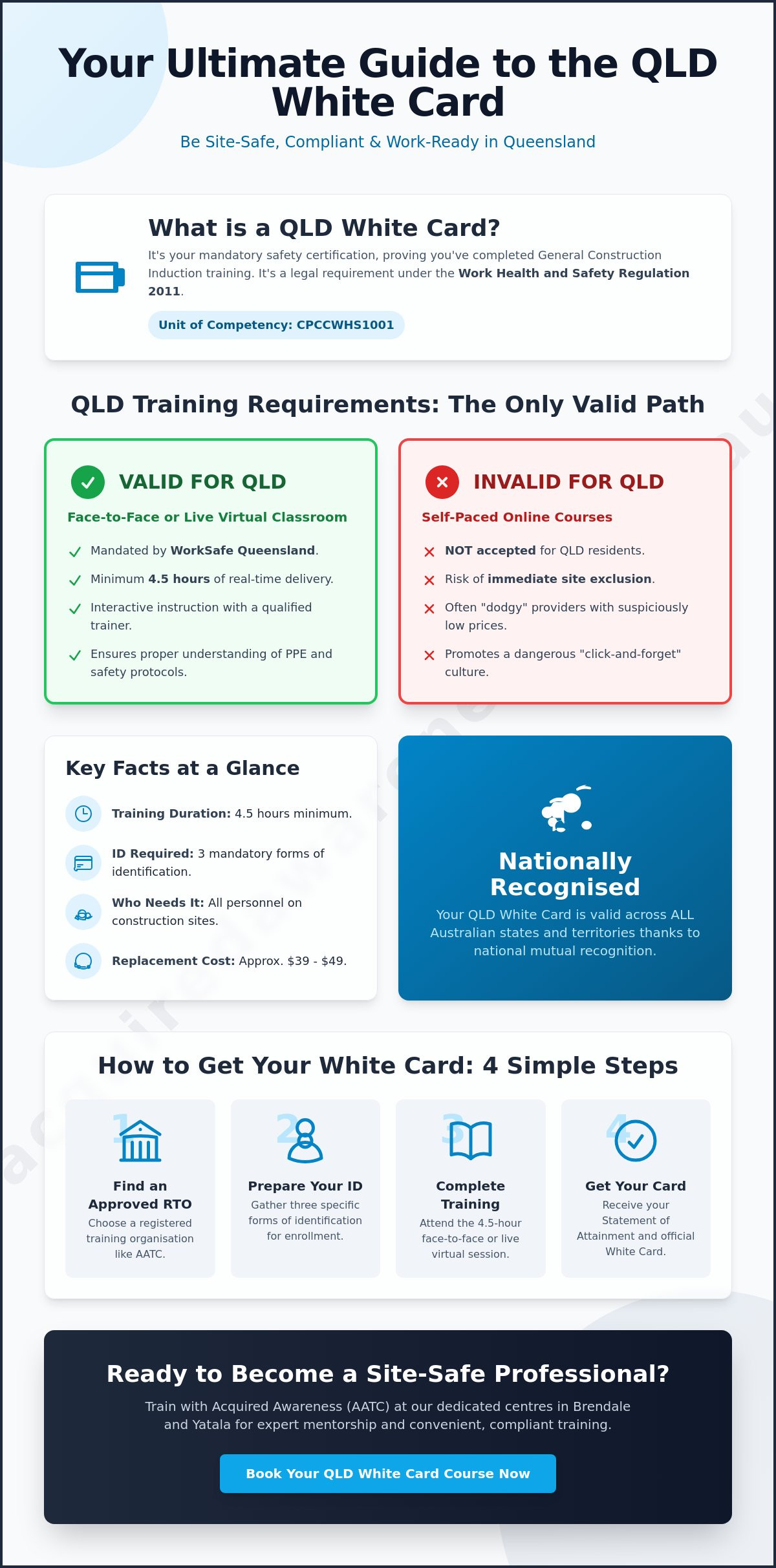
A white card qld is a mandatory safety certification that signifies a worker has completed General Construction Induction training. This requirement is legally mandated by the Work Health and Safety Regulation 2011. It ensures that every individual on a site, from apprentices to project managers, understands the fundamental principles of risk management and site safety. For those asking What is a White Card, it’s essentially a national agreement that safety standards must be uniform across all Australian borders. We view this induction as the foundation of the “Expert Protector” mindset. Safety isn’t a box to tick; it’s a discipline that protects your life and the lives of your colleagues.
Anyone whose role requires them to enter operational construction zones must hold this card. This includes traditional trades like electricians and plumbers, but it also extends to traffic controllers, site supervisors, and surveyors. Even people who enter sites frequently to deliver materials or perform maintenance must comply. Without this ticket, site access is denied immediately. This strict adherence to compliance ensures that everyone on the ground possesses the same baseline knowledge of hazard mitigation and emergency procedures. Part of maintaining a safe and healthy site involves monitoring environmental factors like water quality, and you can learn more about AWARE Water Testing to discover how professional laboratory analysis supports these essential site standards.
The Evolution: From Blue Card to White Card
Before the national standard was fully adopted, Queensland used the “Blue Card” system. This was phased out starting in 2009 to make way for a more portable, nationally recognised qualification. In 2026, many veteran workers still carry their original Blue Cards. These remain valid provided the holder hasn’t been out of the construction industry for a period of two consecutive years or more. If you’ve taken a break longer than 730 days, your Blue Card is no longer compliant. You must complete the current white card qld course to return to the workforce. The transition to the White Card system has significantly improved mobility for workers, allowing them to move between interstate projects without the need for redundant retraining.
CPCCWHS1001: The National Standard for 2026
The official unit of competency for this training is CPCCWHS1001, titled “Prepare to work safely in the construction industry.” This unit replaced the older CPCCOHS1001A code to reflect modern safety practices and legislative updates. The training focuses on three core areas: identifying workplace hazards, reporting safety concerns, and understanding the correct use of Personal Protective Equipment (PPE). By mastering these outcomes, workers become active participants in site safety rather than passive observers. Every state and territory in Australia recognises this specific unit. This ensures that a worker trained in Brisbane can move to a project in Sydney or Perth with full confidence that their credentials meet local compliance standards, which is particularly relevant when performing high-risk infrastructure work for specialized firms like Sewer Services Sydney.
Queensland Training Requirements: Face-to-Face vs. Online
Securing a white card qld requires more than just an internet connection and a credit card. WorkSafe Queensland mandates that all induction training must occur through face-to-face instruction or an approved “connected real-time delivery” model. This means you must be in a physical classroom or a live virtual session with a qualified trainer. Self-paced online modules are not valid for residents of this state. This strict requirement ensures every worker receives interactive instruction on high-risk mitigation and emergency response protocols. It prevents the dangerous “click-and-forget” culture that undermines site safety.
Identifying “dodgy” providers is critical for your career stability. If a website promises a 20-minute certificate for a suspiciously low price, it’s likely a scam. A compliant course must span a minimum of 4.5 hours to satisfy the CPCCWHS1001 requirements. Additionally, training sessions are capped at 15 students per trainer to maintain a high standard of education. We recommend reviewing our upcoming course schedule to ensure you book with an approved Registered Training Organisation (RTO) that prioritises your protection.
The “Online QLD White Card” Myth Explained
Many websites claim to offer a “national” card online, often targeting workers in other states like Western Australia where rules differ. However, if you present a self-paced online ticket on a Queensland site, you risk immediate exclusion. Site managers are trained to verify the RTO and delivery method. For a deeper dive into these pitfalls, read our guide on White Card Online QLD: Myth vs. Reality. Presenting an invalid card doesn’t just cost you the training fee; it costs you the job. Exceptions to face-to-face requirements are extremely rare and generally only apply to specific remote locations where no RTO can provide service, though even then, virtual classrooms are the preferred alternative.
Classroom Dynamics: What to Expect During the 4.5 Hour Course
The 4.5-hour induction follows a methodical rhythm designed to build your confidence as an Expert Protector. It begins with theoretical foundations, covering legal responsibilities and hazard identification. You’ll then move into practical demonstrations, including the correct way to fit and use Personal Protective Equipment (PPE) like hard hats, high-visibility vests, and hearing protection. The assessment process is rigorous but fair. It ensures you have the knowledge to navigate chaotic environments with total control. This interactive environment allows you to ask questions and learn from the real-world experiences of seasoned mentors who have managed complex infrastructure projects across South East Queensland.
Interstate Portability: Is Your QLD White Card Valid Australia-Wide?
If you decide to take a contract in New South Wales, Victoria, or Western Australia, you don’t need to undergo retraining. Regulatory bodies like SafeWork NSW and WorkSafe Victoria recognise the CPCCWHS1001 unit as the gold standard for site entry. This cross-border acceptance is vital for maintaining a consistent safety culture. It means the hazard identification skills you learn in our classrooms apply just as effectively to a site in Melbourne as they do here in South East Queensland. We’ve seen hundreds of our students move seamlessly between interstate projects without any compliance delays; for those targeting the Sydney market, you might check out Inspire Concrete to see the level of professional residential and commercial work being conducted in the region.
Occasionally, a site manager might question an interstate ticket if they aren’t familiar with the specific design of a Queensland-issued card. Don’t let this situation cause anxiety. Always carry your physical card alongside a digital or hard copy of your Statement of Attainment (SoA). Your SoA is the official record from your Registered Training Organisation (RTO) that proves you’ve met the national requirements. It serves as your ultimate backup and provides the documentation necessary to resolve any compliance disputes on the spot. Keeping these records organised demonstrates a level of professional responsibility that site supervisors value.
Moving States: Do You Need a New Card?
While your card is valid everywhere, some workers choose to apply for a local card when they move permanently. This is a personal preference rather than a legal mandate. If you decide to swap your card, you’ll need to contact the local regulator in your new state. They’ll verify your training status through the National Register using your Unique Student Identifier (USI). This 10-digit code acts as a permanent record of your vocational achievements. It ensures your qualifications are never lost, even if you misplace the physical plastic card during a move.
The Value of a Nationally Recognised Ticket
Having a nationally recognised ticket is the first step toward a versatile career. It opens doors beyond traditional construction, allowing you to move into specialised fields like traffic control or site logistics. At Acquired Awareness, we ensure our training exceeds national benchmarks so you’re prepared for any high-risk environment. This high level of preparation is why our graduates are frequently sought after for major Traffic Management Services South East Queensland and beyond. Your white card qld is more than a permit; it’s your passport to the Australian construction industry.
How to Get a White Card: The Step-by-Step Process
The process moves from preparation to participation. You’ll attend a 4.5-hour face-to-face session where you’ll complete both theoretical and practical safety assessments. Upon successful completion, you receive a Statement of Attainment (SoA). This document acts as your interim proof of competency while your physical plastic card is processed and mailed to your address. We recommend keeping a digital scan of your SoA on your phone; this ensures you’re ready for site inductions even if your physical card hasn’t arrived in the mail yet.
The 100-Point ID Checklist for 2026
The 100-point ID requirement is a non-negotiable standard for RTOs in Queensland. You must present original documents on the day of training. Primary documents, such as an Australian Birth Certificate or a current Passport, provide 70 points toward your total. Secondary documents fill the remaining gap. A current Driver’s License provides 40 points, while a Medicare card or a recent utility bill provides 25 points each. If you use a Passport (70) and a Driver’s License (40), you’ve met the 110-point threshold. While digital licenses are increasingly accepted through official government apps, we strongly advise bringing physical backups to avoid any technical delays during enrollment.
Preparing for Training Day
Preparation is the hallmark of a professional. When you arrive for your course, you must be dressed for a construction environment. This means wearing comfortable clothing and, most importantly, enclosed footwear. You cannot participate in the practical PPE assessment in sandals or thongs. You also need to have your Unique Student Identifier (USI) ready. This 10-digit code is required for all vocational training in Australia. If you don’t have one, you should create it via the official government website before arriving. For those seeking specific local details, our White Card Brisbane: The Complete 2026 Guide offers additional insights into our South East Queensland facilities. To secure your spot in an upcoming session, you can book your White Card course today through our streamlined registration portal.
Why Train with Acquired Awareness (AATC) in Brisbane?
Choosing where to complete your white card qld is a decision that impacts your safety mindset for years to come. At Acquired Awareness Training Centre (AATC), we don’t just ‘tick a box’ to get you through the day. We operate as a dual-identity organization. This means we are both a high-level service provider managing active high-risk worksites and a Registered Training Organisation (RTO #40905). Our trainers aren’t just educators; they’re active leaders who understand the chaos of a live infrastructure project. This real-world perspective ensures you receive mentorship that is grounded in practical reality rather than just textbook theory. We take full ownership of the environments we manage, and we pass that sense of professional responsibility on to every student.
Our commitment to excellence is reflected in our “Safety First” mantra. We believe that a well-trained worker is the most effective tool for hazard mitigation on any site. By training with us, you’re learning from a team that leaves nothing to chance. We project a steady, unflappable image that reassures our clients and our students alike. When you walk onto a job site with an AATC-issued ticket, site managers recognize that you’ve been trained by industry experts who prioritize integrity and protection above all else.
Brendale and Yatala Training Centres
We provide two convenient locations to serve South East Queensland’s growing infrastructure needs. Our Brendale facility serves the North Brisbane region, while our Yatala centre is perfectly positioned for workers coming from the Gold Coast or South Brisbane. Both facilities are designed for a methodical and rhythmic learning experience. We strictly adhere to the WorkSafe QLD mandate of capping classes at 15 students per trainer. This small class size ensures you have direct access to your mentor for questions and safety mastery. The environment is disciplined yet approachable, mirroring the structured nature of the construction and traffic management fields.
Your Pathway to Traffic Control
Obtaining your white card qld is the essential first step for anyone looking to build a career in our industry. It serves as the mandatory prerequisite for our Traffic Control Course. Once you’ve progressed into active traffic management roles, understanding your equipment obligations becomes equally critical — our guide on traffic control equipment hire in South East QLD is an essential resource for ensuring your worksites meet MUTCD and TMR compliance standards. We instill a “can-do” Australian attitude in every student, preparing you to handle the complexities of modern worksites with confidence. Our graduates are preferred on site because they understand that safety is a continuous mission, not a one-time event. We’re proud of our Australian roots and our role in protecting the public and the workforce across Queensland’s infrastructure projects. Join a community of professionals who are dedicated to delivering excellence and ensuring outcomes on every shift.
Secure Your Future in Queensland Construction
Your career in construction or traffic management starts with a commitment to safety that goes beyond basic compliance. We’ve detailed why face-to-face training remains the non-negotiable standard for a valid white card qld and how the CPCCWHS1001 unit ensures your skills are recognized in every Australian state. Whether you’re preparing your 100 points of identification or mapping out your path from our Brendale or Yatala centers, the focus must always remain on protecting yourself and your team. Safety isn’t a box to tick; it’s a professional discipline that defines your success in high-risk environments.
Acquired Awareness Training Centre is a Queensland Government Approved RTO (#40905) dedicated to delivering excellence through experienced industry trainers. We don’t just provide tickets; we build the next generation of expert protectors who take ownership of the environments they manage. Don’t leave your site eligibility to chance with invalid online providers. Book Your QLD White Card Course at AATC Today and step onto your next project with total confidence. We’re ready to help you build a safe and successful career on the frontline of Queensland’s infrastructure.
Frequently Asked Questions about the White Card QLD
Can I get a White Card QLD online in 2026?
No, self-paced online training is not permitted for Queensland residents. You must complete your white card qld through face-to-face instruction or an approved “connected real-time delivery” live virtual classroom. WorkSafe Queensland mandates these interactive methods to ensure every worker fully understands site safety and risk mitigation protocols before stepping onto a job site. These standards prevent the dangerous knowledge gaps often found in low-quality online modules.
How much does a White Card cost in Brisbane?
The price for a White Card course in Queensland typically ranges from $99 to $150 as of May 2026. This fee covers the 4.5 hours of professional instruction, the assessment process, and the issuance of your physical card. Choosing a reputable RTO like Acquired Awareness ensures you receive high-quality training from active industry leaders who prioritize your safety over a quick transaction.
What happens if I lose my Queensland White Card?
You should contact the Registered Training Organisation (RTO) that originally issued your ticket to request a replacement. The replacement fee generally falls between $39 and $49 for a lost or damaged card. If the original training provider is no longer operating, you may need to contact WorkSafe Queensland directly or complete the training again to receive a current, valid ticket that meets the Work Health and Safety Regulation 2011.
How long does a White Card last in QLD?
A Queensland White Card doesn’t have a formal expiration date. However, if you’ve not worked in the construction industry for two consecutive years, your card may no longer be considered valid by site supervisors. In this scenario, you’ll likely need to retake the CPCCWHS1001 training to refresh your knowledge of current safety standards and legislative requirements. This ensures your safety skills remain sharp and compliant with modern site demands.
Do I need a White Card for traffic control in Queensland?
Yes, holding a valid white card qld is a mandatory prerequisite before you can undertake a traffic control course. Traffic control is performed within construction zones, so you must demonstrate a foundational understanding of site safety first. Once you have your White Card, the next step is understanding how to get your traffic controller licence in QLD, including the RIIWHS205E course units, the mandatory 20-hour practical placement, and the TMR application process. This ensures every individual on the road or site operates under the same “Safety First” mission to protect themselves and the public from workplace hazards.
Can I use a New South Wales White Card in Queensland?
Yes, you can use a New South Wales White Card on any Queensland construction site. Under the national principle of mutual recognition, all cards issued by an approved RTO in any Australian state or territory are valid nationwide. This allows for total workforce mobility. It ensures that your safety credentials remain valid as you move between interstate infrastructure projects without the need for redundant retraining.
What ID do I need to bring to my White Card course?
You must provide three forms of identification totaling 100 points to enroll in the course. This usually includes a primary document like an Australian Birth Certificate or Passport (70 points) and secondary documents like a Driver’s License (40 points) or a Medicare card (25 points). Your RTO cannot legally issue your certificate without verifying your identity through these physical documents on the day of training. We recommend checking your documents against the 100-point checklist before arriving.
How long does the face-to-face White Card training take?
The face-to-face White Card training takes a minimum of 4.5 hours to complete. This duration is mandated by WorkSafe Queensland to ensure all learning outcomes of the CPCCWHS1001 unit are thoroughly covered. The session follows a methodical rhythm, moving from theoretical safety principles and risk mitigation strategies to the practical demonstration of correctly fitting Personal Protective Equipment (PPE). This time investment is essential for building a disciplined, safety-conscious mindset.