Blog
Recent Articles
Traffic Controller Courses in QLD: Your 2026 Guide to Certification
July 21, 2026
Effective traffic control is far more than just holding a stop-slow bat. It is a high-stakes safety discipline that protects lives on Queensland’s busiest infrastructure projects, from the Gateway Motorway upgrade to 2032 Olympic preparations. You probably recognize the massive demand for skilled personnel but feel uncertain about where to start. It’s common to feel overwhelmed by the technical differences between TC and TMI certifications or the difficulty of securing the mandatory 20-hour vocational placement required for your license.
This guide provides the clear, TMR-aligned path you need to secure your accreditation and enter the industry with professional confidence. We will break down the exact costs, explain the prerequisites for traffic controller courses, and show you how to bridge the gap from the classroom to a live work site. By the end of this article, you’ll understand how to choose a Registered Training Organisation that offers both elite instruction and the industry links necessary to complete your practical training within the required three-month window.
Key Takeaways
- Understand why traffic control is a high-stakes safety profession critical to the 2026 Queensland infrastructure boom.
- Distinguish between TC and TMI certifications to ensure you enroll in the correct program for your desired site responsibilities.
- Navigate the specific requirements for completing your 20-hour vocational placement after finishing your traffic controller courses.
- Verify essential prerequisites including age, literacy, and driver’s licence status before beginning your training.
- Gain a professional advantage by learning from trainers who are active leaders in the traffic management industry.
What is Traffic Control and Why is it a Critical Career in 2026?
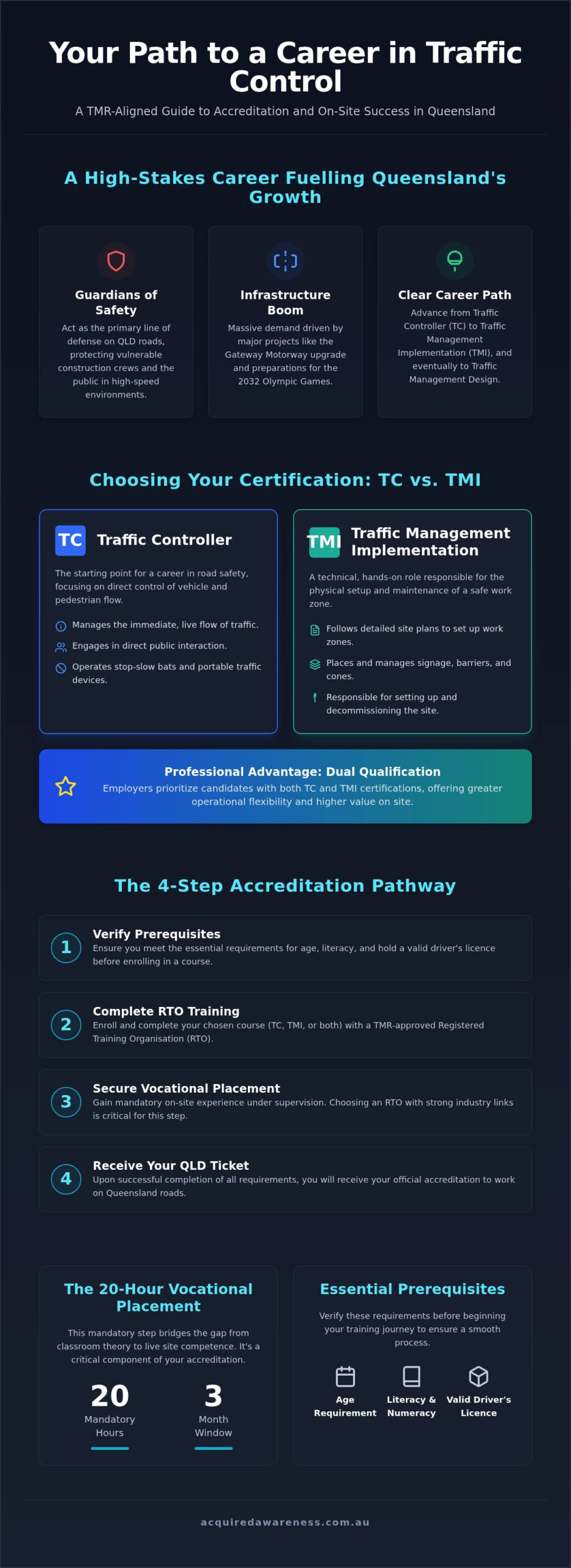
Professional traffic control is the primary line of defense on Queensland’s roads. It is a high-stakes safety discipline that requires total focus and a deep sense of responsibility. In 2026, the role has evolved far beyond the simplistic perception of “holding a sign.” It is now recognized as a specialized field of operational management. Professionals in this sector act as guardians of public welfare, ensuring that high-speed traffic and vulnerable construction crews coexist safely. Road traffic control involves the meticulous coordination of vehicle movements to prevent accidents and maintain the steady flow of our regional transport network.
Career progression in this field is clear and rewarding. Most professionals begin as traffic controllers, mastering the fundamentals of site safety and public interaction. With experience and further training, you can advance into Traffic Management Implementation (TMI), where you take ownership of setting up complex work zones. The most senior roles involve Traffic Management Design, where you create the safety plans that dictate how major projects operate. This pathway offers long-term stability for those who demonstrate a proactive and dependable attitude on site.
The Daily Life of a Traffic Controller
A typical shift demands constant situational awareness and disciplined communication. You will operate essential equipment, ranging from traditional stop-slow bats to advanced portable traffic control devices. Shift structures vary, but the requirement for total composure remains constant regardless of the environment. You are responsible for the lives of your colleagues and the passing public. For a deeper look at the operational realities of the role, explore our detailed resource on What Does a Brisbane Traffic Controller Actually Do?
Why Professional Accreditation Matters
In Queensland, all traffic control work must be performed by individuals who have completed training through a TMR-approved Registered Training Organisation (RTO). Choosing reputable traffic controller courses ensures your accreditation is legally compliant and recognized across the state. Non-compliant training creates significant safety risks and legal liabilities for employers. If you would like to learn more about the professional compliance and shared services that support Australian RTOs, click here. At Acquired Awareness Training Centre (AATC), RTO #40905, we provide ‘Safety-Led Training.’ This approach leverages our dual identity as both a top-tier service provider and an educational authority. We don’t just teach the theory; we prepare you for the technical depth of live operations.
Choosing the Right Traffic Controller Course: TC vs. TMI
Selecting the correct professional pathway is the first step toward a disciplined career in road safety. While many people use the terms interchangeably, Traffic Control (TC) and Traffic Management Implementation (TMI) represent distinct operational skill sets. Understanding the difference ensures you enroll in the traffic controller courses that align with your specific career goals and site responsibilities. A traffic controller manages the immediate flow of vehicles, whereas a TMI professional is responsible for the physical setup and decommissioning of the work zone itself.
To decide which course is right for you, consider your preferred daily tasks. If your focus is on direct public interaction and managing the stop-slow bat to protect a live work area, the TC course is your starting point. If you prefer a more technical, hands-on role involving the placement of signage and barriers according to a site plan, TMI is the appropriate choice. In the competitive Brisbane market, most leading employers prioritize candidates who hold both certifications. This dual qualification allows for greater operational flexibility, making you a more valuable asset to any safety-conscious team. For a detailed comparison of these paths, you can review our Guide to Traffic Control Courses in QLD.
For 2026, the Queensland Department of Transport and Main Roads (TMR) maintains strict standards for these certifications. Accreditation is managed under the Traffic Controller Accreditation Scheme, which dictates the legal framework for working on state-controlled roads. Ensuring your training provider is a TMR-approved Registered Training Organisation is essential for your license to be recognized and valid. If you are ready to begin your professional journey, you can explore the training opportunities at AATC to ensure you meet these rigorous industry standards.
Traffic Controller (TC) Course: The Entry Point
The TC course focuses on the fundamental units required to manage traffic safely. Key competencies include RIIWHS205E (Control traffic with a stop-slow bat) along with core safety units like RIIWHS201E (Work safely and follow WHS policies) and RIICOM201E (Communicate in the workplace). This training typically involves a one-day classroom component where you learn the theory of situational awareness and public safety. It is the mandatory first step for anyone seeking to work as a guardian of public welfare on our roads.
Traffic Management Implementation (TMI) Course
The TMI course, specifically unit RIIWHS302E, focuses on the technical execution of a Traffic Guidance Scheme (TGS). You will learn how to read complex site plans and implement them by accurately placing signs, cones, and bollards. This role carries a high level of professional responsibility, as the correct setup of a work zone is the primary factor in preventing high-speed collisions. It is a methodical and rhythmic process that requires meticulous attention to detail and total focus on the mission at hand.
The 20-Hour Vocational Placement: How to Complete Your QLD Ticket
Classroom training is the foundation, but the live site is where professional competence is truly forged. You cannot secure your Queensland accreditation without completing a mandatory 20-hour vocational placement on a live road site. This practical phase allows you to apply the safety principles learned in your traffic controller courses under the direct supervision of a qualified mentor. It is a strict requirement from the Department of Transport and Main Roads (TMR) designed to ensure every new entrant can maintain total control in high-stakes operational scenarios.
Documentation is a critical component of this process. You must maintain a detailed logbook that records your shift hours, the specific traffic scenarios you managed, and the equipment you operated. This logbook is more than a simple timesheet; it is a formal record of your ability to act as a guardian of public welfare. Training with an integrated provider like Acquired Awareness simplifies this transition. Because we operate both a Registered Training Organisation (AATC) and a major traffic management service (AATM), we understand the logistical hurdles students face. We provide a direct path from the classroom to the field, leveraging our industry leadership to support your development.
Finding a Placement in Brisbane
Many students find that securing a placement is the most difficult part of the certification process. Some RTOs provide the theory but offer no assistance in finding a “placement-friendly” company. This can lead to frustration, especially since the 20 hours must be completed within three months of your classroom training. Choosing an educator with deep regional roots and active industry links is a strategic advantage. When looking for a placement mentor, ensure they meet the following criteria:
- Holds a current and valid Queensland Traffic Controller Accreditation.
- Demonstrates a safety-conscious and disciplined attitude on site.
- Possesses the willingness to provide clear, constructive feedback during live operations.
- Maintains a meticulous approach to site safety and TMR compliance.
What to Expect During Your 20 Hours
Your time on site will be methodical and structured. You aren’t just observing; you are performing essential safety tasks under guidance. You must demonstrate proficiency in several core areas, including stopping and starting traffic with precision, using correct hand signals, and communicating clearly via two-way radio. You will also practice clearing the work zone for emergency vehicles and decommissioning a site at the end of a shift. Safety protocols are non-negotiable, and you must maintain total focus on the mission at hand. A Third Party Report is a formal document signed by your workplace supervisor confirming that you have consistently demonstrated these skills to a professional standard in a live environment.
Prerequisites and Preparation: What You Need Before Enrolling
A frequent question from new entrants concerns the necessity of a driver’s licence. To be eligible for accreditation, you must have held a provisional or open driver’s licence, Australian or foreign, within the last five years. Most employers consider a current licence and a reliable vehicle non-negotiable for site access. Traffic management often requires travel to remote or shifting work zones where public transport is unavailable. Additionally, you must arrive on site with the correct Personal Protective Equipment (PPE). This typically includes high-visibility clothing with reflective strips, steel-capped safety boots, a hard hat, and UV protection. Meticulous attention to your gear reflects your commitment to the safety-first mantra that defines our industry. If you meet these standards, you can enrol in our next intake to begin your certification.
The Importance of the QLD White Card
The General Construction Induction, commonly known as the White Card, is a fundamental prerequisite. You cannot legally step onto a construction site in Queensland without this induction. It provides the essential safety knowledge required to identify and manage risks in high-stakes environments. At Acquired Awareness Training Centre, we offer the White Card Course as both a standalone qualification and a convenient add-on to our other programs. For a comprehensive breakdown of this requirement, read our QLD White Card: The Essential 2026 Guide.
Literacy and Language Requirements
Clear communication is a non-negotiable safety requirement on the road. You must be able to read site plans, follow complex verbal instructions, and relay critical information over two-way radios with total clarity. During the enrollment process for traffic controller courses, you will complete a Language, Literacy, and Numeracy (LLN) assessment. This process ensures you have the technical depth to manage operational documentation and safety reports. Our instructors provide a supportive environment, ensuring that every candidate has the tools to succeed while maintaining the rigorous standards the public expects from a professional traffic controller.
Why Train with Acquired Awareness Training Centre (AATC)?
Choosing where to complete your traffic controller courses is a decision that defines your professional standards from day one. Acquired Awareness Training Centre (AATC), RTO #40905, is not merely a classroom provider; we are the educational arm of Acquired Awareness Traffic Management (AATM), one of South East Queensland’s most established service providers. This dual identity ensures that our curriculum is never static. It is constantly refined by the daily operational realities of high-stakes environments. Our trainers are active industry professionals who bring a wealth of field experience into the classroom, acting as seasoned mentors for the next generation of road safety guardians.
Brendale and Yatala: Convenient SEQ Locations
Our training facilities in Brendale and Yatala are designed to mirror professional work environments, providing a seamless transition from study to the field. Brisbane North students can access our Brendale center, while those on the South side benefit from our Yatala location. Both sites offer easy parking and modern amenities, ensuring your focus remains entirely on the mission at hand. These regional hubs allow us to maintain a local focus while delivering elite level training across the South East Queensland corridor. To view our current schedule and secure your place, you can book your traffic control course at Yatala or Brendale today.
A Direct Path to Employment
One of the most significant advantages of training with AATC is the direct link to potential employment within our own ecosystem. Because we are an active service provider, we frequently recruit top performing students for our own traffic management teams. Employers across Queensland recognize the Acquired Awareness reputation for meticulousness and stability. They know our graduates have been mentored by industry leaders and are safety-ready from their first shift. This unique connection provides a clear path from your traffic controller courses to a stable career in the field. We invite you to view our upcoming course dates and join an organization that prioritizes excellence in every operation.
Secure Your Professional Future in Road Safety
As a TMR-approved provider (RTO #40905), Acquired Awareness Training Centre offers the technical depth and industry mentorship needed to succeed in high-stakes environments. With specialized training centers in both Brendale and Yatala, we provide the local expertise and regional heritage required for the South East Queensland community. We don’t just teach the rules; we lead the industry by example. Enroll in a TMR-Approved Traffic Control Course Today to begin your accreditation process under the guidance of seasoned professionals. The regional infrastructure boom offers a lasting career path for those ready to act as guardians of public welfare. We look forward to seeing you in the field.
Frequently Asked Questions
How much does a traffic control course cost in Brisbane for 2026?
Professional training costs typically involve two separate components. You will pay a fee for the traffic controller courses provided by the Registered Training Organisation and a separate mandatory accreditation fee directly to the Department of Transport and Main Roads. It is essential to verify current rates on our booking page to ensure you have the most recent figures for your enrollment.
How long does it take to get a traffic control ticket in QLD?
Obtaining your accreditation involves a two-stage process that prioritizes technical depth. You first complete a one-day theory component in a classroom environment. Following this, you must finish a mandatory 20-hour vocational placement on a live road site. Most students complete the entire process within a few weeks, though you have up to three months to finish your placement.
Do I need a White Card to do a traffic control course?
Yes, a White Card is a mandatory prerequisite for anyone seeking to work in this field. You cannot legally step onto a construction site or a live roadwork zone in Queensland without this general induction. We offer the White Card course as a standalone qualification or as a convenient add-on for students starting their professional journey.
Can I do the traffic controller course online in Queensland?
Queensland does not permit fully online training for new entrants to the industry. The Department of Transport and Main Roads mandates face-to-face instruction through an approved RTO to ensure all safety protocols are mastered. This disciplined approach ensures you receive the technical depth and hands-on experience required to manage high-stakes environments safely.
How do I renew my traffic control licence when it expires?
Your accreditation remains valid for three years from the date of issue. To maintain your status as a professional traffic controller, you must complete a renewal course through an approved provider before your current license expires. This process includes a refresher on updated safety standards and a new application submitted to the Department of Transport and Main Roads.
What is the 20-hour vocational placement for traffic control?
The placement is a practical assessment where you demonstrate your skills on a live road site under the guidance of a qualified mentor. You are required to document specific traffic scenarios and safety tasks in a logbook. This ensures you can maintain total composure and follow TMR standards in a real-world operational setting before receiving your full license.
What is the difference between a TC and TMI course?
A Traffic Controller (TC) course focuses on the direct management of vehicle flow using a stop-slow bat. In contrast, Traffic Management Implementation (TMI) training teaches you how to read site plans and physically set up signs, cones, and barriers. Many professionals choose to complete both traffic controller courses to increase their versatility and value on a worksite.
Is there a high demand for traffic controllers in South East Queensland?
Demand in South East Queensland is currently at record levels. Major infrastructure projects, such as the $2.7 billion Gateway Motorway upgrade and extensive preparations for the 2032 Olympic Games, have created a constant need for disciplined personnel. This boom provides long-term career stability for those who maintain a safety-conscious and professional attitude.