Blog
Recent Articles
Brisbane Road Closure Management: The 2026 Operational Safety Guide
July 29, 2026
With 253 planned road occupancies scheduled across Brisbane in 2026, the margin for operational error has never been thinner. If you’ve spent any time managing urban infrastructure, you’ve likely felt the pressure of the 20-day BCC lead time or the frustration of a rejected permit. Effective brisbane road closure management isn’t just about placing signs; it’s a high-stakes coordination of legal compliance and public welfare. We understand that navigating the intersection of state-controlled TMR requirements and local council mandates can feel like a bottleneck for your project’s momentum.
It’s true that the complexity of modern traffic environments requires more than just a standard plan. This guide is designed to help you master those complexities with an expert approach to permits, compliance, and safe execution. We’ll examine the July 2026 MUTCD updates, provide a clear roadmap for securing your $341 BCC permit, and outline the operational standards required for a zero-incident worksite. By the end of this article, you’ll have the technical clarity needed to restore traffic flow efficiently while keeping your team and the Brisbane community safe.
Key Takeaways
- Identify the correct jurisdiction for your worksite to choose between BCC Road Corridor Permits and TMR arterial requirements without error.
- Discover technical standards for brisbane road closure management that ensure safety across the city’s unique geography and narrow urban corridors.
- Learn why accredited Traffic Controllers and high-spec equipment hire are non-negotiable for maintaining public welfare in high-traffic zones.
- Streamline your operational execution by following a proven, step-by-step process for Traffic Management Plan design and submission.
- Understand the value of partnering with a local leader that combines 20 years of field experience with Registered Training Organisation credentials.
The Realities of Road Closure Management in Brisbane
Brisbane’s road network is defined by its physical constraints. The winding Brisbane River and historical narrow arterials in areas like Fortitude Valley or Milton leave little room for error. When a lane closes on a major bridge or a feeder road, the ripple effect reaches across the entire South East Queensland network. Meticulous brisbane road closure management is therefore a logistical necessity rather than a mere administrative hurdle. Mismanagement doesn’t just result in heavy fines or project delays. It compromises the safety of every commuter. In the unfortunate event of a collision resulting from road changes, TP Claims can assist with third-party motor vehicle accident claims. We take our role as guardians of these environments seriously. Every closure is executed with total composure and a proactive attitude.
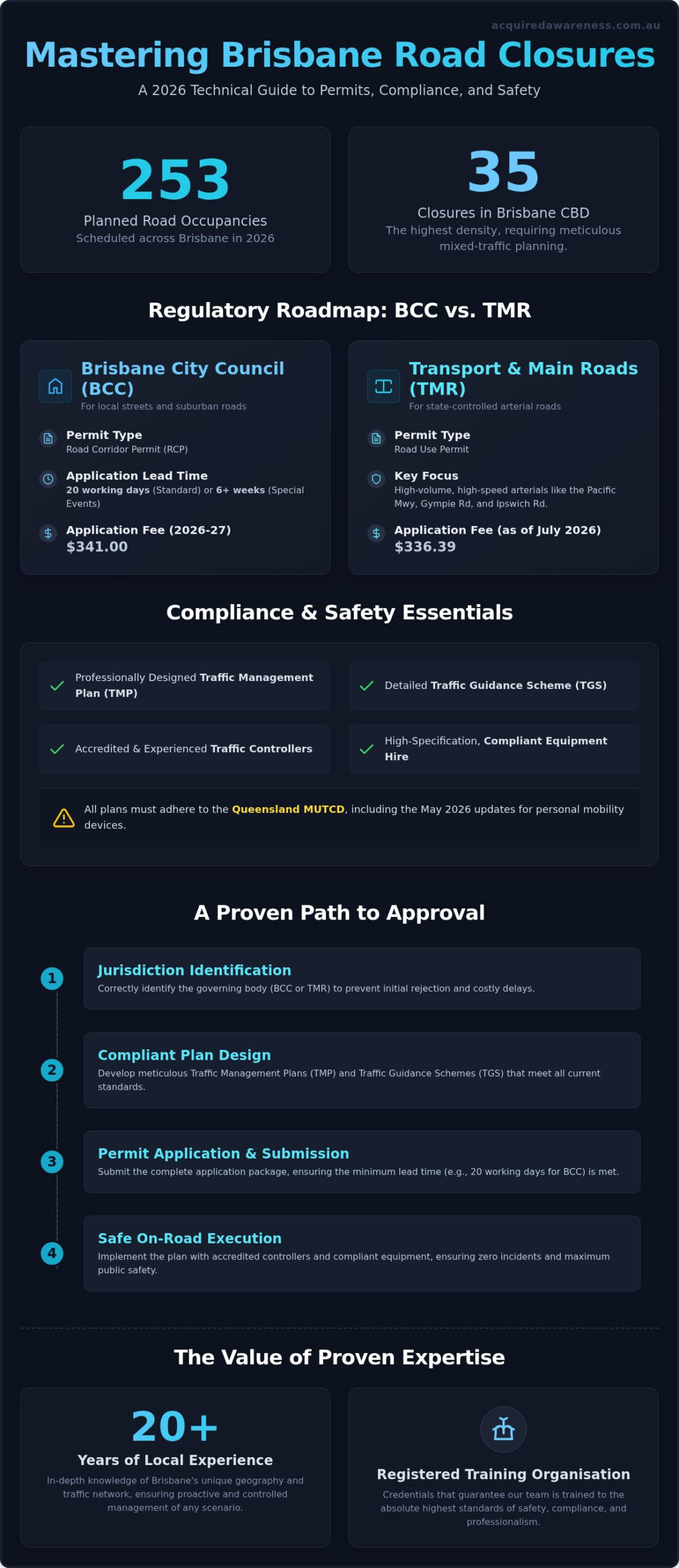
In 2026, the landscape of urban safety has shifted significantly. With 253 planned temporary road occupancies scheduled across the city this year, the demand for precision is at an all-time high. Most of these projects involve excavation or construction, requiring a disciplined leader to manage the site. We don’t just plan for vehicles. We plan for the community. This means prioritizing the well-being of personnel and the public above all else. Our approach is grounded in over 20 years of local experience, ensuring even the most chaotic operational scenarios remain under total control.
For project leads overseeing the civil, mining, or rail components of these works, specialized infrastructure services from mcmahonscivil.com.au can provide the necessary technical support to ensure the entire project site remains compliant and efficient.
Urban vs. Suburban Closure Challenges
The Brisbane CBD currently holds the highest number of planned closures, with 35 scheduled for 2026. Managing high-density pedestrian traffic in the city center requires a focus on “mixed traffic” environments. This includes human-driven cars, cyclists, and the growing number of Personal Mobility Devices. Suburban closures present different hurdles. Detours must balance resident access with construction efficiency to prevent community frustration. Night-time operations add another layer of complexity. We must manage noise ordinances and light pollution while maintaining a high-visibility, safe work zone for our crews. For event coordinators who need to balance these logistics with high-quality technical production, you can discover NextGen AV for specialized audio-visual hire and event support across Australia.
Legal Liabilities and Safety Mandates
Duty of care is our guiding principle. Protecting workers and the Brisbane public is a fundamental professional responsibility. The primary legal framework is the Queensland Manual of Uniform Traffic Control Devices (MUTCD). As of May 28, 2026, this manual has been updated to account for new laws regarding personal mobility devices. Standard Road traffic control practices provide the basics, but Brisbane’s specific hurdles require a more localized, technical approach. Professional management is a prerequisite for insurance compliance. Without a robust, compliant Traffic Management Plan, your project faces significant legal and financial risks. We ensure every detail is meticulous, reflecting our commitment to ethical standards and quality.
Brisbane’s Regulatory Landscape: BCC vs. TMR Permits
Identifying the correct authority is the first critical step in successful brisbane road closure management. Projects often stall because applications are lodged with the wrong governing body, leading to costly delays. Most local streets and suburban roads are managed by the Brisbane City Council (BCC), whereas major transit corridors fall under the jurisdiction of the Department of Transport and Main Roads (TMR). The Road Corridor Permit (RCP) is the primary legal authorization for all temporary road closures on Brisbane City Council roads. Navigating this dual-regulatory system requires a methodical approach, and it’s essential to understand where one jurisdiction ends and another begins.
Navigating the BCC Road Corridor Permit System
Efficiency in the BCC permit system depends on meticulous preparation. For 2026, the standard application lead time remains 20 full working days before your proposed start date. If your project involves a special event, this lead time extends to a minimum of six weeks. Applications must include a professionally designed Traffic Management Plan (TMP) and a detailed Traffic Guidance Scheme (TGS). The non-refundable application fee for a standard closure in the 2026-27 period is $341.00. Most rejections occur due to insufficient lead times or TGS documents that fail to meet current safety standards. Our team of experts provides Traffic Management Design services to ensure your documentation is compliant the first time.
State-Controlled Roads in the Brisbane Region
State-controlled roads like the Pacific Motorway, Gympie Road, and Ipswich Road operate under different mandates. These high-volume arterials require a TMR Road Use Permit, which carries an application fee of $336.39 per title reference as of July 2026. Managing these sites often involves high-speed lane drops and complex merges that must align with the Queensland Guide to Traffic Management. This document outlines specific departures from national standards that are unique to our state. We maintain a proactive relationship with both BCC and TMR authorities. This dual-authority liaison allows us to streamline the approval process for projects that cross jurisdictional boundaries, ensuring your worksite remains a safe environment for both personnel and the public.
Essential Components of Safe On-Road Execution
Securing a permit is only the foundation. The physical execution of brisbane road closure management requires a transition from administrative compliance to tactical precision. On-road safety depends on the synergy between elite personnel and high-spec technology. We believe that a worksite is only as secure as the equipment protecting it and the people managing it. This proactive approach ensures that even the most complex urban closures remain under total control. Reliability on the ground is what prevents project delays and protects the lives of your crew and the passing public; to see how MyGatePass can further enhance site security through digital visitor management, click here.
Effective execution also means staying ahead of national standards. In May 2026, Austroads released updated editions of the Guide to Temporary Traffic Management (AGTTM). These updates place a greater emphasis on dynamic risk assessment during the life of a closure. We don’t just set up a site and walk away. We maintain a constant, watchful presence. By utilizing professional traffic control equipment hire, you ensure your project uses the latest safety innovations, from VMS boards to impact-absorbing attenuators.
The Human Element: Accredited Personnel
Our personnel are more than just sign-holders. As a Registered Training Organisation (RTO #40905), we ensure every controller is a disciplined leader. They’re trained to manage the high-stress environments typical of the Brisbane CBD. This includes handling aggressive driver behavior with calm authority and maintaining strict radio discipline. A site supervisor’s role is to act as a guardian of public welfare. They ensure that communication protocols are followed and that every team member understands their operational mandate. This level of professional responsibility is essential for maintaining a zero-incident worksite.
This commitment to training and professional development is a cornerstone of the industry. To explore specialist advisory and consultancy services from Corehard Ltd that support these high standards in street works and traffic legislation, you can read more about expert technical guidance.
Specialized Equipment for Brisbane Closures
Modern brisbane road closure management demands specialized hardware. For high-speed arterials like the Inner City Bypass, we deploy Truck Mounted Attenuators (TMAs). These vehicles provide a physical crash barrier that saves lives. In dense urban areas, the focus shifts to pedestrian safety. We use high-visibility barriers and clear signage to manage “mixed traffic” where pedestrians and cyclists coexist with heavy machinery, such as specialized concrete pumping units from Equipcon. Variable Message Signs (VMS) are vital for real-time driver communication, allowing us to warn motorists of changes before they reach the work zone. For night operations, we provide silenced lighting towers to meet noise ordinances while ensuring total visibility for our crews.
Step-by-Step: The Road Closure Management Process
A disciplined approach to brisbane road closure management follows a methodical, five-phase progression. We ensure every step is documented and every risk is mitigated before the first cone is placed. This logical sequence is what allows us to maintain total composure in high-stakes environments. By following a structured roadmap, we eliminate the guesswork that often leads to project delays or safety breaches. Our role is to act as a steady partner, guiding your project from the initial site audit through to the final restoration of traffic flow.
The process begins with Phase 1: a comprehensive site audit and traffic management services South East Queensland consultation. We identify physical constraints like narrow lanes or blind corners. Phase 2 involves the design and submission of compliant Traffic Guidance Scheme (TGS) and Traffic Management Plan (TMP) documents. These must align with the July 2026 MUTCD updates. Phase 3 focuses on pre-closure preparation and stakeholder notification. Once the site is live in Phase 4, our team provides ongoing monitoring. Finally, Phase 5 ensures a safe pack-up and the efficient restoration of normal traffic flow. Our meticulousness during these stages ensures that your operational mandates are met with precision.
Pre-Closure Planning and Stakeholder Engagement
Success starts long before the road is closed. Best practice involves notifying local Brisbane businesses and residents well in advance to minimize community friction. We also coordinate closely with emergency services, including the Queensland Ambulance Service (QAS), Queensland Police Service (QPS), and Queensland Fire and Emergency Services (QFES). This ensures that emergency routes remain viable throughout the project duration. A final site check is mandatory. We verify every signage placement against the TGS to ensure total compliance before the work begins. This proactive attitude is a core value of our regional heritage.
Live Site Management and Contingency
Once a closure is live, the environment becomes dynamic. Our controllers perform continuous risk assessments to respond to unpredictable factors like sudden weather events or traffic accidents. We maintain clear access for public transport and emergency vehicles at all times. This is where the ‘Guardian’ mindset becomes essential. We take full ownership of the environment, projecting an unflappable image that reassures all stakeholders. Whether it’s managing a minor lane drop or a full arterial closure, our focus remains on site integrity and public welfare. If you require expert oversight for your next project, you can book our Traffic Management Design services to secure a compliant and safe worksite.
Why Acquired Awareness is Brisbane’s Trusted Partner
Choosing a partner for brisbane road closure management is a decision that directly impacts public safety and project timelines. We bring over 20 years of South East Queensland experience to every worksite. This local heritage means we understand the specific hurdles of Brisbane’s geography and the nuances of both BCC and TMR regulations. Our dual identity as both a premier service provider and a Registered Training Organisation (RTO #40905) allows us to speak with the weight of an instructor. We don’t just plan closures. We train the industry to execute them with total composure and professional responsibility.
Our end-to-end service model removes the complexity from your operations. From the initial permit application to the final cone removal, we take full ownership of the environment. This unflappable leadership is essential when managing chaotic urban scenarios in the CBD or on high-speed arterials. For organizations looking to develop their own internal expertise, we offer a comprehensive traffic control course. This ensures your team is grounded in the same ethical standards and meticulousness that define our brand.
The RTO Advantage in Operational Safety
Our training background ensures that every controller on your site is elite. We implement the latest 2026 safety innovations, including the updated Austroads Guide to Temporary Traffic Management. Being an educational authority means we’re constantly improving our processes, often incorporating the science of organizational change and executive coaching championed by Intact Academy. Industry leaders trust us because we prioritize the well-being of personnel and the public above all else. This commitment to quality is what makes us a reliable, regional partner for the most complex Brisbane closures. Every team member acts as a guardian of public welfare, ensuring total site integrity from start to finish.
Secure Your Brisbane Project Today
A successful partnership is built on trust and a shared focus on the mission at hand. We offer a proactive, no-ego approach that prioritizes results and compliance. By managing the administrative burden of permits and documentation, we allow you to focus on your core project goals. Our goal is to ensure a zero-incident worksite while maintaining efficient traffic flow. Reliability is our core value. You can Contact Acquired Awareness for a Road Closure Consultation to see how our expertise can protect your project and the community.
Secure the Future of Your Brisbane Infrastructure Projects
Mastering brisbane road closure management requires a disciplined balance of regulatory precision and tactical execution. We’ve examined the necessity of navigating BCC and TMR permit systems while maintaining the highest standards of on-road safety through elite personnel and specialized equipment. Successful projects in 2026 depend on more than just simple compliance; they require a proactive partner who understands the local landscape and takes full ownership of site integrity.
With over 20 years of South East Queensland experience and RTO #40905 accredited training standards, we provide the leadership necessary for zero-incident worksites. Our dedicated fleet of TMA and VMS vehicles ensures that your team and the public are protected by the industry’s best technology. We act as a guardian of public welfare, ensuring every operational scenario remains under total control. Let us help you navigate your next challenge with the calm authority and meticulousness your project deserves.
Request a Professional Road Closure Assessment for Your Brisbane Project
Your success is our mission, and we’re ready to build a safer Brisbane together.
Frequently Asked Questions
How long does it take to get a road closure permit from Brisbane City Council?
Standard applications for temporary road closures require a minimum lead time of 20 full working days. If your project is classified as a special event, the Brisbane City Council requires at least six weeks for the approval process. Meticulous planning is essential to avoid project delays, as incomplete documentation can reset these timelines.
Do I need a different permit for closing a footpath versus a road in Brisbane?
Yes, any activity that impacts the flow of traffic or pedestrian movement requires specific authorization. A Road Corridor Permit (RCP) is generally required for any occupancy of the road or footpath that interferes with normal traffic patterns. Effective brisbane road closure management ensures that both vehicle and pedestrian detours are legally compliant and safe for the public.
What is the difference between a Traffic Management Plan (TMP) and a Traffic Guidance Scheme (TGS)?
A Traffic Management Plan (TMP) is a strategic document outlining the overall approach to site safety and traffic flow. In contrast, a Traffic Guidance Scheme (TGS) is a detailed technical diagram showing the exact placement of signs, cones, and barriers. You must have a compliant TGS as part of your broader TMP for any significant Brisbane project.
Are there specific hours when I am not allowed to close roads in the Brisbane CBD?
Peak hour restrictions typically prohibit closures between 7:00 AM to 9:00 AM and 4:00 PM to 6:00 PM on business days. These “clearway” periods are strictly enforced to maintain traffic flow during high-volume transit times. Night-time closures are often the preferred alternative, provided you comply with local noise ordinances and light pollution standards.
Does Acquired Awareness provide the physical equipment for the road closure?
We provide a comprehensive Equipment Hire service that includes a full fleet of specialized hardware. This includes Variable Message Signs (VMS), Truck Mounted Attenuators (TMA), lighting towers, and standard traffic control devices. Our equipment is maintained to the highest standards to ensure reliability in high-stakes urban environments.
What happens if my road closure causes an unexpected traffic jam?
Our on-site controllers perform dynamic risk assessments to identify and mitigate congestion in real-time. If a closure causes significant disruption, we work with site supervisors to adjust the TGS or restore flow as quickly as possible. When unexpected breakdowns or stalled machinery threaten lane access, check out Done Wright Towing & Transport for dependable towing and transport support across the region. This proactive attitude is essential for maintaining public welfare and project integrity during brisbane road closure management.
How much does professional road closure management cost in Brisbane?
Total costs depend on the project’s scale, duration, and required personnel, though fixed regulatory fees apply. For the 2026-27 period, the BCC non-refundable application fee for a standard closure is $341.00. We recommend a professional consultation to determine the exact requirements for equipment hire and accredited personnel for your specific worksite.
Can AATM help with emergency or short-notice road closures?
We act as a dependable partner for infrastructure projects and can often assist with urgent requirements, though we prioritize compliance with council lead times. While emergency works follow different protocols, standard construction closures should always aim for the 20-day window. Contact us directly to discuss your specific timeline and operational needs.