Blog
Recent Articles
Traffic Controller Training Brisbane: Your 2026 Career Kickstart Guide
July 30, 2026
With Queensland’s infrastructure pipeline valued at over $80 billion in 2026, the orange work shirt represents one of the state’s most stable and essential career paths. Choosing the right traffic controller training brisbane is the first step toward joining this critical workforce and ensuring public safety on our roads. It is natural to feel some hesitation before you begin. You might worry about the technical differences between TC and TMI courses, or feel uncertain about how to secure the mandatory 20 hours of supervised vocational placement required for your accreditation.
Key Takeaways
- Understand the vital role traffic controllers play in Brisbane’s $80 billion infrastructure pipeline and why TMR-approved accreditation is a legal necessity for site safety.
- Identify the specific course you need to meet your goals, whether you’re starting fresh with traffic controller training brisbane or progressing into management implementation.
- Discover the tactical advantage of training with an active industry leader that bridges the gap between classroom theory and real-world operational standards.
- Follow a clear, step-by-step roadmap to navigate compliance requirements, from securing your mandatory White Card to completing supervised vocational placement.
- Explore long-term career pathways that can transition you from an entry-level controller to a management implementer or even a traffic management designer.
Starting Your Career with Traffic Controller Training in Brisbane
Brisbane’s urban landscape is evolving at a rapid pace. As we move through 2026, the city’s road networks are under constant development, creating a massive need for skilled personnel. Traffic guards, also known as traffic controllers, serve as the essential guardians of these zones. They are responsible for the safety of construction crews, motorists, and the general public. Obtaining your traffic controller training brisbane is more than just a job requirement; it’s a legal mandate. Under the Department of Transport and Main Roads (TMR) standards, anyone performing traffic control must hold a current accreditation. This “Traffic Control Ticket” is your professional passport, signifying that you’ve mastered the technical protocols necessary to manage high-risk environments with calm authority.
Why Brisbane is a Hub for Traffic Management Jobs
South East Queensland is currently benefiting from an unprecedented infrastructure pipeline. Major upgrades to arterial roads and new urban development projects have created a surge in recruitment across the region. As these sites often incorporate advanced architectural elements, you can learn more about Alpha LED Lighting to see how specialized neon and LED lighting are being integrated into modern construction and resort environments. For those seeking stability, this industry provides a reliable career path. Unlike many seasonal roles, traffic management in Brisbane remains constant year-round. This work demands a deep sense of professional responsibility. Whether you’re stationed in the busy CBD or working on regional projects in areas like Brendale or Yatala, your presence ensures that even the most chaotic operational scenarios remain under total control. It’s a role built on meticulousness and a proactive attitude that keeps our community moving safely.
Essential Prerequisites for Queensland Students
Entering the industry requires meeting specific foundational standards. These prerequisites ensure that every student is prepared for the safety-critical nature of the work. You don’t need prior experience, but you must be ready to meet the following criteria:
- Age and Identity: You must be at least 18 years of age and provide valid evidence of Australian work rights.
- Driver’s Licence: You need to hold a current or recent driver’s licence. While TMR guidelines vary, most Brisbane employers require a minimum of a P2 provisional licence to confirm you understand road rules. This fundamental road awareness is the same standard promoted by Seattle Driving Academy, which highlights the importance of comprehensive training in maintaining public safety.
- White Card: Site access is impossible without a valid QLD White Card. This induction proves you understand general construction safety.
- Communication Skills: Safety depends on clear communication. Students must meet Language, Literacy, and Numeracy (LLN) standards to ensure they can interpret traffic plans and use radio equipment effectively during an emergency.
Meeting these standards is the first step toward your RTO #40905 approved training. By ensuring you have these prerequisites in order, you can focus entirely on the technical skills taught during your course. This preparation demonstrates the disciplined approach required for a successful career in traffic management. Since first aid skills are often highly valued or mandatory on construction sites, you may also want to check out Coolangatta First Aid & CPR Training to round out your safety qualifications.
Choosing the Right Course: New Entrant vs. Renewal Training
Selecting the correct path for your traffic controller training brisbane depends entirely on your current standing within the industry. The Queensland Department of Transport and Main Roads (TMR) maintains a structured official traffic controller accreditation scheme to ensure every individual on a live road site possesses the precise skills required for their specific role. It is critical to understand that controlling traffic and implementing plans are distinct professional functions. A Traffic Controller (TC) focuses on the direct management of vehicle flow using a stop-slow bat, while a Traffic Management Implementer (TMI) is responsible for the physical setup and removal of signs and devices according to a site-specific plan.
The New Entrant Pathway (TC Ticket)
The Traffic Control Course for New Entrants (RIIWHS205E) is the standard entry point for those beginning their journey. During the initial classroom component, you’ll cover the theoretical foundations of site safety, risk assessment, and emergency procedures. Success in this role hinges on more than just holding a bat. It requires disciplined radio communication skills and the ability to maintain total composure under pressure. The TC course serves as the foundational safety unit for all personnel operating on QLD roads. Once the classroom theory is complete, students transition to the mandatory 20 hours of supervised vocational placement to prove their competence in a live environment.
Renewals and Keeping Your Skills Current
Accreditation isn’t a one-time achievement. To maintain high safety standards, TMR requires all controllers to renew their ticket every three years. Industry regulations and safety protocols evolve; therefore, regular refresher training ensures your knowledge remains current with 2026 compliance standards. The renewal process is more streamlined than the initial entrant course, focusing on regulatory updates and reinforcing best practices. Maintaining a valid licence is a professional responsibility that demonstrates your commitment to public welfare. For those looking to map out their professional development, our Guide to Traffic Control Courses in QLD provides a comprehensive overview of the path from entry-level to advanced implementation.
While the TC role is foundational, the Traffic Management Implementation (TMI) course (RIIWHS302E) offers a clear path for career progression beyond your initial traffic controller training brisbane. This training allows you to take ownership of the site layout, ensuring all signage and barriers align with the approved Traffic Management Plan. If you’re unsure which unit matches your current needs, you can review our upcoming course dates at acquiredawareness.com.au to find the right fit for your schedule.
The AATC Difference: Training Delivered by Industry Leaders
Acquired Awareness Training Centre (RTO #40905) operates with a distinct advantage that standalone training schools cannot replicate. We serve as the educational arm of a major traffic management provider, Acquired Awareness Traffic Management (AATM). This dual identity means our curriculum is not just based on textbooks, but on the real-time operational requirements of South East Queensland’s most complex work zones. When you enroll in traffic controller training brisbane with us, you are learning from a provider that manages thousands of hours of live traffic every week. This connection to active industry operations ensures that our safety protocols are current, practical, and meticulously aligned with the highest standards of professional responsibility.
Our commitment to public welfare is unwavering. We believe that a well-trained controller is the first line of defense against road trauma. Our training methodology supports the objectives of the National Road Safety Strategy, focusing on creating a safe environment for both workers and the motoring public. By choosing a provider that is also a major employer, you gain insights into the technical depth of operations that others simply cannot offer. We don’t just teach you how to hold a bat; we teach you how to think like a professional who takes full ownership of their environment.
Mentorship Over Just Certification
We view our students as future colleagues. This perspective shifts the training from simple certification to genuine mentorship. Our instructors bring decades of combined experience from major Brisbane roadworks into the classroom. They understand the “why” behind every safety protocol, from the specific placement of a sign to the nuances of radio etiquette during a high-stress incident. Students benefit from using the same high-specification equipment used on our actual AATM projects, ensuring total familiarity before they ever step onto a live site. Industry employers prioritize candidates trained by AATC because they know our graduates are disciplined, safety-conscious, and ready for the rigors of the field, a quality standard maintained by leading vocational institutions like Apeiro Institute.
Convenient Brisbane Locations: Brendale and Yatala
Accessibility is key to launching your career. We operate two primary training hubs to serve the entire Brisbane region. Our Brendale facility provides a central point for Northside residents, while our Yatala centre is perfectly positioned for those on the Southside or the Gold Coast corridor. Both locations feature dedicated spaces designed for real-world simulation. These environments allow students to practice their skills in a controlled setting that mirrors the challenges of urban Brisbane traffic. Whether you are navigating our Brendale or Yatala centres, you will find a structured, methodical learning environment that prepares you for the transition to a live road site. Choosing our traffic controller training brisbane means training where the industry actually works.
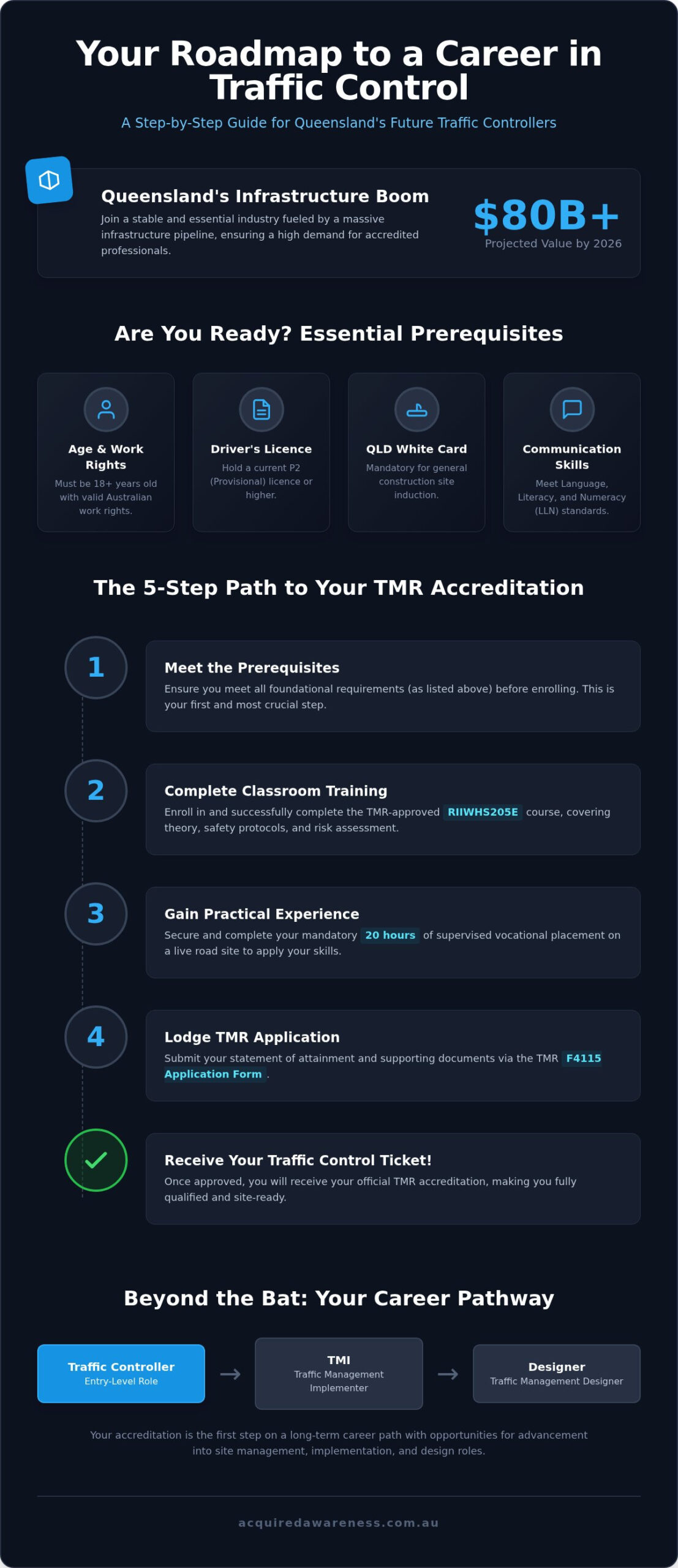
Step-by-Step: How to Get Your Traffic Control Ticket in QLD
Securing your accreditation is a methodical process that ensures every operator on the road meets the rigorous safety standards required for South East Queensland’s infrastructure projects. To begin your traffic controller training brisbane, you must follow a specific sequence of compliance steps. This structured pathway is designed to transition you from a student to a disciplined professional capable of managing complex traffic scenarios with total composure.
- Step 1: Secure Your Foundation. Before you can enter a worksite, you must obtain your QLD White Card. This general construction induction is a non-negotiable prerequisite for site access and safety awareness.
- Step 2: Classroom Theory and Practical. Complete your 1-day intensive training at an approved centre. This session covers the technical knowledge and hands-on skills required to operate a stop-slow bat and understand site-specific safety protocols.
- Step 3: Vocational Placement. You’re required to finish 20 hours of supervised practical experience on a live road site. This is where your classroom knowledge is applied under the guidance of seasoned mentors.
- Step 4: TMR Application. Once your training and placement are verified, you must lodge your application with the Department of Transport and Main Roads (TMR).
- Step 5: Official Accreditation. Upon approval, TMR issues your Industry Authority Card. This card is your official licence to work as a traffic controller across Queensland.
Navigating the 20-Hour Vocational Placement
The 20-hour placement is a critical phase of your traffic controller training brisbane. During this time, you will work under the direct supervision of an accredited controller on an active road site. You’ll be responsible for documenting every hour in your official TMR logbook, which must be signed off by your supervisor to confirm your competence. This process ensures you have encountered a variety of traffic conditions and successfully managed them according to safety standards. Vocational placement must be completed within 3 months of finishing your theory training. This timeframe ensures your theoretical knowledge remains fresh as you apply it to real-world operational scenarios.
Working with TMR for Your Final Licence
After completing your training and placement, the final step involves the Queensland Government. You must submit Form F4115 along with the required accreditation fee, which is $230.45 for the 2026-27 period. You’ll need to provide specific identification and proof of your completed training. TMR conducts a criminal history check and a traffic history review as part of the rigorous approval process. For detailed instructions on maintaining your status or checking your application progress, you can refer to our guide on securing a traffic controller licence in QLD. Once your card arrives, you’re legally prepared to join the workforce.
Ready to start your career? You can book your training session online to secure your spot in an upcoming class.
Beyond the Classroom: Career Opportunities with Acquired Awareness
Completing your traffic controller training brisbane is a significant milestone, but it is only the beginning of your professional journey. At Acquired Awareness, we don’t just provide a certificate and send you on your way. We are an active industry leader with a dual identity as both an educator and a top-tier service provider. This means we have a constant need for high-quality, safety-conscious controllers to manage our own projects across South East Queensland. We take pride in our regional heritage and maintain a steadfast commitment to the communities we serve. For many graduates, their training at AATC serves as the foundation for a long-term partnership with Acquired Awareness Traffic Management (AATM).
The industry offers a clear and structured path for advancement. You might start on the road with a stop-slow bat, but your career doesn’t have to stop there. Many of our team members have progressed from Traffic Controllers (TC) to Traffic Management Implementers (TMI), where they take on greater responsibility for site setup and compliance. From there, some move into Traffic Management Design, using their field experience to create safe and efficient plans for future projects. This progression reflects our belief in continuous improvement and professional development. To support your growth in other areas of workplace safety, you can discover Alpha Safety. We value the technical depth our staff brings to every project, and we actively support those who demonstrate the discipline to move into leadership roles.
What Employers Look for in a Traffic Controller
Reliability is the cornerstone of our operations. When you’re assigned to a site, the safety of your colleagues and the public depends on your presence. We look for individuals who demonstrate punctuality and a proactive attitude toward risk management. Clear communication is vital. You must be able to follow a Traffic Guidance Scheme (TGS) with precision and maintain a professional demeanor at all times. Your appearance and conduct on-site reflect the standards of the entire organization; much like how Fitting Room Alterations helps professionals present their best selves in formal settings, a tidy work uniform signals competence. A disciplined approach ensures that even the most complex urban environments remain under total control. We prioritize candidates who understand that they are guardians of public welfare, not just workers on a site.
Join the Acquired Awareness Team
As a leading employer in SEQ, AATM values the skills we teach in our classrooms. We encourage our students to view their traffic controller training brisbane as a professional introduction to our company. We observe your technical aptitude and your commitment to safety protocols throughout the course. If you demonstrate the meticulousness and reliability we require, there are often opportunities to join our crew immediately upon receiving your TMR accreditation. We operate with a lack of ego and a total focus on the mission at hand, and we want team members who share that mindset. To begin this journey and secure your place in the industry, visit our Traffic Control Course Brisbane guide to book your session and take the first step toward a stable, rewarding career.
Secure Your Professional Future on Brisbane’s Roads
Launching your career in traffic management requires more than just a certificate. It demands a commitment to public safety and a disciplined approach to operational management. You’ve seen how the right traffic controller training brisbane provides the foundational skills needed to navigate a high-stakes environment. By choosing a provider with a dual identity as an educator and an active service leader, you gain a tactical edge that standalone training schools cannot replicate.
Our RTO #40905 accredited training ensures you meet every TMR requirement while learning from mentors who manage live sites every day. This approach bridges the gap between classroom theory and the practical realities of the field. Whether you’re starting as a new entrant or seeking to advance into management implementation, your journey begins with a focus on professional responsibility. We take pride in guiding the next generation of safety-conscious professionals who will keep South East Queensland moving safely and efficiently.
Take the first step toward a stable and rewarding career today. Book Your Traffic Control Training in Brisbane with AATC. We look forward to seeing you on-site.
Frequently Asked Questions
How much does a traffic controller earn in Brisbane in 2026?
Do I need a driver’s licence to take a traffic control course in QLD?
How long does it take to get a traffic control ticket in Brisbane?
Obtaining your traffic control ticket involves a two-stage process that typically takes several weeks to finalize. You must first complete a one-day theory and practical classroom session. Following this, you are required to finish 20 hours of supervised vocational placement on a live road site. Once your logbook is signed off and your TMR application is processed, your official Industry Authority Card is issued.
What is the difference between a TC and a TMI course?
The primary difference lies in the level of operational responsibility and the specific tasks performed on-site. A Traffic Controller (TC) focuses on directing traffic flow using a stop-slow bat and radio communication. In contrast, a Traffic Management Implementer (TMI) is responsible for physically setting up, maintaining, and removing the signs and devices specified in a Traffic Management Plan. Both roles are essential for maintaining site safety.
Can I get a job immediately after finishing my traffic controller training?
Employment opportunities are abundant due to the high demand for traffic controller training brisbane, but a job is not guaranteed immediately upon course completion. However, training with a provider that is also a major employer, like AATM, increases your visibility to recruiters. Graduates who demonstrate punctuality, a proactive safety attitude, and professional conduct during their placement are often prioritized for available roles within our active road crews. In addition, many road and infrastructure workers enhance their career versatility by obtaining commercial heavy vehicle qualifications; professional schools such as Right Way Transport Training illustrate how comprehensive driver education opens up further avenues across the broader transport sector.
Is the 20 hours of vocational placement paid or unpaid?
The mandatory 20 hours of vocational placement are typically unpaid, as they constitute the practical assessment component of your training. This period allows you to gain essential real-world experience under the supervision of a qualified mentor without the pressure of full operational duties. It is a critical investment in your professional skills that ensures you are fully competent before you begin paid employment on Brisbane roadworks.
How often do I need to renew my traffic control ticket in Queensland?
You must renew your traffic control accreditation every three years to maintain your legal authority to work on Queensland roads. This renewal process involves completing a refresher course to update your knowledge on the latest TMR safety standards and legislative changes. Keeping your ticket current is a professional responsibility that ensures our work zones remain compliant and safe for both the public and site personnel.
What equipment do I need to bring to my traffic control training course?
Students attending traffic controller training brisbane should arrive in work-ready attire, including steel-capped boots and high-visibility clothing. You will also need to bring your valid White Card and proof of identification for TMR documentation. We provide the specialized technical equipment, such as radio units and stop-slow bats, for use during the practical classroom simulations. Coming prepared reflects the disciplined attitude required for the industry.