News
Recent News
Traffic Control Course Brisbane: Your 2026 Guide to Getting Started
April 25, 2026
Most people see a stop-slow bat and think it’s a dead-end job, but they’re overlooking the vital backbone of Queensland’s A$50 billion infrastructure pipeline. It’s understandable if you feel overwhelmed by technical jargon or shifting QLD TMR compliance standards. You want a career that offers more than just standing on a road; you want stability, safety, and a clear path forward.
The demand for qualified professionals in South East Queensland has never been higher. As we move into 2026, the construction pipeline remains robust, fueled by regional growth and preparations for future international events. Completing a traffic control course is the first step toward a career that offers stability, variety, and a clear path for advancement. If you are also exploring other roles in the transport industry, such as becoming a certified driving instructor, you can read more about specialized training pathways that complement your safety skills.
This guide simplifies the process of completing a professional traffic control course in Brisbane. We’ll clarify the difference between TC and TMI certifications so you don’t waste time on the wrong units. You’ll gain a complete understanding of the current 2026 regulations, the earning potential in South East Queensland, and how to select a reputable RTO that prioritizes your safety. We’ll move from the initial classroom theory to your first day on-site with total confidence. By the time you finish reading, you’ll have a step-by-step roadmap to becoming a qualified professional in an industry that never stops growing.
Key Takeaways
- Understand the mandatory QLD TMR-approved training standards required to ensure public safety and operational excellence on Brisbane roads.
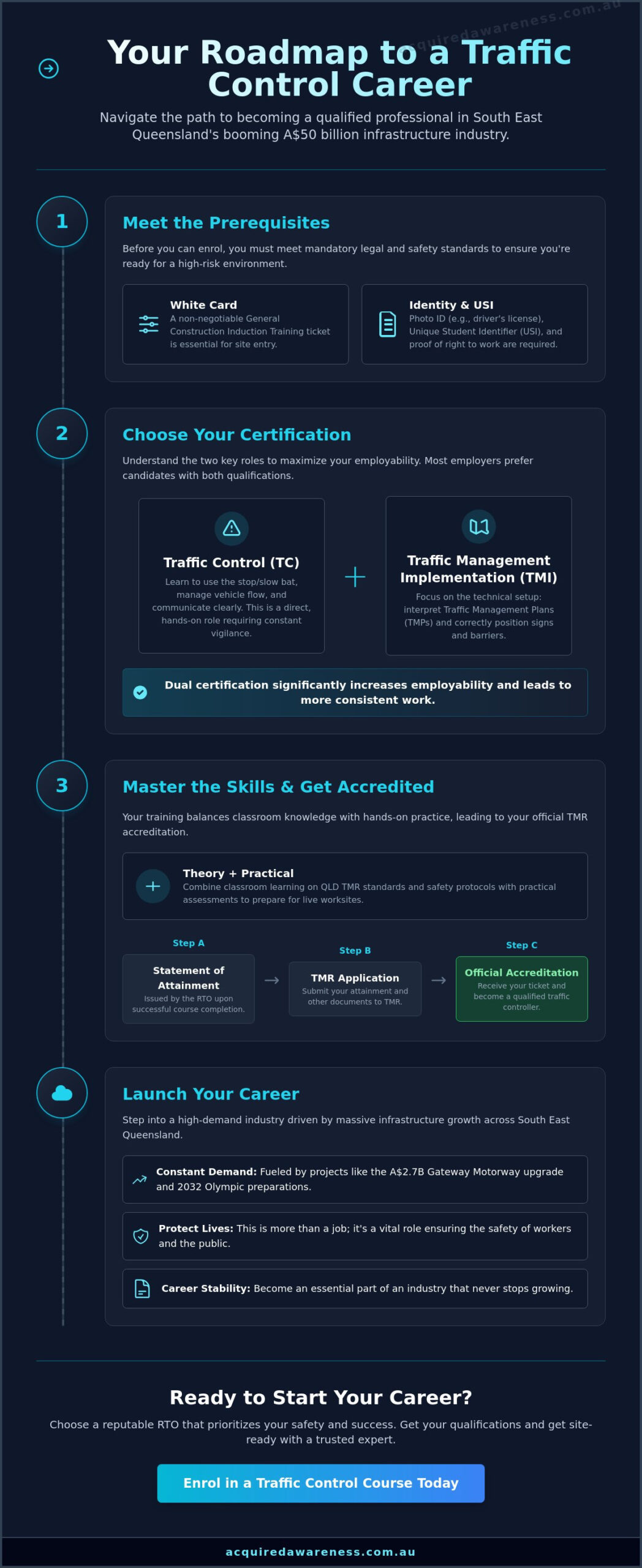
- Identify critical prerequisites, such as the General Construction Induction (White Card), required to enroll in your professional traffic control course.
- Master the balance of classroom theory and practical assessments to prepare for the high-pressure demands of a live worksite.
- Navigate the formal accreditation path from receiving your Statement of Attainment to finalising your TMR application.
- Explore the career opportunities driven by South East Queensland’s infrastructure expansion and what a typical day involves for a modern controller.
What is a Traffic Control Course in Brisbane?
A traffic control course is the mandatory training program approved by the Queensland Department of Transport and Main Roads (TMR). It provides the legal accreditation required to manage road traffic control on any public road in the state. In 2026, Brisbane and South East Queensland (SEQ) are seeing record demand for these skills. Major infrastructure projects, including the A$2.7 billion Gateway Motorway upgrade and extensive 2032 Olympic Games site preparations, have created a constant need for disciplined safety professionals. This training isn’t just about holding a sign. It’s about protecting lives. You’re responsible for the safety of construction crews, daily commuters, and the local community. Only a Registered Training Organisation (RTO) has the authority to issue these certifications. Choosing an RTO means you’re learning from experts who understand the high-risk nature of the job and the technical compliance required to keep sites running smoothly.
TC vs. TMI: Which Course Do You Need?
Understanding the difference between these two roles is vital for your career. The Traffic Control (TC) course focuses on direct interaction. You’ll learn to use the stop/slow bat and manage vehicle flow with calm authority. It’s a role that requires clear communication and constant vigilance. Traffic Management Implementation (TMI) focuses on the technical setup. You’ll learn to interpret Traffic Management Plans (TMPs) and position signs and barriers correctly. Most Brisbane employers prefer candidates who hold both qualifications. Bundling these courses increases your employability significantly. It allows you to transition between setting up a site and managing live traffic, making you a more valuable asset to any crew. We’ve seen that workers with dual certification often secure more consistent shifts across various SEQ projects.
The Legal Framework: QLD TMR Standards
The Queensland Government manages the Traffic Controller Accreditation Scheme to maintain the highest safety standards. This framework ensures that every controller operates with the same level of precision and care. If you hold a ticket from NSW or Victoria, don’t assume it’s valid here. You’ll often need a bridging course to meet specific QLD TMR standards. This isn’t just red tape; it’s about ensuring everyone on a Brisbane site speaks the same safety language. Adopting the “Expert Protector” mindset means you respect these regulations as the foundation of your work. Following these strict protocols ensures that risks are mitigated and every worker returns home safely at the end of the day. Our commitment to these standards reflects our pride in supporting Queensland’s growth with integrity and excellence.
Queensland Prerequisites: What You Need Before You Enrol
Entering the traffic management industry in South East Queensland requires a commitment to safety and professional readiness. Before you can step onto a live site, you must meet several mandatory legal and physical standards. These prerequisites ensure that every trainee has the foundational knowledge to manage high-risk environments without compromising public safety. Securing your place in a traffic control course is the first step toward a career built on discipline and vigilance.
The Importance of the White Card
The General Construction Induction Training, or White Card, is the essential safety ticket for anyone entering a construction zone. It’s a non-negotiable requirement that proves you understand basic hazard identification and risk mitigation. Acquired Awareness offers this as a standalone unit or bundled with other certifications to help you get site-ready faster. While the card doesn’t have an official expiry date, many Queensland contractors require a refresher if you’ve been out of the industry for more than 24 months. Following national safety standards is the only way to maintain the integrity of our road networks.
Personal Identity and Documentation
When you enrol with a Registered Training Organisation (RTO), you must provide specific documentation to satisfy federal auditing requirements. This process protects the validity of your qualifications. You’ll need to prepare the following:
- Photo Identification: A current Australian driver’s license, passport, or 18+ card.
- USI: Your Unique Student Identifier must be provided at the time of enrolment.
- Proof of Residency: Documentation confirming your right to work in Australia.
The USI is a federal government requirement for all VET training. This identifier acts as a lifelong digital record of your nationally recognised training. Without it, an RTO cannot legally issue your Statement of Attainment upon completion of your traffic control course.
Physical stamina is just as critical as your paperwork. Traffic controllers often work 10-hour shifts, standing on hot bitumen while maintaining total focus. Brisbane’s climate adds another layer of difficulty; you must be prepared to work in 30-degree heat and high humidity. Literacy and numeracy skills are also vital. You’ll need to read technical Traffic Guidance Schemes and use two-way radios to coordinate vehicle movements with precision. Most roles in the SEQ region also require a valid driver’s license and reliable transport to reach various sites across the city. If you’re prepared to meet these standards, you can view our training calendar to find a session that fits your schedule.
What to Expect During Your Traffic Control Training
Enrolling in a traffic control course is the first step toward a career where professional responsibility is the only priority. Training typically spans one to three days. This duration depends on whether you’re completing basic entry-level units or advanced management modules. We balance technical classroom theory with rigorous practical assessments to ensure every student is field-ready. Our “Safety First” mantra drives every module. We don’t just teach you how to stand on a road; we teach you how to survive it. You’ll move from the controlled environment of the classroom to supervised field simulations. This transition ensures you understand the gravity of the role before you step onto a live Brisbane infrastructure project. For a comprehensive breakdown of the exact steps required to earn your nationally accredited statement of attainment and apply for your TMR Industry Authority Blue Card, our detailed guide on completing a traffic control course Brisbane professionals rely on covers the full process from enrolment to on-site placement.
Theory Modules: The Science of Safety
Safety is a science that requires precision. You’ll learn to interpret a Traffic Guidance Scheme (TGS) and a Traffic Management Plan (TMP) with absolute accuracy. These documents are your lifeline. Our instructors cover radio communication protocols to ensure clear, concise information exchange between team members. We also focus on risk assessment techniques. You’ll learn to identify hazards on high-speed roads before they become incidents. Mitigation is our primary tool for protecting the public and our crews. Understanding these technical frameworks is essential for compliance and personal protection.
Practical Training: Mastering the Stop/Slow Bat
Practical sessions take place at our Brisbane training centres. You’ll get hands-on experience with the stop/slow bat and other essential equipment. We emphasize the correct positioning of signs and devices according to the Manual of Uniform Traffic Control Devices (MUTCD). This manual is the legal standard in Queensland. You’ll also practice simulated scenarios. These include managing emergency vehicle passage and de-escalating interactions with aggressive drivers. We prepare you for the reality of the road, not just the theory of it. Our trainers provide immediate feedback to ensure your technique is flawless.
The assessment process is thorough and transparent. It includes written tests to verify your technical knowledge and supervised practical demonstrations. You must show competence in a live or simulated environment to pass. Our RTO status means we hold our students to the highest industry standards. We don’t cut corners. Every successful student demonstrates the ability to maintain total control over their work zone. This traffic control course ensures you leave with the confidence to manage traffic safely and professionally. We take pride in producing graduates who are ready to protect the Queensland community from day one.
Obtaining Your Ticket: The Path to Accreditation
Completing your traffic control course is the first major milestone, but the journey to the job site requires official government recognition. Once you’ve successfully completed your training with a Registered Training Organisation (RTO), you’ll receive a Statement of Attainment. This document proves your competency but isn’t your license. You must then apply for your Traffic Controller Accreditation through the Department of Transport and Main Roads (TMR). We treat this transition with the same precision as our on-site operations. It’s about moving from a student mindset to a professional identity.
The path to accreditation follows a strict, logical sequence designed to ensure only qualified, vetted individuals manage our roads:
- Successfully complete the RTO assessment and obtain your Statement of Attainment.
- Submit your application via a TMR customer service center or through their official online portal.
- Pay the mandatory government licensing fees. For 2026, the TMR fee for a new three-year accreditation is A$234.60, following the standard July 1st indexation.
- Wait for the mandatory criminal history check to clear.
- Receive your physical or digital “Traffic Controller Silk” card, which acts as your badge of authority on any Queensland site.
The TMR Application Process
The RTO provides the skills, but TMR manages the authority. Every applicant undergoes a mandatory criminal history check as part of the vetting process. This ensures that those managing public safety meet the necessary character requirements for high-responsibility work. In the Brisbane TMR office, processing typically takes 21 days from the date of submission. You can track your application status online. Don’t step onto a site until you have your digital authority or physical card in hand, as site supervisors will check this during your morning pre-start meeting.
Renewals and Staying Current
Accreditation isn’t a permanent qualification. Your ticket remains valid for three years. Before this period ends, you must complete a specific “Renewal” course path. This refresher is vital because the Manual of Uniform Traffic Control Devices (MUTCD) undergoes frequent updates. For example, recent 2025 amendments to the QLD MUTCD Part 3 introduced stricter guidelines for high-speed road transitions. Staying current ensures you aren’t just compliant, but actually capable of protecting your team. Working with an expired ticket is a serious breach of Queensland safety regulations. It exposes you to personal fines and leaves your employer liable for significant compliance penalties. We maintain a “Safety First” culture by ensuring every controller understands the weight of their accreditation.
Career Outlook: Finding Traffic Control Jobs in Brisbane
The demand for qualified professionals in South East Queensland has never been higher. As we move into 2026, the construction pipeline remains robust, fueled by regional growth and preparations for future international events. Completing a traffic control course is the first step toward a career that offers stability, variety, and a clear path for advancement.
A typical day involves much more than managing a stop-slow bat. You’re the primary guardian of your crew and the public. Shifts often start early, requiring a disciplined approach to punctuality and site preparation. In return, the industry provides competitive pay rates. Most workers receive industry-standard benefits, including penalty rates for night work or weekends and travel allowances to compensate for different site locations across the city.
Where the Jobs Are: Major SEQ Projects
Brisbane’s landscape is currently defined by massive infrastructure hubs. The Cross River Rail project continues to be a primary source of employment, alongside significant upgrades to the M1 and the Bruce Highway. Beyond these high-profile sites, local councils require constant support for road maintenance, water utility repairs, and vegetation management. Private events also contribute to the steady stream of work available. Acquired Awareness is a respected name on these major worksites because we prioritize compliance and precision. Our teams are frequently selected for complex projects where safety cannot be compromised. If you’re a project manager or site supervisor looking to understand how to procure compliant traffic management services south east queensland projects depend on, our 2026 procurement guide covers QGTTM compliance, TMR permit lead times, and how to avoid hidden equipment costs across the region’s major infrastructure sites. If you’re based further south and looking to work on the Gold Coast’s $8.1 billion construction pipeline, our dedicated guide to the traffic control course Gold Coast professionals need covers everything from the Light Rail Stage 3 project to meeting RIIWHS205E standards in high-speed environments.
Why Train with Acquired Awareness Training Centre?
We offer a unique advantage to our students. We don’t just teach the theory; we manage active sites every single day. This dual identity as both a service provider and a Registered Training Organisation (RTO) ensures our curriculum is grounded in real-world scenarios. Our local training facilities in Brendale and Yatala provide easy access for residents across the north and south of Brisbane. You’ll learn from instructors who have spent years on the road, gaining insights that a textbook cannot provide.
We operate with a commitment to integrity and excellence. We expect our graduates to uphold these same values on the job. For top-performing students, completing your traffic control course with us can lead directly to employment opportunities within our own operational divisions. We prefer to hire people we’ve trained ourselves because we know they meet our high safety standards. We take pride in seeing our graduates move from the classroom to the front lines of Queensland’s infrastructure growth.
Take Control of Your Career Path in Brisbane
Securing your role in Queensland’s infrastructure starts with professional accreditation. You now understand the essential prerequisites and the clear path toward obtaining your ticket. Acquired Awareness has served as a leading SEQ traffic management provider since 1997, bringing nearly three decades of operational authority to every session. Our traffic control course is delivered through RTO #40905, maintaining the highest compliance standards for your safety and success. We focus on delivering results that keep both workers and the public protected at all times.
With specialized training centres located in Brendale and Yatala, we offer accessible, high-level instruction tailored to the local market. We don’t just teach the basics; we mentor you to become a disciplined leader on busy worksites. Our commitment to excellence ensures you enter the workforce with a “can-do” attitude and the technical skills required for the 2026 construction landscape. We take pride in protecting our community and helping you build a stable, rewarding career. Your journey toward becoming an industry professional starts with a single, decisive step. We look forward to seeing you on-site.
Book Your Brisbane Traffic Control Course Today
Frequently Asked Questions
How long does a traffic control course take in Brisbane?
A standard traffic control course in Brisbane typically requires one full day of classroom and practical training followed by 20 hours of supervised on-site experience. This structure ensures you meet the Department of Transport and Main Roads (TMR) mandatory requirements. Once the RTO verifies your 20 logbook hours, they issue your final statement of attainment. This process prioritizes safety and ensures you’re ready for the rigors of the Queensland infrastructure sector.
How much can a traffic controller earn in Queensland in 2026?
Traffic controllers in Queensland can expect to earn between A$32 and A$48 per hour in 2026 depending on their experience and the specific project. According to 2024 Economic Research Institute projections adjusted for inflation, annual salaries for entry-level roles often start around A$65,000. Weekend shifts and night work frequently attract penalty rates that increase your total take-home pay. We focus on preparing you for these high-demand roles.
Do I need a drivers license to become a traffic controller in QLD?
You must hold a current or recent Australian O (open) or P (provisional) class driver’s license to qualify for traffic control accreditation in Queensland. The Department of Transport and Main Roads (TMR) mandates this because the role requires a fundamental understanding of road rules and driver behavior. If your license is currently suspended or cancelled, you won’t be eligible to enroll in a traffic control course until your driving privileges are fully restored.
Is the traffic control course hard to pass?
The course isn’t designed to be difficult, but it’s rigorous because safety is our absolute priority. Most students pass on their first attempt if they follow the trainer’s instructions and engage with the safety protocols. We focus on clear, logical steps to manage risk effectively. Our goal is to ensure every trainee leaves with the confidence to protect themselves and the public in high-pressure environments.
What is the difference between a TC and a TMI ticket?
A Traffic Controller (TC) ticket authorizes you to direct traffic using a stop-slow bat, while a Traffic Management Implementation (TMI) ticket allows you to set up and take down traffic guidance schemes. TMI holders focus on the physical placement of signs and barriers according to approved plans. Many workers choose to hold both qualifications to increase their versatility on a job site. This dual capability makes you a more valuable asset to any infrastructure team.
Can I work in other states with a Queensland traffic control ticket?
While your Queensland accreditation is specifically designed for TMR standards, you can often apply for mutual recognition in other states under the Mutual Recognition Act 1992. Each state’s regulatory body, such as SafeWork NSW or VicRoads, has its own specific application process and may require a short bridging unit. It’s essential to check the local requirements of the state you intend to work in before starting your shift.
How often do I need to renew my traffic control accreditation?
You must renew your traffic control accreditation every three years to remain compliant with Queensland state regulations. This ensures all personnel stay updated on the latest safety standards and legislative changes. The Department of Transport and Main Roads (TMR) will usually send a reminder, but it’s your responsibility to complete a refresher course before your current card expires. Missing this deadline means you cannot legally work on any road site.
What equipment do I need to bring to my first day of training?
You need to bring safety boots, long pants, and a long-sleeved shirt to your first day of training to meet basic site safety requirements. We provide the necessary hi-vis vests and technical equipment used during the practical sessions. Bringing a hat, sunscreen, and plenty of water is also vital since a portion of the training occurs outdoors. Being prepared shows the professional discipline required for a career in traffic management.